

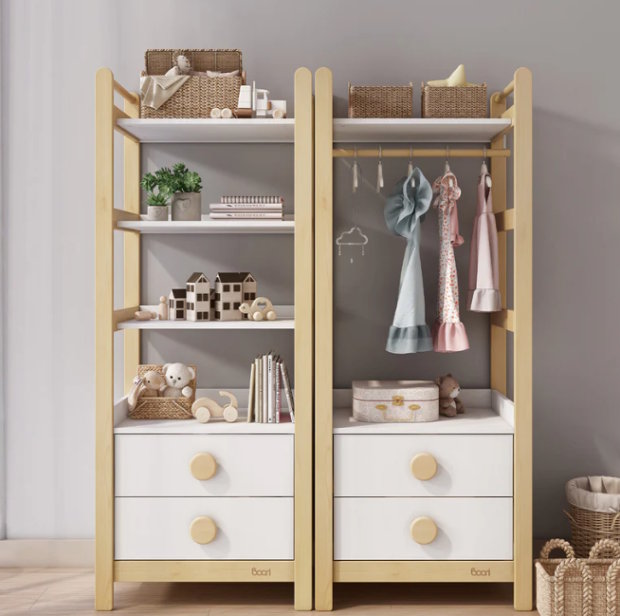
Furniture tip-over incidents involving children are among the most common causes of serious home injury in the under-six age group in Australia. Bookshelves, dressers, and wardrobes account for a significant proportion of these incidents, and the majority of them are preventable with a simple anti-tip wall anchoring system that takes less than fifteen minutes to install correctly. Despite this, many parents skip the step, either because the bookshelf appears stable when empty, because the anchoring hardware requires finding a stud in the wall, or because it feels like an optional step rather than a fundamental safety requirement.
Key Takeaways
- Furniture tip-over incidents are one of the most common causes of serious injury in children under six. Wall anchoring a bookshelf is the most direct and effective prevention.
- A bookshelf that appears stable when empty can tip under the load of books combined with the force of a toddler pulling on a shelf or leaning against a panel.
- Wall anchoring should be completed before loading the bookshelf with books, before placing it in the child's room, and before the child has any access to the space.
- Anchoring to a wall stud provides significantly more holding strength than anchoring into plasterboard alone. Locating the stud before anchoring is an essential step.
- Every quality children's bookshelf should include anti-tip wall anchoring brackets or have compatible brackets available. This should be confirmed before purchasing.
Why Bookshelves Are a Higher Tip Risk Than They Appear
|
Risk Factor |
Why It Matters |
How Wall Anchoring Addresses It |
|
Books loaded on upper shelves |
Raises centre of gravity significantly |
Prevents tipping under static load |
|
Child pulling on shelf panel |
Applies sudden lateral force |
Bracket absorbs force before tipping begins |
|
Child climbing shelf rungs |
Dramatically increases tip force |
Essential prevention for climbing behaviour |
|
Uneven floor surface |
Reduces base stability |
Anchoring compensates for floor irregularity |
|
Rotating or interactive shelves |
Movement creates dynamic tip forces |
Anchoring keeps the base fixed during rotation |
How to Wall Anchor a Kids Bookshelf Correctly
Step 1: Locate the Wall Studs
A stud finder is the most reliable tool for locating the timber or metal studs behind a plasterboard wall. Studs are typically spaced at 450 or 600 millimetre centres in Australian residential construction. If a stud finder is not available, the knock test, tapping along the wall and listening for the change in sound from hollow to solid, can locate studs with reasonable accuracy. Anchoring into a stud rather than into plasterboard alone provides five to ten times more holding strength for the anti-tip bracket.
Step 2: Position the Bookshelf
Place the bookshelf in its intended position before anchoring. Confirm that the bookshelf back panel sits flush against the wall and that the bookshelf is level front-to-back and side-to-side. A bookshelf that is not level before anchoring will remain not level after anchoring and will look and feel unstable even when fixed to the wall.
Step 3: Install the Anti-Tip Bracket
Most quality children's bookshelves include an anti-tip bracket and screws in the packaging. The bracket typically attaches to the top of the bookshelf at the back and then fixes to the wall. Follow the manufacturer's instructions for the specific bracket design. Use the screws provided, or replace them with longer screws if the bracket is being anchored into a stud rather than into a wall anchor in plasterboard.
Step 4: Test Before Loading
Once the bracket is installed, apply lateral force to the top of the bookshelf before loading it with books. The bookshelf should not move. If there is any perceptible movement, the anchoring is not sufficient and should be investigated before the bookshelf is placed in the child's room. A bookshelf that has been loaded with books and then found to be inadequately anchored is far more difficult to reanchor safely.
What to Do If You Cannot Anchor Into a Stud
In some rooms, the stud positions do not align with the bookshelf position. In this case, the options are to reposition the bookshelf to align with a stud, to use heavy-duty plasterboard anchors rated for the combined weight of the bookshelf and its loaded books, or to add a wood batten horizontally across the wall at the anchoring height and fix the bracket through the batten into studs at its ends. Each of these solutions provides adequate security when done correctly.
For children's bookshelves that include anti-tip anchoring provisions as a standard feature, visit
https://boori.com.au/collections/bookshelves-bookcases.
Frequently Asked Questions
Does a low bookshelf still need wall anchoring?
Yes. A low bookshelf with books loaded on its upper shelves has a higher centre of gravity than it appears when empty. Toddlers also pull on low bookshelves frequently when learning to stand, applying lateral force at exactly the point where a low bookshelf is most vulnerable to tipping forward. Wall anchoring is appropriate for all freestanding bookshelves in children's rooms regardless of height.
How do I anchor a bookshelf in a rental property without damaging the wall?
Most rental agreements permit minor wall fixings such as small screws for curtain rods and picture hooks. A single screw for an anti-tip bracket falls within this category in most tenancies. Confirm with the property manager or the lease agreement before anchoring. The alternative of a floor fixing point, available on some children's bookshelves, provides additional stability without any wall contact, but is generally less reliable than wall anchoring for preventing tip-over events.
What is the difference between plasterboard anchors and stud anchoring?
A stud is the solid timber or metal framing member behind the plasterboard surface. Screwing directly into a stud provides strong, reliable hold. A plasterboard anchor is a device inserted into a hole in the plasterboard that grips the back surface to provide hold where no stud is present. Plasterboard anchors have lower holding strength than stud anchoring and should be rated for at least twice the expected load when used for anti-tip brackets on loaded children's furniture.
How often should I check the wall anchoring on a kids bookshelf?
Check the tightness of the anchoring bracket every six months. Children's bookshelves are loaded and unloaded regularly, and the vibration and movement that accompanies this can gradually loosen screw connections over time. A quick check takes less than a minute and ensures the anchoring remains effective long after the initial installation.
Final Thoughts
Wall anchoring a children's bookshelf is a step that takes fifteen minutes and prevents an injury that can take weeks or months to recover from. It is not a recommendation. It is a requirement for any bookshelf placed in a room where a child under ten will be unsupervised. The hardware is inexpensive or included with the bookshelf. The skill level required is basic. The protection it provides is complete. There is no reasonable argument for skipping it.

