

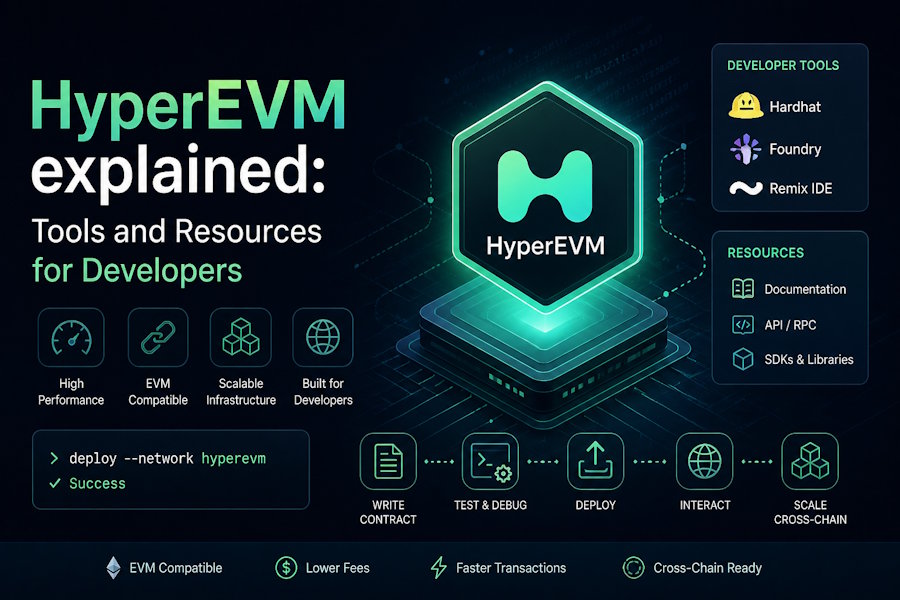
If you’ve been working in blockchain development for a while, you’ve probably noticed how quickly new environments start to appear. HyperEVM is one of those that’s starting to get real attention, especially from developers already comfortable with Ethereum.
At a glance, it’s an Ethereum-compatible execution environment. That means you can build using familiar tools while working in a setup that aims to improve performance and scalability.
In this guide, you’ll get a clear understanding of what HyperEVM is, how it works, and what you actually need to start building with it.
So what exactly is HyperEVM and why should you care?
HyperEVM is an EVM-compatible chain that lets you deploy and run smart contracts in a way that feels very similar to Ethereum. If you’ve built contracts before, you won’t feel out of your depth. Most of what you already know still applies.
That’s really what EVM compatibility comes down to. You’re not starting from zero or learning a completely new system. You’re working with the same mental model and many of the same tools you’re already comfortable using.
When you’re building, though, the little things tend to slow you down. Transactions take longer than expected, fees creep up, and testing becomes more frustrating than it should be.
HyperEVM is meant to smooth that out. You’ll likely get faster feedback while testing, and you won’t feel the same pressure around costs when deploying or interacting with your contracts. If you’re building something that needs to handle more users or activity, that kind of improvement starts to matter pretty quickly.
If you want a solid starting point that connects the bigger picture, it’s worth taking a few minutes to read this guide on Hyperliquid explained by deBridge for HyperEVM development resources. It helps tie together how the ecosystem, tooling, and infrastructure fit from a developer perspective.
What’s happening under the hood when you use HyperEVM?
You don’t need to know every technical detail to start building, but having a rough sense of what’s going on makes everything feel a lot more manageable.
The execution layer in practice
Think of the execution layer as the place where your contracts actually run once they’re deployed. It’s responsible for taking in transactions, running the logic inside your code, and updating the blockchain state as everything progresses.
When someone interacts with your contract, this is the part of the system processing that action in real time. It checks what needs to happen, executes the instructions, and records the outcome on-chain.
It’s also what keeps everything moving while your app is live. Every function call, every state change, every transaction gets handled here in the background while your application stays responsive on the surface.
How your smart contracts move through the system
When you deploy a contract, it goes through this layer. Your code runs, transactions get validated, and the results are recorded on-chain. From your side, the flow feels familiar. You’re still working with gas fees, waiting on confirmations, and calling contract functions. The difference shows up in how smoothly everything runs, especially when there’s more activity.
What shapes performance as you build
As your project grows, performance starts to matter more. Faster transaction handling and better throughput can make a noticeable difference, especially when you’re testing often or building something users interact with regularly. Small delays tend to stand out more once you’re deep in development.
How everything connects beyond your contract
You’re not just deploying a contract and leaving it there. Your app needs to connect to wallets, respond to user actions, and sometimes work across different chains. HyperEVM fits into that flow without forcing you to rethink your setup. You can plug into the tools and services you’re already used to.
Working across chains feels more natural
Once everything is connected, building across chains starts to feel less complicated. Moving assets, sharing data, or connecting different parts of your app becomes something you can plan for instead of work around. As your project grows, having that flexibility makes a real difference.
What tools do you need to start building?
This is usually the point where things either click or start to feel a bit overwhelming. In reality, if you’ve worked with Ethereum tools before, you’re already most of the way there.
Sticking with tools you already know
There’s no need to rebuild your entire setup just to get started. Most developers stick with the tools they already know and make small adjustments where necessary.
Hardhat and Foundry are still strong choices for compiling, testing, and deploying smart contracts. If you’ve built anything on Ethereum before, you’ll likely find that most of your existing configuration still works. In many cases, you’re just updating network details or tweaking a few environment settings rather than changing your workflow.
Getting connected to the network
Before you can do anything meaningful, you need to connect your setup to the network.
That usually means putting a few key pieces in place:
- An RPC endpoint so your app can communicate with HyperEVM
- A wallet for signing and sending transactions
- Access to a node, either through a provider or a self-hosted setup
Once that’s configured, things move quickly. You can deploy contracts, send transactions, and start interacting with the network almost immediately.
Keeping your testing workflow intact
Your testing and debugging flow doesn’t really need to change. You can still run local environments, simulate transactions, and work through issues before anything goes live.
If you’ve ever caught a bug during testing and saved yourself from a broken deployment, you already know how valuable that step is. The same habits carry over here, and in most cases, your existing testing setup will feel completely familiar.
Getting started and building with confidence
If you’re ready to move from reading to actually building, the process is more straightforward than it might seem at first.
Setting up and deploying your first contract
Start with a simple setup. Install your preferred framework, connect your wallet, and point everything to a testnet. It doesn’t need to be perfect. You just need a working environment so you can start experimenting.
From there, the deployment process should feel familiar. You write your contract in Solidity, compile it, and deploy it using your framework. A simple example like a basic storage contract is usually enough to get going. Once that’s live, you know your setup is working and you can start building something more meaningful.
After deployment, you’ll want to interact with your contract. You can do that through scripts or by connecting it to a frontend. This is usually the point where everything starts to feel more real, especially once you can trigger functions and see results coming back.
If you’ve connected a UI to a contract before, the flow won’t feel new. It’s mostly about wiring things together and testing how users will interact with what you’ve built.
As you keep building, it’s worth paying attention to how your contracts behave over time. Getting something to work is one thing, but making sure it’s reliable and efficient takes a bit more care.
Security plays a big role here. Small issues in smart contracts can lead to bigger problems later, so it’s worth slowing down and reviewing your code before deploying anything important.
A few habits go a long way:
- Review your contracts carefully before deployment
- Stay aware of common vulnerabilities like reentrancy
- Use trusted libraries instead of writing everything from scratch
Performance is another area that starts to matter as your project grows. Keeping your contract logic clean and avoiding unnecessary operations can help reduce gas usage and improve execution speed.
Even small improvements can make a noticeable difference once your contract is used more frequently.
So where do you go from here?
HyperEVM gives you a familiar environment to build in, while still opening the door to better performance and scalability. You’re not starting from scratch here, you’re building on top of what you already know.
The next step can be simple. Set up a basic project, connect to a testnet, and deploy a simple contract. Even something small is enough to start seeing how things actually behave in practice.
From there, it’s about layering things in slowly. Try interacting with your contract, connect a basic frontend, and see how changes affect your workflow. That hands-on experience tends to teach you more than anything else.
Most of it starts to make sense once you start building.

