

Introduction to Semi Truck Parking
Semi truck parking is one of the most important yet underdeveloped parts of the modern transportation and logistics industry. As global trade continues to expand and road freight becomes even more essential for supply chains, the demand for safe, accessible, and well-designed parking areas for heavy-duty trucks has increased significantly. Despite its importance, the availability of proper parking facilities has not grown at the same pace as the number of commercial trucks on the road, creating a serious challenge for drivers, fleet operators, and infrastructure planners. Understanding semi truck parking in detail is essential because it directly affects road safety, driver health, operational efficiency, and overall transportation costs.
Importance of Semi Truck Parking
The importance of semi truck parking begins with regulatory compliance and driver safety. Truck drivers are required to follow strict rules regarding driving hours to prevent fatigue-related accidents, which means they must take regular breaks and rest periods. Without properly designated parking areas, drivers may be forced to park in unsafe or illegal locations, or continue driving beyond safe limits. Proper parking facilities ensure that drivers can rest securely, comply with regulations, and resume their journeys in a safe and refreshed condition.
Major Challenges in Semi Truck Parking
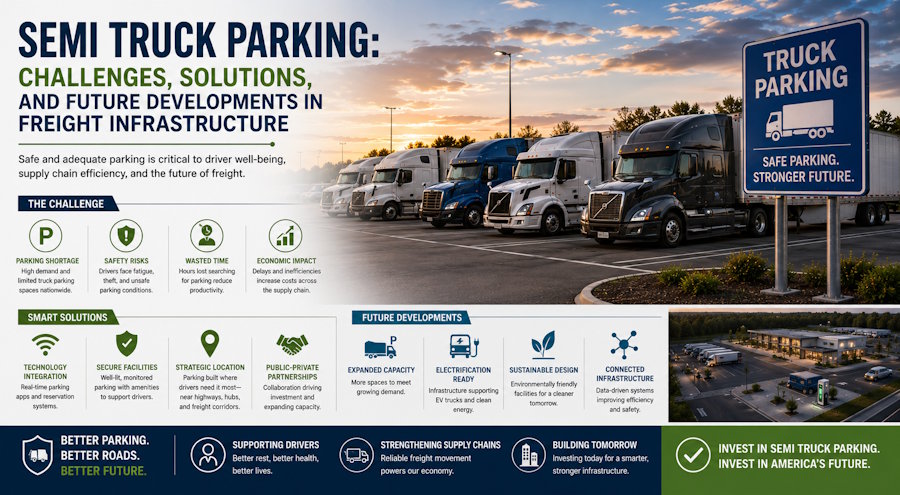
One of the biggest challenges in semi truck parking is the severe shortage of available spaces in many regions. As freight transportation grows due to e-commerce and industrial expansion, highways and transport routes are experiencing increased traffic from large commercial vehicles. However, the infrastructure for parking these vehicles has not expanded at the same rate. This imbalance results in overcrowded truck stops where drivers often struggle to find legal parking spots, especially during peak hours or at night. In some cases, drivers are forced to park on road shoulders or unauthorized areas, which increases the risk of accidents and traffic violations.
Another major issue is the uneven distribution of parking facilities along major transport routes. Some areas may have well-developed truck stops and rest areas, while others have very limited or no dedicated parking options at all. This creates uncertainty for drivers who must carefully plan their routes around potential parking availability. The lack of consistency makes long-distance trucking more stressful and less efficient.
Security is also a significant concern in semi truck parking. Many drivers carry valuable cargo, and not all parking facilities are equipped with adequate security measures such as surveillance cameras, fencing, lighting, or on-site personnel. Poorly secured parking areas can lead to theft, vandalism, or cargo tampering, resulting in financial losses and operational disruptions.
Types of Semi Truck Parking Facilities
There are several types of semi truck parking facilities available, each designed to serve different needs and conditions. Truck stops are the most common option, offering fuel stations, food services, restrooms, and parking spaces. These locations are convenient but often overcrowded due to high demand. Government-operated rest areas provide free parking and are strategically located along highways, but they usually offer limited amenities and fill up quickly.
Private truck parking facilities are designed specifically for heavy vehicles and often provide better security, organized layouts, and additional services, making them a preferred option for many drivers. Some warehouses and distribution centers also offer temporary parking for trucks during loading and unloading operations, although these spaces are not always available for long-term use.
Design and Infrastructure Considerations
Designing effective semi truck parking requires careful planning and engineering. These facilities must accommodate large vehicles with enough space for turning, reversing, and maneuvering safely. Unlike standard parking lots, truck parking areas need wider lanes, reinforced surfaces, and clearly marked parking bays to prevent congestion and accidents.
Strong base materials such as reinforced concrete or heavy-duty asphalt are commonly used because they can support the weight of fully loaded trucks without cracking or sinking over time. Proper drainage systems are also essential to prevent water accumulation, which can damage surfaces and create unsafe conditions.
Lighting and visibility play a crucial role in design. Well-lit spaces reduce the risk of accidents during nighttime parking and improve security by deterring criminal activity. Clear signage and organized layouts help drivers navigate the facility more easily.
Technology is increasingly becoming an important part of modern semi truck parking solutions. Digital platforms and mobile applications now allow drivers to locate available parking spaces in real time, reducing the time spent searching for a spot. This improves efficiency and reduces stress during long hauls.
Some advanced facilities are equipped with smart sensors that monitor occupancy levels and provide live updates to drivers. This helps reduce congestion and ensures better utilization of available space. In addition, the rise of electric trucks is leading to the integration of charging stations within parking facilities, supporting more sustainable transportation systems.
Economic and Operational Impact
The economic impact of efficient semi truck parking is significant. When drivers can easily find safe parking, they can better manage schedules, reduce fuel consumption, and avoid unnecessary delays. This improves supply chain efficiency and reduces operational costs for logistics companies.
On the other hand, lack of parking leads to wasted time, increased fuel usage, and higher stress levels for drivers, all of which negatively affect productivity. Therefore, investing in proper parking infrastructure is not just a safety measure but also an economic necessity for the entire logistics industry.
Improved semi truck parking systems also contribute to environmental sustainability. When trucks do not need to circle around searching for parking, fuel consumption decreases, which reduces carbon emissions. Permeable surfaces and eco-friendly materials help manage stormwater and reduce environmental impact.
Sustainable design approaches are becoming more important as the transportation industry moves toward greener solutions. Efficient parking infrastructure supports this transition by reducing unnecessary vehicle movement and supporting cleaner technologies.
Common Mistakes in Truck Parking Development
Several mistakes can reduce the effectiveness of semi truck parking facilities. Poor planning of space utilization often leads to congestion and inefficient layouts. Another common issue is failing to consider future demand, resulting in facilities that quickly become insufficient as freight volumes increase.
Neglecting maintenance is also a serious problem. Cracks, potholes, and poor lighting can quickly make a parking facility unsafe and less usable. These issues highlight the importance of continuous monitoring and upgrades
The future of semi truck parking is expected to evolve significantly with advancements in technology and infrastructure planning. Governments and private developers are beginning to invest more in dedicated truck parking facilities along major freight corridors. Smart systems, automated monitoring, and integrated logistics platforms will likely become standard features.
As electric and autonomous trucks become more common, parking facilities will need to adapt by including charging infrastructure and advanced communication systems. These developments will transform parking from a basic necessity into a highly optimized part of the logistics network.
Conclusion
Semi truck parking is a vital part of the transportation industry that directly affects safety, efficiency, and economic performance. While current systems face challenges such as shortages, security concerns, and uneven distribution, ongoing improvements in design and technology are helping to address these issues.
With proper planning and investment, semi truck parking can become more efficient, secure, and sustainable, supporting the growing demands of global logistics and ensuring smoother operations for drivers and businesses alike.

