

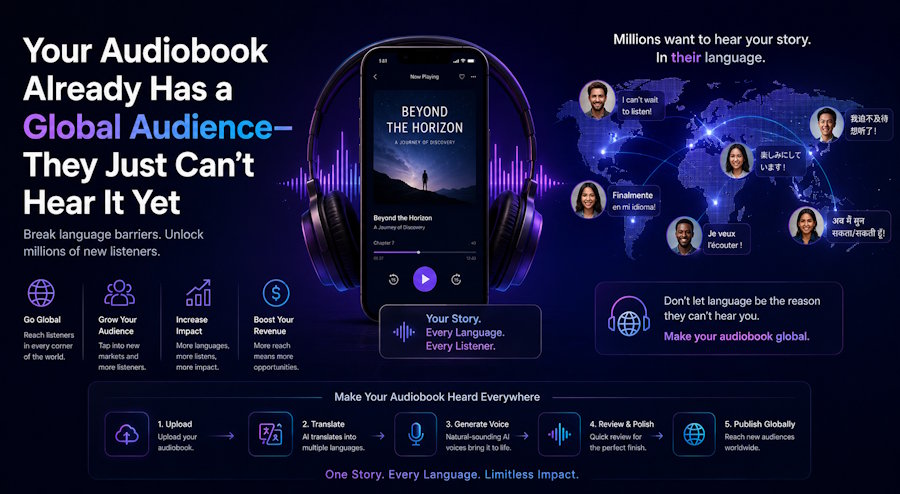
You spent months writing the book. Weeks producing the audio. And now it's live on Audible, Apple Books, and Spotify — earning royalties in English, for English-speaking listeners.
Meanwhile, there are 500 million Spanish speakers on the planet. Over 90 million audiobook listeners across Europe. A Latin American market growing at 24.7% annually that's hungry for audio content in their language, on the platforms they already use.
None of them can access your book.
That's not a discoverability problem. It's a localization problem — and it's one that an AI audio translator is built specifically to solve.
The Localization Wall That Most Creators Never Climb
Traditional audiobook translation isn't a single task. It's a project with six moving parts, each of which requires a different specialist:
- Transcription of the original audio
- Human translation of the full manuscript
- Casting and hiring a native-language voice actor
- Recording sessions (often 10+ hours for a full-length book)
- Audio editing, noise reduction, and level matching
- Sync and mastering for platform delivery
Even a short non-fiction audiobook can take six to eight weeks to localize this way. A novel can take months. And the cost of hiring professional translators and narrators in multiple languages — Spanish, French, German, Portuguese — compounds fast, often running $12,000 to $28,000 per finished title in traditional studio workflows.
For independent authors and small publishers, that math doesn't work. So most creators simply don't localize. They leave international demand on the table indefinitely, assuming it's a problem they'll solve "later."
Later almost never comes.
What's Actually Changed in 2025
The AI audio translation landscape in 2025 looks fundamentally different from even two years ago.
The biggest signal: Audible itself has moved. In May 2025, Audible announced it's rolling out AI translation services in beta, supporting speech-to-speech and text-to-text translation from English into Spanish, French, Italian, and German. Speech-to-speech translation preserves the original narrator's voice and style across languages — meaning your audiobook doesn't just get translated, it gets localized in your voice.
Audible's CEO put the ambition plainly: the goal is "every book in every language." Only 2–5% of published books currently exist in audio form. AI translation is how that gap gets closed.
This isn't a fringe experiment. It's the direction the entire industry is moving, and indie creators don't have to wait for Audible's invite-only beta to participate. AI audio translation tools available today can accomplish the same workflow for creators who want to act now.
The Markets That Are Ready and Waiting
The opportunity isn't evenly distributed, and knowing where the demand actually lives helps prioritize where to localize first.
Spanish is the most urgent. Spanish-language audiobooks grew 31% in 2025, with Latin America expected to surpass North America in total audio listenership by the end of this year. Brazil and Mexico alone account for 68% of Latin American audiobook revenue. Local-language AI narration now makes it possible to produce a professional Portuguese or Spanish audiobook for $1,200–$2,800 — compared to $12,000–$28,000 for traditional studio production. The ROI case writes itself.
Europe is already paying. The UK, Germany, and France collectively represent over 90 million active listeners. Nordic markets are further along — audiobooks already account for a third of publishers' digital revenue in Scandinavia. Listeners there are habituated to paying subscription prices and actively seek catalog depth.
Asia-Pacific is accelerating. South Korea's Naver Audiobook reported 38% listener growth in 2025, largely driven by Seoul commuters. Japan's market grows at 19.4% annually. These markets are early but growing fast — getting into them before they're saturated matters.
Every one of these audiences is accessible. The only thing standing between your existing audiobook and all of them is the language it's in.
How AI Audio Translation Actually Works
The mechanics are worth understanding, because not all tools approach this the same way.
The strongest AI audio translation platforms offer two modes:
Speech-to-speech translation. The tool analyzes the original audio file, extracts the vocal characteristics and emotional delivery, translates the content, and regenerates the speech in the target language — preserving the pacing, tone, and feel of the original narration. For creators who've already built an audience around their specific voice, this is the most powerful option.
Text-to-speech translation. The manuscript is translated first, then run through an AI narrator in the target language. This works better when the original audio quality is inconsistent, or when a creator wants to use a specifically optimized voice for a given language and regional accent.
Either way, the output is a publish-ready audio file. Not a rough draft. Not a proof of concept. Something that goes directly to your distribution platform.
The Mistakes That Turn Good AI Translation Into Bad Audio
AI quality has improved dramatically, but poor execution still produces results that hurt more than help. The most common mistakes:
Using low-quality source audio. Ambient noise, inconsistent levels, and recording artifacts get amplified in translation. Clean, well-mastered source audio produces dramatically better translated output. If your original recording has issues, fix them before running translation.
Treating it as a word-for-word exercise. Direct translation produces technically accurate but often unnatural-sounding audio. Idioms, humor, phrasing rhythms — these all need localization, not just translation. The best workflows include a native-speaker review pass, even a light one, before final export.
Skipping platform-specific formatting. Audible, Spotify, and Apple Books each have their own audio spec requirements (sample rate, bitrate, chapter structure). A translated file that doesn't meet those specs gets rejected at submission. Build formatting compliance into your workflow from the start, not as an afterthought.
Publishing one language and stopping. The efficiency gain in AI translation is greatest when you're producing multiple language versions in a single workflow session. Running Spanish, French, and German translations in sequence takes a fraction of the time of doing them separately, and the per-language cost drops significantly.
Building a Localization Strategy That Actually Scales
For creators ready to move beyond English, here's a practical approach that limits upfront risk while capturing meaningful upside.
Start with your strongest-performing title. Don't localize your full catalog at once. Pick the book with the best English performance metrics — highest completion rate, most reviews, most consistent sales — and localize that one first. It's the most likely to perform well in new markets too.
Prioritize Spanish first. The market size, growth rate, and production cost economics all point to Spanish as the highest-ROI first localization. Portuguese (Brazilian) is a strong second choice given Brazil's 27.3% annual market growth.
Distribute wide from the start. A Spanish audiobook exclusive to Audible misses Storytel, Kobo, and Spotify — all platforms that are actively growing their Spanish-language catalogs. Wide distribution is especially important in international markets where Audible's dominance is weaker.
Treat each language version as a separate product. Different cover art, different metadata, different keyword optimization for each platform. The audio file is the foundation, but the listing is what drives discovery.
The Window That Won't Stay Open
Independent creators who localize now have a compounding advantage that's hard to close later. Platform algorithms reward catalog depth and listening history. International audiences who find your content early become loyal subscribers. The infrastructure you build — translation workflow, distribution relationships, multilingual metadata — gets more valuable with every title you add to it.
The global audiobook market is projected to reach $56 billion by 2032. The majority of that growth is happening in markets that currently have very little English-language content competing for their attention.
Your next audience is already out there. They're just waiting for someone to speak their language.
AI audio translation is how you start that conversation.

