

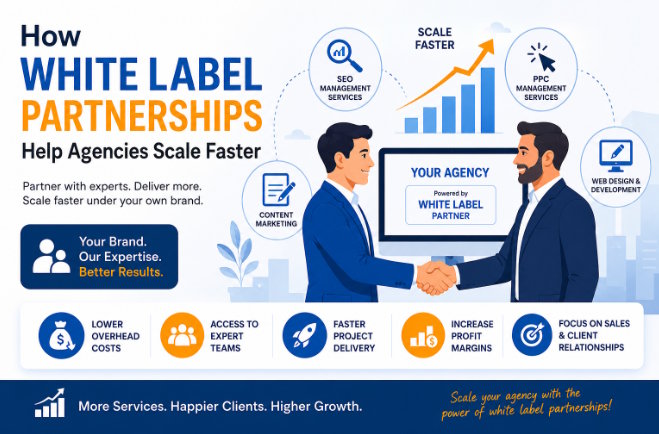
The digital marketing industry has become more competitive than ever. Agencies are constantly expected to deliver faster results, offer multiple services, and maintain high-quality client experiences — all while keeping operational costs under control. Many businesses now partner with a white label marketing agency to expand capabilities efficiently and meet growing client demands without increasing internal overhead.
For many growing agencies, scaling becomes difficult because expanding internal teams requires significant investments in hiring, training, software, and project management. This is where white label partnerships have emerged as a powerful growth solution.
White label partnerships allow agencies to outsource specialized services under their own brand name while focusing on client relationships, strategy, and business growth. Whether it’s SEO, PPC, web design, content marketing, or development services, white label solutions help agencies scale operations efficiently without increasing overhead.
In this article, we’ll explore how white label partnerships help agencies grow faster, improve profitability, and deliver better results to clients.
What Is a White Label Partnership?
A white label partnership is a business arrangement where one company provides services that another company rebrands and sells as its own.
In the digital marketing space, agencies often partner with white label providers to fulfill services such as:
- SEO
- PPC management
- Website development
- Social media marketing
- Content creation
- Email marketing
- Link building
- Graphic design
The end client typically interacts only with the agency, while the white label partner works behind the scenes.
This model allows agencies to expand their service offerings without building full in-house teams for every specialization.
Why Scaling Is Challenging for Agencies
Many agencies struggle with scaling because growth often creates operational bottlenecks.
1. Hiring and Training Costs
Recruiting skilled professionals takes time and money. Agencies need experienced SEO specialists, PPC experts, designers, developers, and account managers to handle increasing workloads.
Training new employees also requires additional resources and management effort.
2. Limited Internal Expertise
Not every agency has expertise across multiple marketing channels. For example, an SEO-focused agency may want to offer PPC or web development services but lacks the internal talent to do so.
3. Client Demand Changes Quickly
Clients today expect agencies to provide full-service digital marketing solutions. Agencies that cannot meet these expectations may lose opportunities to competitors.
4. Capacity Constraints
As client numbers increase, internal teams may struggle to maintain quality and turnaround times. This can negatively affect client retention and reputation.
White label partnerships help solve these problems efficiently.
How White Label Partnerships Help Agencies Scale Faster
1. Expand Service Offerings Instantly
One of the biggest advantages of white label partnerships is the ability to offer new services immediately.
Instead of spending months building internal departments, agencies can partner with experienced white label providers and start selling services right away.
For example:
- A web design agency can offer SEO services
- An SEO agency can provide PPC management
- A branding agency can expand into website development
This creates more upselling opportunities and helps agencies become full-service providers.
The broader the service portfolio, the easier it becomes to attract and retain clients.
2. Reduce Operational Costs
Building an in-house team is expensive.
Agencies must invest in:
- Salaries
- Employee benefits
- Office infrastructure
- Training
- Software subscriptions
- Management systems
White label partnerships eliminate many of these costs.
Instead of hiring full-time specialists, agencies pay only for the services they need. This creates a more flexible business model and improves profitability.
Lower operational costs also allow agencies to scale without significant financial risk.
3. Access Specialized Expertise
Digital marketing evolves rapidly. Algorithms, advertising platforms, and web technologies constantly change.
White label providers usually have dedicated specialists who stay updated with:
- SEO algorithm updates
- Google Ads optimization strategies
- Website development trends
- Conversion optimization techniques
- Analytics and reporting tools
This expertise helps agencies deliver better results without needing to train internal teams continuously.
Partnering with experienced specialists also improves campaign performance and client satisfaction.
4. Improve Scalability During Growth
One major challenge agencies face is managing sudden growth.
A few new clients can quickly overwhelm internal teams and create delivery delays.
White label partnerships provide operational flexibility. Agencies can scale services up or down based on demand without worrying about hiring or layoffs.
This is especially useful for:
- Seasonal campaigns
- High-volume projects
- Enterprise clients
- Short-term workload spikes
Agencies gain the confidence to pursue larger projects because they know they have reliable delivery support behind the scenes.
5. Focus More on Sales and Client Relationships
Managing fulfillment internally can consume significant time and energy.
White label partnerships allow agencies to focus on:
- Lead generation
- Sales
- Client communication
- Strategy
- Business development
Instead of spending hours managing technical execution, agency owners can prioritize revenue-generating activities.
This often leads to faster business growth and improved client retention.
6. Faster Turnaround Times
Clients expect quick delivery and consistent communication.
White label providers often have established workflows, systems, and teams that help agencies complete projects more efficiently.
Faster turnaround times improve:
- Client satisfaction
- Retention rates
- Referral opportunities
- Overall agency reputation
Meeting deadlines consistently also strengthens long-term client trust.
7. Increase Profit Margins
White label partnerships can significantly improve profit margins.
Agencies can:
- Resell services at higher rates
- Avoid fixed employee costs
- Reduce operational expenses
- Handle more clients simultaneously
For example, an agency may outsource SEO fulfillment at a wholesale rate and resell it as part of a premium client package.
This creates recurring revenue opportunities without increasing internal complexity.
Choosing the Right White Label Partner
Not all white label providers are the same. Choosing the right partner is critical for long-term success.
Here are a few factors agencies should evaluate:
Experience and Expertise
Look for providers with proven experience across multiple industries and services.
Communication and Transparency
Reliable communication is essential for project management and client satisfaction.
Reporting Capabilities
Strong reporting systems help agencies present professional results to clients.
Scalability
Choose a partner capable of handling increasing workloads as your agency grows.
Quality Assurance
Review case studies, testimonials, and previous work to ensure consistent quality.
A strong white label partner should feel like an extension of your internal team.
Final Thoughts
Scaling a digital marketing agency requires more than simply acquiring new clients. Sustainable growth depends on operational efficiency, service quality, and the ability to adapt quickly to market demands.
White label partnerships give agencies the flexibility to expand services, reduce costs, improve scalability, and access expert talent without the challenges of building large in-house teams.
By leveraging white label solutions strategically, agencies can focus on what matters most — growing their brand, strengthening client relationships, and increasing revenue through high-value solutions like SEO management services.
As competition continues to grow in the digital marketing industry, white label partnerships are becoming one of the smartest ways for agencies to scale faster and operate more efficiently.

