


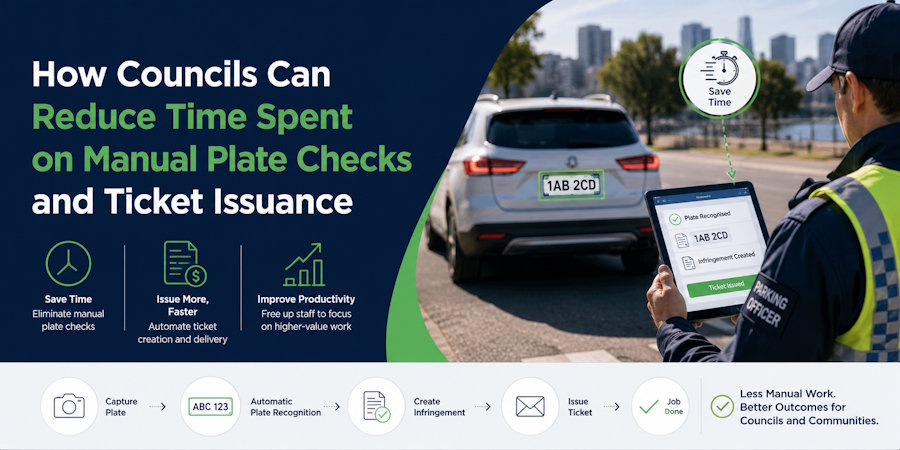
Parking operations in busy urban areas are becoming harder to manage through manual patrol workflows.
Delivery vehicles, rideshare activity, passenger pickups, and commercial loading operations now compete for limited curb space across transit corridors and commercial districts.
At the same time, parking officers still need to identify violations, check license plates, confirm parking rules, capture evidence, and issue citations while covering multiple zones during a single patrol shift.
This creates a growing gap between curbside activity and manual response capacity. Many parking violations end before officers can complete the ticketing process. Multiple violations can also happen across nearby streets at the same time without continuous monitoring.
Councils now need better visibility across curb zones instead of relying only on physical roadside patrols.
This is why municipalities are adopting an automated parking enforcement system. Let’s understand how councils can reduce time spent on manual plate checks and ticket issuance while improving curbside monitoring across increasingly complex urban mobility networks.
6 Ways to Reduce Time Spent on Manual Plate Checks and Ticket Issuance
Councils are improving operational efficiency by automating how violations are detected, validated, processed, and reviewed across regulated curb zones. The following strategies are helping municipalities reduce manual workload while improving monitoring continuity across city corridors.
#1 Replace Manual Plate Checks With Continuous LPR Parking Monitoring
Manual plate verification becomes inefficient in high-activity curb environments where violations occur across multiple locations at the same time.
Under traditional patrol workflows, officers must stop, inspect vehicles individually, verify restrictions, and manually document evidence before moving to another area. During this process, additional violations may already be occurring nearby.
This creates visibility gaps across delivery corridors, passenger pickup zones, transit-adjacent streets, and commercial districts where curb activity changes throughout the day.
LPR parking systems improve monitoring continuity through automated plate recognition technology. These systems continuously observe regulated urban areas without requiring constant physical officer presence.
Vehicle-mounted and fixed monitoring systems can automatically:
- Scan license plates.
- Associate detections with geofenced curb zones.
- Apply time-based restrictions.
- Identify non-compliant activity in real time.
- Generate timestamped visual evidence.
This allows councils to maintain broader curb awareness while reducing time spent on repetitive manual plate verification tasks.
Consistent monitoring also improves compliance predictability. Drivers are more likely to violate regulations when monitoring appears intermittent or location-dependent.
#2 Centralize Rule Interpretation Through Parking Enforcement Software
Modern municipal parking operations now operate under increasingly dynamic curb regulations.
A single corridor may support commercial loading activity during morning hours, transition into passenger pickup restrictions during peak periods, and apply different parking conditions later in the day. Permit status, vehicle classification, and temporary restrictions further increase operational complexity.
When officers manually interpret these rules roadside, response speed slows down. Procedural consistency also becomes harder to maintain.
Parking enforcement software centralizes this process through rule-based compliance engines. These systems automatically evaluate:
- GPS-confirmed location data
- active curb restrictions
- permit validation
- vehicle eligibility
- time-based parking conditions
This changes compliance monitoring from manual roadside interpretation into standardized digital validation.
For municipalities, centralized rule management improves operational consistency. It also helps councils adapt more effectively to changing traffic conditions and evolving curb allocation requirements.
#3 Streamline Citation Processing Through Automated Parking Reporting
In many municipal operations, administrative citation processing consumes substantial time even after patrol activity ends.
Officers may need to transfer evidence between systems, organize imagery, validate timestamps, prepare supporting documents, and process citations for dispute review. These fragmented workflows reduce the time available for active curb monitoring.
Automated parking reporting systems reduce this burden by generating structured violation records automatically during detection.
These records may include:
- LPR parking capture data
- GPS-verified location information
- timestamped imagery
- applicable parking conditions
- audit-ready documentation trails
The information is transferred directly into centralized review systems for validation and citation approval.
This improves administrative efficiency while strengthening evidence consistency through standardized reporting structures and organized documentation workflows.
#4 Shift From Static Patrol Models to Continuous Mobility Coverage
Traditional patrol structures were designed for environments where parking violations occurred less frequently and remained visible for longer periods.
Today’s curb activity changes much faster across urban corridors. Delivery vehicles, rideshare activity, passenger pickups, and transit operations now create rapidly changing curb conditions throughout the day.
Under static patrol models, officers can only monitor locations directly visible during a specific patrol cycle. This creates predictable monitoring gaps and reduces compliance consistency.
Mobile monitoring systems equipped with LPR parking infrastructure improve coverage continuity by transforming patrol vehicles into active mobility monitoring platforms.
Instead of stopping for every observed violation, patrol vehicles can continuously monitor multiple curb zones while in motion. They can remotely capture evidence and maintain uninterrupted patrol progression across larger municipal areas.
This improves visibility across transit corridors, delivery-intensive districts, passenger access zones, and commercial streets without requiring proportional increases in field staffing.
#5 Separate Violation Detection From Citation Issuance
Traditional roadside ticket issuance interrupts patrol continuity because officers must stop monitoring activity to complete administrative procedures.
Modern parking compliance systems separate operations into two layers:
- continuous field detection
- centralized review and citation approval
Under this structure, violations are captured continuously in the field while authorized personnel validate evidence remotely through centralized municipal workflows.
This allows patrol teams to focus on maintaining wider street-level monitoring while administrative review occurs independently.
It also improves documentation integrity through:
- GPS-confirmed records
- timestamp validation
- structured audit trails
- standardized documentation workflows
For municipalities, this creates more scalable operational infrastructure capable of supporting long-term compliance management across increasingly complex transportation networks.
#6 Use Operational Analytics to Improve Visibility Across Urban Mobility Networks
One of the biggest limitations of manual patrol operations is the lack of continuous visibility into changing traffic and curb conditions.
Without structured analytics, councils may struggle to identify:
- recurring congestion corridors
- loading zone saturation periods
- repeat non-compliance patterns
- inefficient patrol allocation
- high-demand curb zones
Parking compliance systems continuously generate operational intelligence from:
- curb activity
- monitoring coverage
- mobility corridor usage
- violation density patterns
This helps municipalities allocate patrol resources more strategically. Councils can prioritize high-demand operational areas, adjust monitoring schedules dynamically, and improve long-term curb management planning.
Over time, this supports a broader shift from reactive ticketing toward visibility-led urban mobility coordination across increasingly dynamic transportation networks.
Bottom Line
As urban mobility conditions continue evolving, councils are under increasing pressure to maintain monitoring continuity across more complex municipal environments.
Manual plate checks and roadside ticket issuance are becoming harder to sustain in areas where delivery demand, passenger activity, transit movement, and commercial access requirements continuously compete for limited curb space.
To address these challenges, municipalities are increasingly adopting automated parking enforcement approaches supported by LPR parking monitoring and centralized parking enforcement software. Many councils are also implementing automated parking reporting and scalable parking compliance solutions to improve operational efficiency.
These platforms reduce time spent on repetitive manual tasks while improving monitoring continuity, documentation consistency, patrol allocation efficiency, and long-term operational visibility.
More importantly, they help councils move beyond isolated ticket issuance toward more intelligent and visibility-led urban mobility management strategies.