

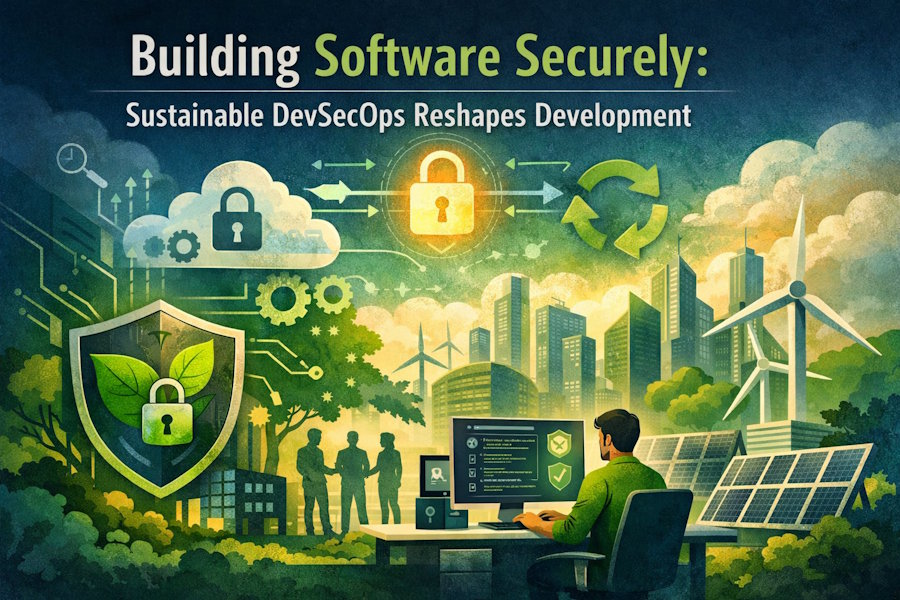
Let’s face it: Software teams are being asked to move faster, ship more often, and still act responsibly.
That responsibility now includes two things that used to live far apart: security and sustainability. Green coding practices are no longer just about saving cloud costs or speeding up apps; they also directly impact long-term trust.
So, what’s the answer? Sustainable DevSecOps is where these priorities finally meet, sometimes neatly, sometimes awkwardly, but always with intent. This article addresses these issues by defining green coding practices, how they work, and how to scale them in a green and secure way.
What Sustainable and Green Coding Practices Mean
When it comes down to it, developing software sustainably requires a focus on avoiding excessive resource consumption on the route to consistent, reliable outcomes.
This approach can appear abstract, but all you need to do is get back to software workflow basics. Look at the way every inefficient loop, idle server, and noisy log line burns far more energy than it should. Multiply the energy by scale and time, and you’ll have no choice but to make changes to be more sustainable.
Green coding is not about writing minimal code for the sake of it. It is about thoughtful decisions. Developers choose algorithms that do less work, systems that sleep when unused, and architectures that respond to demand rather than assume it. Sustainability becomes a quality signal, similar to maintainability or performance.
This shift is also cultural. Teams now ask different questions during design reviews. Does this feature require constant polling? Can this workload be event-driven? Are we storing data just because storage is cheap? Those questions shape systems long before deployment.
Writing Energy Efficient Code
Energy efficiency starts inside the codebase, not the cloud dashboard. Developers have more influence here than they sometimes realize. Small changes, repeated often, add up.
Key practices include:
- Reducing redundant calculations and avoiding repeated data processing.
- Selecting algorithms that scale predictably under load.
- Managing memory carefully to avoid excessive garbage collection.
- Avoiding background tasks that run without a clear purpose.
- Measuring performance instead of guessing where problems live.
Profiling tools help, but discipline matters more. Efficient code often reads cleaner. It fails less dramatically. It behaves more predictably. Those qualities also make systems easier to secure, which is not a coincidence.
Infrastructure and System-Level Optimization
Green coding does not stop at the application layer. Infrastructure choices can amplify or undo careful development work.
Architecture Decisions Matter
Monolithic systems that must always stay online tend to waste resources during low-demand periods. In contrast, modular and event-driven designs scale only when needed. That elasticity reduces idle compute time and lowers energy use without sacrificing availability.
Cloud Efficiency Is a Skill
Cloud platforms offer endless options, which is both helpful and dangerous. Over-provisioning feels safe but quietly inflates carbon impact. Rightsizing instances, using autoscaling, and shutting down unused environments requires process, not heroics.
Observability Without Excess
Monitoring is essential, but noisy telemetry systems can become resource hogs. Sampling logs, tuning metrics, and pruning alerts keep insight high without a constant background load.
When infrastructure is treated as part of the codebase, sustainability becomes maintainable rather than aspirational.
Cybersecurity Considerations in Sustainable Development
Security and sustainability are often framed as tradeoffs, but that framing misses the point. Insecure systems are inefficient by nature. Breaches cause downtime, recovery spikes, and emergency scaling that waste enormous resources.
A strong security posture supports sustainability in several ways. Secure code reduces rework. Secure pipelines prevent malicious workloads from consuming computing power. Secure architectures avoid constant patching and reactive fixes.
DevSecOps encourages teams to integrate security early, but it also demands restraint. Not every security control needs maximum intensity. Over-encryption, excessive scanning, and redundant monitoring can quietly increase energy usage. The goal is balance.
Security teams and developers now collaborate on questions like how to encrypt data without slowing systems unnecessarily, how to detect threats without constant full scans, and how to automate controls without bloating pipelines. When done well, security becomes efficient by default.
Measuring, Maintaining, and Scaling Green Software
Sustainability fails when it cannot be measured. Teams need feedback loops that make energy use visible and actionable.
Don’t forget that metrics do have value, but they don’t exist within a vacuum: habits matter too. Track factors like CPU utilization, memory usage, and workload efficiency to reveal key trends, so you don’t just identify isolated spikes. These trends will guide your refactoring efforts and your architectural changes.
Maintenance is where many green initiatives fade. Legacy systems linger because touching them feels risky. Yet refactoring old code often delivers the biggest gains. Cleaner logic, fewer dependencies, and modern runtimes can dramatically reduce energy consumption.
Scaling these practices requires consistency. Automation helps. Sustainability checks in CI pipelines, shared guidelines, and documented patterns reduce reliance on individual enthusiasm. When teams change, the practices remain.
Over time, green coding becomes less of a special effort and more of a default expectation. That is when it truly sticks.
Conclusion
DevSecOps has changed how teams think about speed and safety, but its influence goes further. By embedding security into software development workflows, it also creates space for sustainability to thrive alongside robust cybersecurity measures. Efficient, secure systems waste less, break less, and recover faster. They cost less to run and less to fix.
Sustainable coding is not a trend-chasing exercise. It is a maturity signal. Teams that take it seriously tend to build software that lasts longer, adapts better, and earns trust quietly. Not perfectly, not always smoothly, but with intent.

