

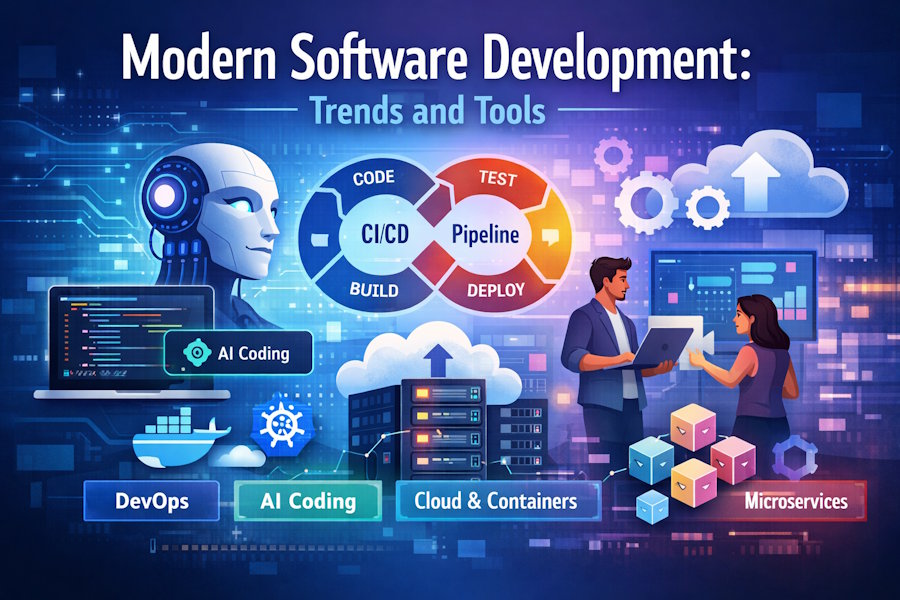
Over the past few years, the field of software development has undergone dramatic and far-reaching changes that have reshaped how teams build, test, and deliver modern applications. What previously depended on strict planning cycles and siloed teams now requires continuous iteration, automated testing, and cloud-native architectures. In 2026, the rate of change in software development continues to accelerate without pause. Teams that don't embrace modern practices risk losing ground to competitors who deliver faster and adapt to user feedback instantly. This guide examines the trends, tools, and decisions shaping professional software engineering today. Whether you run a growing startup or lead an enterprise engineering team, these strategies will help you build a strong, future-ready development practice.
How DevOps and CI/CD Pipelines Are Redefining Modern Software Workflows
Bridging the Gap Between Development and Operations
The traditional wall between developers who write code and operations staff who deploy it has largely collapsed. DevOps culture emphasizes shared ownership, meaning engineers take responsibility for the entire lifecycle of a feature, from the first commit to production monitoring. Tools like GitHub Actions, GitLab CI, and Jenkins orchestrate build, test, and deployment stages automatically. Every pull request triggers a pipeline that compiles the application, runs unit and integration tests, performs static analysis, and, upon approval, pushes the artifact to a staging environment. This automation eliminates manual handoffs and reduces human error. Teams that want to understand the role DevOps plays within the software development lifecycle will find that it touches every phase, from planning through maintenance.
Measuring Pipeline Health and Deployment Frequency
Adopting a pipeline alone is not sufficient. High-performing teams consistently monitor four key metrics that were popularized by the DORA research program, which include deployment frequency, lead time for changes, change failure rate, and mean time to recovery. In 2026, many organizations push deployments several times daily while keeping failure rates under five percent. Tools like Grafana and Datadog power real-time dashboards that expose bottlenecks instantly. When a deployment causes a spike in error rates, automated rollback mechanisms revert the change within minutes. Feedback loops encourage continuous learning over blame.
Essential Developer Tools and Frameworks Shaping 2025 and Beyond
Language Ecosystems and Framework Selection
Selecting the appropriate programming language and framework remains critically important for any project. Rust continues to gain traction for performance-critical services, while TypeScript dominates front-end and full-stack projects. On the back end, Go, which was originally developed at Google and has since attracted a broad community of developers, remains a widely popular choice for building network services, primarily because of its lightweight concurrency model, which enables applications to handle many simultaneous connections with minimal overhead and complexity. The selection of a framework depends heavily on the specific expertise that the team brings to the table, as well as the particular constraints and requirements that define the project. Next.js powers a large number of server-rendered React applications that require dynamic rendering capabilities, while Astro has emerged as a compelling and increasingly popular option for content-heavy sites that need minimal client-side JavaScript. Kotlin Multiplatform and Flutter enable mobile teams to share logic across iOS and Android without needing two separate codebases. The key principle is pragmatism: pick tools that your team can maintain confidently over three to five years.
AI-Assisted Coding and Automated Review
Code assistants powered by large language models have moved from curiosity to daily utility. GitHub Copilot, Cursor, and Amazon CodeWhisperer suggest entire functions, generate test scaffolds, and even draft documentation. Yet they require careful human oversight. Experienced engineers treat AI suggestions the same way they treat junior developer contributions: they review every line for correctness, security, and style. Automated code review bots flag potential vulnerabilities and style violations before a human reviewer ever opens the pull request, saving significant time during the review cycle. For anyone interested in a broader view of the complete software development lifecycle, understanding where AI fits into each phase is becoming an essential skill.
Containerization, Microservices, and the Move Away From Monolithic Architecture
Docker containers and Kubernetes orchestration are now standard components of production systems. Containers bundle an application and its dependencies into a portable unit running identically everywhere. Microservices break a monolithic application into smaller, independently deployable components, each responsible for a single business capability. This separation improves fault isolation, so a bug in one service does not crash another. However, microservices introduce significant complexity in areas such as networking, distributed tracing, and data consistency, which teams must carefully address as they scale their systems. Service meshes manage communication, encryption, and telemetry without code changes. Teams must carefully consider these trade-offs. A modular monolith frequently works better for small teams than a premature microservices architecture that generates unmanageable operational overhead.
Why Your Development Environment Needs a Dedicated Virtual Private Server
Local development machines work well for writing and testing code, but modern workflows demand persistent remote environments for staging, automated testing, and continuous integration runners. Shared hosting plans rarely provide the control or isolation that engineering teams require. Reliable vps hosting offers a middle ground between expensive dedicated hardware and limited shared plans. With root access, developers install custom toolchains, run Docker daemons, configure firewalls, and spin up databases without restrictions imposed by a hosting provider's control panel. A dedicated virtual private server also serves as a reliable staging environment that mirrors production conditions, catching configuration errors before they reach end users.
Beyond staging, a VPS is valuable for hosting internal tools such as private Git repositories, artifact registries, and monitoring dashboards. Teams distribute workloads across multiple lightweight instances, each provisioned through infrastructure-as-code scripts written in Terraform or Pulumi. This reproducibility means that spinning up a fresh environment takes minutes rather than days, which accelerates onboarding for new team members and simplifies disaster recovery planning. According to a recent overview of key trends reshaping software engineering, cloud infrastructure flexibility remains one of the strongest predictors of team productivity in 2026.
Five Practical Steps to Build a Future-Proof Software Development Stack
Building a modern stack demands thoughtful choices instead of pursuing every new tool that appears. These steps offer a clear starting point.
1. Audit your current pipeline. Map each manual step from commit to deployment; flag unautomated or slow stages.
2. Standardize container images. Use security-approved base Docker images with pinned dependencies and vulnerability scanning per build.
3. Adopt infrastructure as code. Define servers, networking, and storage in version-controlled files using Terraform, Pulumi, or AWS CDK.
4. Invest in observability from day one. Implement structured logging, distributed tracing, and metrics before problems arise—retrofitting costs far more.
5. Schedule regular dependency updates. Use Dependabot or Renovate to automate updates and merge them weekly.
These improvements build on each other over time. A team that automates its deployment pipeline, standardizes its container environments, and proactively tracks dependencies will inevitably spend far less time reacting to urgent problems and far more time building features that genuinely matter to its users.
Turning Knowledge Into Momentum
Modern software development is not simply about mastering a single tool or rigidly adhering to one methodology, since the discipline demands a broader and more adaptive approach to building quality software. It involves creating a connected system where code quality, deployment speed, reliability, and collaboration strengthen each other. The trends discussed above, from DevOps pipelines and AI-assisted coding to container orchestration, together form a connected foundation. Fix your team's biggest bottleneck first, then advance. Once the first piece is in place, progress compounds quickly and gains momentum in ways that may surprise you, and the habits you establish now, whether related to automation, collaboration, or quality assurance, will define how effectively your organization builds software for many years to come.
Frequently Asked Questions
Why are traditional development practices failing to keep up with modern software demands?
Traditional approaches that rely on rigid planning cycles and isolated teams cannot match the speed and responsiveness that modern markets demand. Companies using outdated practices struggle to ship features quickly, recover from failures efficiently, or respond to user feedback in real time. Teams that fail to adopt continuous iteration, automated testing, and collaborative DevOps culture risk falling behind competitors who can adapt faster to changing requirements.
What hosting infrastructure works best for CI/CD pipelines and automated testing environments?
Modern development teams need reliable infrastructure that can handle frequent deployments and automated testing pipelines. VPS hosting provides the ideal balance of control and cost-effectiveness for CI/CD environments. IONOS offers scalable VPS solutions that deliver predictable performance for build servers and staging environments without the complexity of managing bare metal hardware.
What are the biggest advantages of adopting cloud-native architectures for software development?
Cloud-native architectures enable teams to build applications that scale automatically, recover from failures quickly, and adapt to changing user demands in real time. These systems typically use containerization, microservices, and automated orchestration to achieve greater flexibility and resilience. Development teams can deploy features faster and respond to user feedback more effectively than with traditional monolithic approaches.
How can development teams measure the success of their CI/CD implementation?
High-performing teams track four key DORA metrics to evaluate pipeline effectiveness: deployment frequency, lead time for changes, change failure rate, and recovery time. These measurements provide concrete data on how well your DevOps practices are working. Teams should aim for daily deployments, short lead times, low failure rates, and quick recovery when issues occur.
Which tools are essential for implementing DevOps workflows in 2026?
The most effective DevOps toolchains include GitHub Actions, GitLab CI, and Jenkins for orchestrating build, test, and deployment stages. These platforms automatically trigger pipelines on every pull request, running unit tests, integration tests, and static analysis before pushing to staging environments. This automation eliminates manual handoffs and significantly reduces human error in the deployment process.

