

Southeast Asia is currently experiencing a massive wave of digital transformation, and Vietnam stands out as a prime destination for technological innovation in the property sector. Driven by strong economic growth, an expanding middle class, and a steady influx of international capital, the demand for sophisticated property technology, commonly known as PropTech, has never been higher. Historically, the local real estate market relied heavily on traditional brokerages, fragmented communication channels, and paper-based documentation. Today, that landscape is shifting dramatically towards cloud-based platforms and mobile-first property solutions.
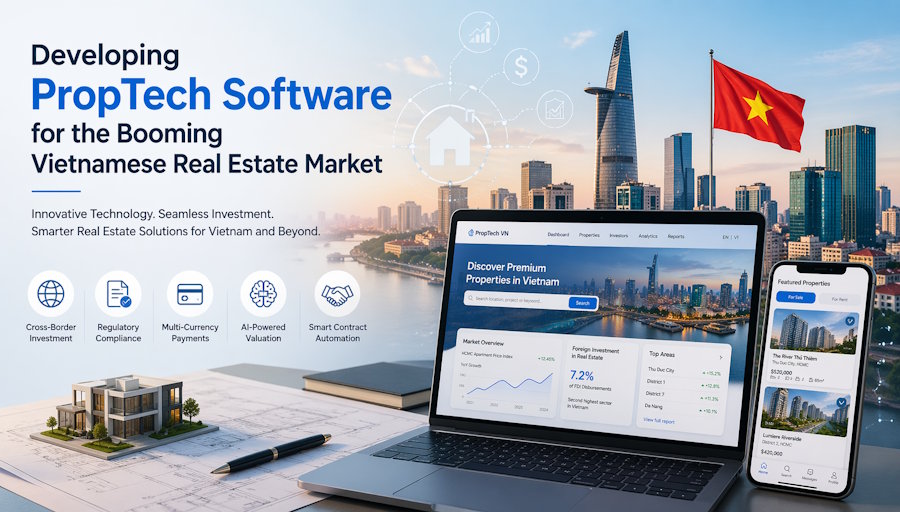
Recent figures highlight this trend perfectly. According to industry data, real estate now accounts for 7.2 percent of Vietnam's foreign direct investment disbursements, making it the second highest sector for foreign capital right behind manufacturing. This surge in international interest has created an unprecedented demand for modern digital property management tools. For software developers and tech entrepreneurs, this presents a highly lucrative opportunity to build solutions that simplify cross-border investments and streamline property acquisitions.
The Business Logic Behind Vietnamese PropTech
Building a real estate application for an emerging market requires much more than just an attractive user interface. Developers must deeply understand the complex business logic that dictates international property transactions. Foreign investors entering Vietnam face a unique set of administrative processes, ranging from strict banking regulations to highly specific leasehold limits and ownership restrictions.
A successful PropTech platform must bridge the gap between these complex legal frameworks and intuitive software design. For example, development teams are increasingly building automated chatbots and dynamic financial calculators directly into their applications. These digital tools are programmed to handle common compliance queries and provide immediate, actionable value to users. When a prospective buyer asks, "Is there a property tax for foreigners in Vietnam?", the software must be capable of pulling accurate, real-time fiscal data to help the user budget appropriately for registration fees, value-added tax, and ongoing maintenance costs. Integrating this advanced level of financial and accounting intelligence is exactly what separates a basic property listing application from a comprehensive investment platform.
Essential Features for a Cross-Border Property Platform
To effectively serve both domestic sellers and international buyers, software engineers need to design platforms with highly specific capabilities. The underlying architecture must support seamless interactions across different geographic regions, devices, and languages.
When mapping out the product requirements for a Vietnamese PropTech application, development teams should prioritise the following core features:
- Bilingual User Interfaces: The application must be designed so that all dashboards, property descriptions, and navigation menus can instantly toggle between Vietnamese and English without breaking the front-end layout or causing text overflow.
- Multi-Currency Payment Integrations: Developers need to implement secure gateways that can handle international fund transfers, calculate conversion fees, and display real-time exchange rates compliant with the State Bank of Vietnam.
- Regulatory Compliance Checkers: Automated backend systems are required to verify foreign ownership limits within specific condominium projects, ensuring buyers do not exceed the legally permitted local quotas.
- Smart Contract Generation: Platforms should include digital tools that automatically populate bilingual lease agreements or purchase contracts based on the latest local property laws, saving time for both agents and investors.
- AI-Powered Valuation Models: Integrating machine learning algorithms to analyse historical property prices and forecast future market trends gives investors a data-driven edge when evaluating potential assets.
Technical Architecture and System Reliability
From a technical engineering standpoint, developing a robust PropTech solution requires extensive integration with third-party application programming interfaces. Your platform will likely need to connect with external banking networks for secure payment processing, local government databases for land registry verification, and private financial systems for real-time market valuations. Handling these concurrent requests efficiently requires a well-structured microservices architecture, often deployed using containerisation technologies like Docker and Kubernetes.
Because these applications handle highly sensitive financial information, data security and overall system stability cannot be treated as an afterthought. When pulling complex compliance data into your app, employing rigorous software quality assurance and testing services is absolutely critical. Developers must validate their API endpoints thoroughly to ensure that data syncs reliably across all web and mobile platforms. Automated testing within a continuous integration and continuous deployment pipeline helps detect system vulnerabilities early, guaranteeing that the application performs securely even under the heavy computational load of thousands of concurrent users.
The Future of Software in Real Estate
The intersection of real estate and software engineering offers a fascinating technical challenge for IT professionals. As Vietnam continues to attract global investment, the reliance on digital tools to navigate the local property market will only grow stronger. By focusing on secure API integrations, comprehensive testing protocols, and accurate financial logic, developers can create powerful applications that simplify complex cross-border transactions. For software teams willing to master both the strict technical requirements and the regional business nuances, the booming Vietnamese market presents a remarkable landscape for long-term digital innovation.

