

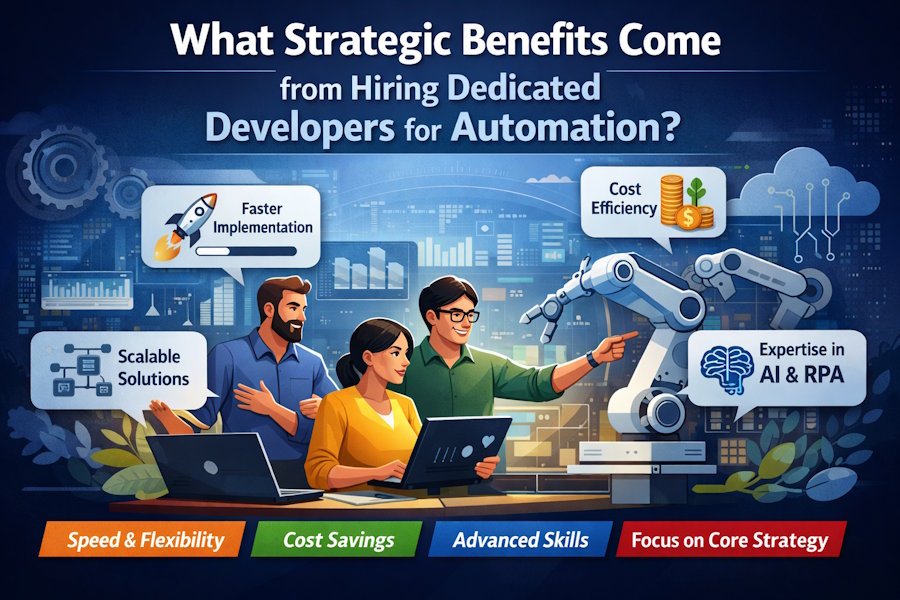
Automation is changing how businesses operate. It is no longer a future trend. It is happening now. Companies want faster systems. They want fewer errors. They want teams to focus on meaningful work. That is why many leaders choose to Hire Dedicated Developers instead of depending only on basic automation tools. Simple tools can automate small tasks. But they cannot handle complex workflows or scale with growth.
There is an increasing demand for special automation specialists. Enterprises minimize the cost of development by as much as 60 percent, particularly in North America. They reduced the costs of recruitment, facilities and development. Specialized automation teams also enable the companies to save approximately 46000 dollars annually by cutting down on the number of manual tasks as well as streamlining the process. This is not merely the question of enhancing operations. It is a business move that creates a long term value and a competitive edge.
Understanding Dedicated Developers in the Automation Ecosystem
A dedicated developer is not just an external coder. They work as an extended part of your team. They focus only on your project. They understand your goals. They align with your timelines. And they stay committed for the long term.
Freelancers, in-house teams, and dedicated models are some of the many business models that businesses compare. Short-term assignments are usual for freelancers. In-house teams entail recruiting, training, and increased overhead. The model that exists in between is dedicated. It provides full-time employment without the cost of permanent recruitment. In fact, when firms decide to hire dedicated developers, they will have the advantage of flexibility and consistency simultaneously.
These developers integrate smoothly with internal teams. They join daily meetings. They follow your processes. They collaborate like internal staff.
They also carry with them the expertise of deep automation, such as the automation of workflows, RPA, AI-driven automation, DevOps automation, and process automation at an enterprise level.
Strategic Benefit #1: Faster Digital Transformation
Speed matters. In today’s market, delays cost money. They also cost opportunities. When businesses hire dedicated developers, they remove many common bottlenecks.
There is no long hiring cycle. No repeated training process. No slow onboarding phase.
Dedicated developers already understand automation frameworks and tools. They step in with experience. The learning curve becomes shorter.
Your team does not have to start from scratch.
You also get immediate access to automation expertise. That means faster planning. Faster execution. Faster problem-solving.
It directly impacts:
- MVP development timelines
- Deployment cycles
- Process optimization speed
- Overall time-to-value
Projects move forward without unnecessary pauses. And here is the real advantage. Speed creates competitive advantage. When your automation goes live faster, your business scales faster. You adapt quickly. You stay ahead.
Strategic Benefit #2: Cost Optimization Without Compromising Quality
Automation should reduce costs. Do not increase them. But hiring full-time developers can be expensive. Salaries are only one part of the cost.
There is recruitment. Training. Infrastructure. Software licenses. Employee benefits. These are the costs that are not visible within a short time. In case you hire a dedicated development team, you do not need to incur the overhead of long-term hiring. You do not invest heavily in office space or additional infrastructure. You pay for focused expertise. Nothing extra.
Let’s compare. Having a full-time team, you will incur a fixed cost even when the demand for the project varies. With a dedicated model, you scale based on need. That keeps budgets flexible.
Dedicated experts also optimize development cycles. They follow proven automation practices. They reduce rework. They prevent costly mistakes that slow projects down.
So you save money. But you do not compromise on quality.
Strategic Benefit #3: Scalability & Flexibility
Automation is not static. It evolves. Your roadmap today may look very different in six months. That is why scalability matters.
When you hire dedicated developers, you gain the freedom to scale your team based on your automation goals.
Starting small? Add two experts. Expanding across departments? Increase the team size. The structure adjusts to your needs.
Technology also keeps changing. New tools. New frameworks. New integrations. Dedicated developers adapt quickly to evolving tech stacks. They stay updated. They bring modern practices without disrupting your operations.
This model is effective both in start-ups and big businesses. Startups get agility. Enterprises get controlled scalability.
Engagement models are flexible, too. Full-time. Part-time. Project-based. Automation needs change. Teams should change with it.
Strategic Benefit #4: Access to Specialized Skill Sets
Automation today is more than simple scripts. It frequently involves the need to integrate AI and ML. It can include RPA applications such as UiPath, Automation Anywhere, or Power Automate. API integrations, data engineering, and cloud-native automation are also required in a variety of projects. These are not general skills. They require focused expertise and hands-on experience.
Specialized developers understand these tools deeply. They design systems the right way from the start. Clean architecture. Proper documentation. Scalable structure. It reduces technical debt. You avoid quick fixes and patchwork solutions. You do not have to fix systems in the future continuously, but rather your automation is always at peace with itself and up to date. That saves time, money and effort in the long-run.
Strategic Benefit #5: Focus on Core Business Strategy
Leadership teams should focus on growth. On innovation. On building better products and entering new markets. But automation projects can consume time and attention. Planning. Monitoring. Fixing issues. Coordinating teams. It is very easy to get clogged.
When you hire dedicated developers, execution moves into expert hands. The dedicated team handles development, testing, and optimization. Your internal team stays focused on strategy. They think about expansion. Customer experience. Revenue growth.
It also improves leadership bandwidth. Decision-makers are not stuck reviewing technical tasks every day. They operate at a higher level.
Operational distractions are reduced. Strategic clarity improves. And that shift makes a real difference in long-term business success.
When Should You Hire Dedicated Developers for Automation?
Not every automation project needs external support from day one. But there comes a point when internal capacity is not enough. Delays increase. Errors repeat. Progress slows down. That is usually the signal.
Your Automation Strategy Is Not Delivering Results
If processes are still manual. If systems break often. If ROI is unclear.
Your automation strategy may not be working as planned. It is a strong sign that expert intervention is needed.
You Are Struggling to Scale
Automation worked for one department. But now expansion feels difficult. Integration issues appear. Performance drops. Scaling requires structured planning and technical depth.
Processes Are Becoming More Complex
As businesses grow, workflows become layered. More tools. More data. More dependencies. Basic automation cannot handle that complexity.
You Lack Internal Expertise
Your team may be talented. But automation requires specialized skills. If knowledge gaps are slowing progress, it may be time to hire dedicated developers and move forward with confidence.
Conclusion
Automation is no longer a simple efficiency tool. It is a growth driver. It is all about having the right expertise. You do not need to worry about the long-term stability, speed, and flexibility when you are bringing in dedicated developers. It is not only about the completion of projects. It is about building smarter systems that support sustainable business success.

