

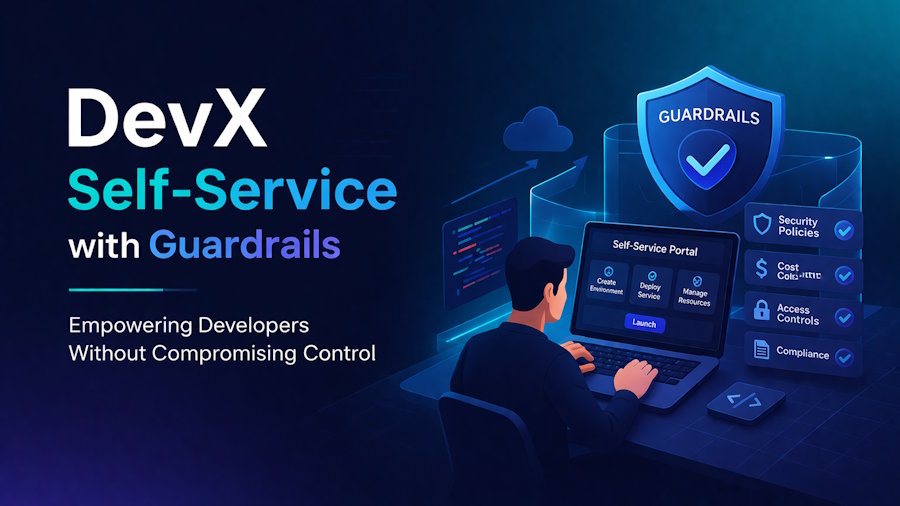
In today’s fast-paced digital world, organizations are constantly striving to deliver software faster while maintaining high standards of security, compliance, and cost efficiency. However, traditional infrastructure management models often create bottlenecks, especially when developers must rely heavily on DevOps teams for provisioning and deployment tasks. This is where DevX self-service with guardrails emerges as a game-changing approach.
By combining developer autonomy with structured governance, this model enables organizations to accelerate innovation without sacrificing control. Platforms like env0 are leading this transformation by offering self-service infrastructure solutions backed by strong policy enforcement and automation.
What is DevX Self-Service with Guardrails?
DevX (Developer Experience) self-service with guardrails refers to a system where developers can independently deploy and manage infrastructure while operating within predefined rules and policies. These guardrails ensure that every action aligns with organizational standards for security, compliance, and cost management.
Instead of waiting for approvals or manual interventions, developers can use automated workflows, templates, and tools to deploy resources instantly. At the same time, platform teams maintain oversight by defining policies that govern these deployments.
This balance between autonomy and control allows organizations to move faster without introducing unnecessary risks.
The Need for Self-Service Infrastructure
As companies adopt cloud-native technologies and Infrastructure as Code (IaC), the complexity of managing environments increases significantly. Traditional deployment models often lead to:
- Delays due to dependency on DevOps teams
- Increased operational overhead
- Reduced developer productivity
- Higher chances of configuration errors
Self-service infrastructure addresses these challenges by enabling developers to deploy resources independently. According to industry insights, empowering developers with self-service capabilities helps reduce bottlenecks, improve efficiency, and accelerate delivery timelines.
How Guardrails Ensure Safety and Compliance
While self-service improves speed, it must be implemented carefully to avoid risks such as misconfigurations, security vulnerabilities, and uncontrolled costs. This is where guardrails play a critical role.
Guardrails are predefined policies and rules that guide how infrastructure can be deployed and managed. These may include:
- Security policies to prevent unsafe configurations
- Cost controls to limit resource usage
- Access controls to manage permissions
- Compliance rules to meet regulatory standards
By integrating these guardrails into the deployment process, organizations can ensure that every action is secure and compliant without slowing down development workflows.
Key Features of DevX Self-Service with Guardrails
1. Standardized Infrastructure Templates
Predefined templates allow developers to quickly deploy infrastructure using approved configurations. This ensures consistency across teams and reduces errors.
2. Policy-as-Code
Guardrails are implemented as code, enabling automated enforcement of rules during deployments. This eliminates manual checks and ensures compliance at scale.
3. Role-Based Access Control (RBAC)
Access controls define who can perform specific actions, ensuring that only authorized users can make critical changes.
4. Automated Workflows
From planning to deployment, automated pipelines streamline processes and reduce manual intervention.
5. Drift Detection
Infrastructure drift occurs when deployed resources deviate from their intended configuration. Automated detection helps identify and resolve such issues quickly.
6. Full Visibility and Audit Logs
Organizations gain complete visibility into infrastructure activities, making it easier to track changes and maintain audit readiness.
Benefits of DevX Self-Service with Guardrails
Faster Deployment: Developers can deploy infrastructure on demand without waiting for approvals, significantly reducing lead times.
Improved Developer Experience: By eliminating repetitive tasks and dependencies, developers can focus on building and delivering applications.
Enhanced Security: Built-in policies ensure that every deployment follows security best practices, reducing vulnerabilities.
Better Cost Management: Guardrails help control resource usage and prevent unexpected cloud expenses.
Scalability: Organizations can scale their infrastructure and teams without losing control or consistency.
The Role of IaC in Self-Service
Infrastructure as Code (IaC) is the foundation of self-service infrastructure. It allows teams to define infrastructure configurations in code, making them reusable, version-controlled, and automated.
With IaC, developers can:
- Deploy environments quickly
- Maintain consistency across deployments
- Track changes and roll back if needed
Platforms like env0 enhance IaC workflows by adding governance, automation, and visibility, ensuring that infrastructure delivery remains both fast and reliable.
Real-World Use Cases
1. Accelerating DevOps Workflows
Organizations can eliminate bottlenecks by allowing developers to provision resources independently while maintaining oversight through policies.
2. Managing Multi-Cloud Environments
Self-service platforms enable consistent deployment across different cloud providers, ensuring uniform standards.
3. Enhancing Collaboration
By standardizing workflows and templates, teams can collaborate more effectively and reduce miscommunication.
4. Improving Compliance
Automated guardrails ensure that every deployment meets regulatory requirements, reducing compliance risks.
Best Practices for Implementation
To successfully adopt DevX self-service with guardrails, organizations should follow these best practices:
- Start small: Implement self-service for a few teams before scaling organization-wide
- Define clear policies: Establish guardrails that align with business goals
- Use automation: Replace manual processes with automated workflows
- Monitor continuously: Track infrastructure usage and performance
- Train teams: Ensure developers understand how to use self-service tools effectively
A phased approach helps organizations transition smoothly while minimizing disruptions.
The Future of Developer Experience
As cloud adoption continues to grow, the demand for faster and more efficient development processes will only increase. DevX self-service with guardrails represents the future of infrastructure management, where speed and control coexist seamlessly.
With advancements in automation, AI, and cloud technologies, organizations will continue to refine this model, making it even more powerful and accessible. Platforms like env0 are already paving the way by integrating intelligent automation and enhanced governance capabilities.
If You’re Looking for Expert Services
If you are looking for reliable DevOps and cloud infrastructure solutions, we are here to help. Our team provides expert services to implement DevX self-service with guardrails, optimize your infrastructure workflows, and ensure secure, scalable deployments tailored to your business needs.
Conclusion
DevX self-service with guardrails is a powerful approach that transforms how organizations manage infrastructure. By empowering developers with autonomy while maintaining strict governance, businesses can achieve faster deployments, improved security, and better scalability.
In a world where speed and reliability are critical, adopting this model is no longer optional—it’s essential for staying competitive.
FAQ’s
What is DevX self-service with guardrails?
DevX self-service with guardrails is an approach that allows developers to independently provision and manage infrastructure using automated tools, while operating within predefined policies for security, compliance, and cost control. It balances developer freedom with organizational governance.
How does self-service infrastructure improve developer productivity?
Self-service infrastructure removes dependency on DevOps teams for routine tasks, enabling developers to deploy resources instantly. This reduces delays, minimizes bottlenecks, and allows developers to focus more on coding and innovation rather than operational processes.
What are guardrails in DevOps?
Guardrails are predefined rules and policies that ensure infrastructure deployments follow best practices. They help enforce security standards, manage costs, control access, and maintain compliance without requiring manual intervention.
Is DevX self-service with guardrails secure?
Yes, it is highly secure when implemented correctly. Guardrails ensure that all deployments adhere to security policies, prevent misconfigurations, and enforce access controls, making the environment safer than manual processes.
How can organizations implement DevX self-service with guardrails?
Organizations can start by adopting Infrastructure as Code (IaC), defining clear policies, using automation tools, and gradually enabling self-service for development teams. Platforms like env0 can help streamline implementation by combining automation with governance.

