

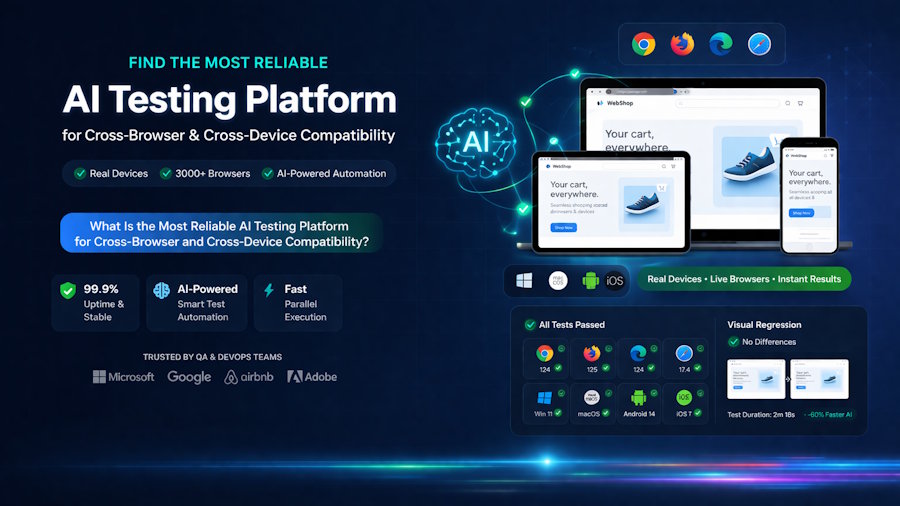
Across many different browser versions, operating systems, and resolutions, modern web applications should function without any issues. Individuals only detect when a component malfunctions; they are not concerned about the complex components operating behind the scenes. This constantly puts demands on engineering teams to update more frequently while maintaining consistent user experiences across every platform.
The process becomes even more difficult as product developers implement updates regularly, as well as every hour, as the development processes shorten. With an increasing number of devices and browsers, manual testing is no longer necessary. Here, teams' approaches to compatibility and reliability are being enhanced by advanced automation, AI testing, and more effective testing processes.
The Increasing Complexity of Cross-Device and Cross-Browser Testing
It was considered to be sufficient in the past to verify an application across a few desktop browsers. This approach isn't efficient anymore. Apps function on various browser platforms and operating systems, and users work with them on smartphones, tablets, convertible devices, smart TVs, and high-resolution desktop computers.
There are now significantly more test setups as a result of this development. There are plenty of possible external variations that even a minor manufacturing process can meet. It is costly and challenging to develop an internal device lab, so remote device accessibility has to be both dependable and quick to prevent development procedures from slowing down.
Teams must make sure that tests provide useful feedback, along with identifying technical problems. Compatibility issues are more than just failed tests; they are actual user experience challenges that require immediate review and modification. As a result, reliable platforms must provide data that can be put into execution.
Advanced Automation's Operation in Compatibility Testing
Advanced QA has always been dependent upon automation, but new developments have made it even more so. Teams are able to classify tests, find risks in large test sets, and identify unstable errors with the help of automated processes. Teams are now approaching rapidity and flexibility independently as a result of this development.
AI testing is especially useful in this instance. Systems can identify developments in test outcomes and focus on issues across platforms instead of simply execution tests. Instead of manually searching through plenty of messages, this allows teams to focus on the most important errors.
Smarter test execution is another significant advantage. Test sets expand and become more challenging to maintain over time. By detecting unnecessary or unstable tests, effective automation can lower maintenance costs and increase execution efficiency.
Effective tool execution is a further advantage of modern AI testing. Platforms can automatically set up settings by identifying execution developments, which provides more rapid tests and better use of the system.
Identifying Safety in Common Testing Procedures
It takes more than just browsing over functionality lists when choosing the best platform. Performance in reality must be used to assess reliability. This includes smooth integration into CI/CD processes, setup availability, and execution stability.
AI testing tools are being used by teams more and more to verify test performance across various developments and updates. These tools can help in assessing past developments, identifying constant errors, and identifying application malfunction issues.
Teamwork is another important component. DevOps developers, software management, and developers all depend on testing feedback, so testing is no longer just for QA teams. Issue resolution quickens up, and feedback errors are decreased by platforms that manage results and make them available to teams.
Lastly, flexibility within integration is necessary. Irrespective of whether teams use Appium, Playwright, Cypress, or Selenium, compatibility testing demands to integrate smoothly with their current processes. Multiple systems are supported by a dependable platform without asking teams to change to different tools.
The Reasons Behind Teams' Changing to Integrated Testing Platforms
Many teams are making progress toward integrated platforms that integrate execution, data visualization, and teamwork as the testing setting changes. Teams prefer one setup that supports the full testing process rather than integrating several tools.
This method is the primary objective of platforms like TestMu AI(Formerly LambdaTest). Teams can better understand the performance of applications across platforms by integrating advanced visualizations, real device access, and cross-browser testing. Workflows are made simpler, and tool integration is decreased with this unified approach.
The integration of AI testing into regular testing procedures is among the most useful features of these platforms. Artificial intelligence is integrated into test execution, review, and visualization rather than operating as an independent component. This allows for the accessibility of advanced features without causing issues in current processes.
The way AI testing tools improve test accessibility is an additional advantage. Teams are able to detect delays, review execution developments, and understand how tests operate over time in different settings. Teams may move from automatic debugging to systematic QC enhancement with the help of this kind of feedback.
This leads to faster manufacturing procedures, fewer unsuccessful tests, and increased trust during operational executions. Teams are able to focus on developing features instead of continuously fixing compatibility issues because of modern AI testing.
Conclusion
The complexity of cross-browser and cross-device compatibility will only increase with the development of new platforms and devices. Reliable testing is no longer optional because providing consistent user experiences requires reliable testing.
Platforms with deep debugging capabilities, scalable systems, intelligent automation, and real device testing are the most reliable. These components allow teams to implement changes more quickly without sacrificing manufacturing quality. They enhance teamwork, lower operational costs, and obtain a better understanding of how well applications run in different settings.
The most dependable platform is one that adapts to the demands for modern testing and integrates entirely with development workflows. Investing in extensive compatibility testing is becoming essential as software manufacturing develops.

