

As your organization scales, the pressure on your internal IT department intensifies. Systems grow more complex, cybersecurity threats multiply, and business leadership expects seamless digital operations, all while your IT team is already stretched thin. The instinctive response for many senior business leaders is straightforward: hire more people.
In an era defined by economic uncertainty, talent scarcity, and accelerating technological change, a growing number of enterprise leaders are turning to a more strategic alternative: co-managed IT services. Understanding when this model outperforms traditional hiring is no longer a question for your IT director alone. It is a boardroom-level decision with direct implications for operational agility, cost structure, and long-term competitive positioning.
What Co-Managed IT Services Actually Means
Co-managed IT is not outsourcing. It is a collaborative model in which an external managed service provider (MSP) works alongside your existing internal IT team, not instead of it. Your team retains strategic control, institutional knowledge, and direct alignment with business objectives, while the MSP fills capability gaps, extends operational capacity, and provides access to specialized expertise on demand.
Think of it as augmenting your internal engine rather than replacing it.
This distinction matters enormously. Unlike full outsourcing, co-managed IT preserves your organizational culture and keeps mission-critical decision-making in-house. Unlike hiring, it delivers expertise without the overhead, onboarding delays, and long-term fixed costs associated with permanent staff.
The Hidden Cost of Always Choosing to Hire
Before examining when co-managed IT is the superior choice, it is worth confronting an uncomfortable truth: the real cost of an IT hire extends far beyond salary.
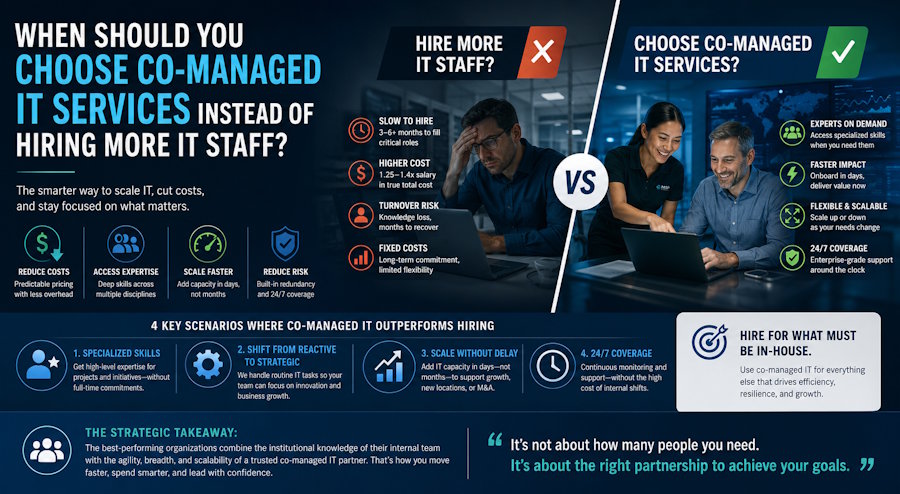
When you factor in benefits, employer taxes, recruitment fees, onboarding, training, licensing, and the productivity lag during ramp-up periods, the total cost of a single mid-level IT professional can easily reach 1.25 to 1.4 times their base salary annually. For senior or specialized roles such as cloud architects, cybersecurity engineers, and compliance specialists, that figure climbs sharply, and competition for qualified talent remains fierce across virtually every sector.
Add to this the risk of turnover. When a key IT employee departs, they take institutional knowledge with them. The organization is exposed. Recovery takes months.
Co-managed IT services, by contrast, provide a predictable, scalable cost model with built-in redundancy. You are not dependent on a single individual. You gain access to a team with collective expertise across disciplines, available at a fraction of the fully loaded cost of equivalent in-house staff.
Four Strategic Scenarios Where Co-Managed IT Outperforms Hiring
1. When You Need Specialized Expertise Without a Full-Time Demand
Your business may require a cybersecurity architect for a six-month compliance initiative, or a cloud migration specialist to lead a platform transition. These are high-skill, high-value engagements, but they do not justify permanent headcount once the initiative concludes.
Co-managed IT gives you access to these specialists precisely when needed, without locking the organization into long-term salary obligations. For senior leaders focused on lean, agile operations, this is a material strategic advantage.
2. When Your IT Team Is Operationally Reactive Rather Than Strategically Focused
One of the most common symptoms of an under-resourced IT department is strategic stagnation. Your internal team is talented, but they are consumed by helpdesk tickets, routine maintenance, and firefighting. There is no bandwidth for digital transformation, infrastructure modernization, or competitive technology initiatives.
Co-managed IT absorbs the operational burden, covering routine monitoring, patching, and Tier 1 and Tier 2 support, freeing your internal team to operate at the strategic level where their organizational knowledge is most valuable. The result is not just relief; it is an elevation of your internal IT function.
3. When Your Organization Is Scaling Faster Than Hiring Can Keep Pace
Rapid growth creates an acute staffing paradox. The business demands more IT capacity immediately, but quality hiring cycles take three to six months, and that is before accounting for onboarding and productivity ramp. The gap between business need and available capability represents a period of real operational risk.
Co-managed IT services scale on demand. Whether you are opening new offices, acquiring a subsidiary, launching a new product line, or expanding into new markets, an MSP partner can extend your IT capacity in days rather than months. For growth-stage enterprises and organizations undergoing M&A activity, this responsiveness is not a convenience; it is a competitive necessity.
4. When 24/7 Coverage Is Required but Cost-Prohibitive to Staff Internally
Round-the-clock IT operations, whether for cybersecurity monitoring, infrastructure availability, or global user support, require shift coverage that is enormously expensive to maintain internally. Staffing three shifts of qualified IT professionals is financially untenable for most organizations outside the enterprise tier.
Co-managed IT providers offer continuous monitoring and support as part of their service model, distributed across their client base in a way that makes the economics fundamentally different. Your organization receives enterprise-grade coverage at a fraction of what internal staffing would cost.
When Hiring Remains the Right Answer
Co-managed IT is not universally superior. There are contexts in which expanding internal headcount is clearly the correct decision.
If your organization requires proprietary system ownership with no external access for compliance or security reasons, internal hiring may be non-negotiable. Similarly, if your IT function is a core competitive differentiator and your technology capability is effectively your product, then building deep internal bench strength remains strategically sound.
The key is intentionality. Hire for the roles where internal ownership creates irreplaceable long-term value. Leverage co-managed services for everything else.
A Framework for Executive Decision-Making
When evaluating whether to hire or engage a co-managed IT partner, senior business leaders should pressure-test the decision against three dimensions:
- Urgency: Can you afford a four-to-six-month hiring and onboarding cycle, or do you need capability now?
- Duration: Is this a permanent, ongoing need, or is it project-based and time-bound?
- Specialization: Does this role require depth that justifies full-time salary and benefits, or is periodic expert access sufficient?
If the answers point toward speed, flexibility, and cost efficiency, co-managed IT services deserve serious consideration as the primary vehicle, not a fallback option.
The Strategic Takeaway
The organizations that will lead in the next decade are not those with the largest IT departments. They are those with the most intelligently structured IT capabilities, combining the institutional knowledge of a strong internal team with the agility, breadth, and scalability that a trusted co-managed partner provides.
For senior business and technology leaders, the question is no longer simply how many people do we need? The more precise and strategically consequential question is: What combination of internal talent and external partnership best positions us to execute our business objectives?
Co-managed IT services, when chosen deliberately and structured well, are not a compromise. They are a force multiplier.

