

If you work on software for a business that sells physical products, whether that's a manufacturer, a wholesaler, a retailer, or a brand managing its own catalog, the product data problem will find you eventually. It usually lands on your desk as a concrete task: the mobile app shows stale prices, the marketplace feed has incorrect descriptions, or someone needs product data normalized across three internal systems that were never designed to talk to each other. The underlying issue is almost always the same: product data lives in too many places, is maintained by too many people, with no single authoritative source.
This is what Product Information Management (PIM) systems are built to solve. Not the storage of product data (any database can do that), but the consistency, completeness, and distribution of it across multiple channels. Wrong product titles on Amazon, outdated specs on the website, missing translations in the mobile app: these are PIM problems, not database problems.
What a PIM Actually Is
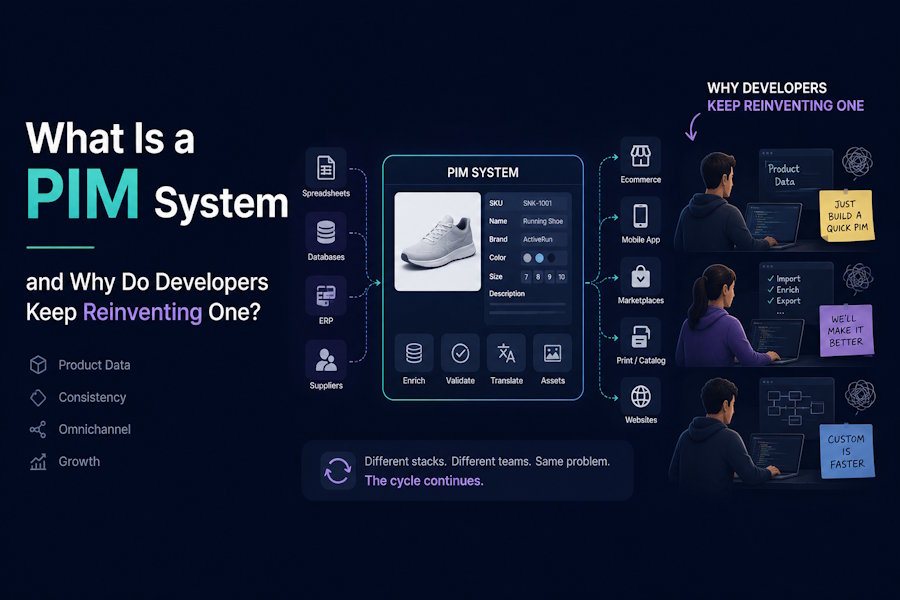
From a developer's perspective, a PIM is a centralized application layer that sits between your raw product data and every channel that needs to consume it. It stores structured product information: names, descriptions, attributes, media assets, variants, pricing rules, categorization, and localization. It then exposes that data outward through APIs, feeds, or direct integrations.
The key distinction from a plain database or a CMS is that a PIM is purpose-built for the specific complexity of product data: attribute inheritance, product families, channel-specific field mapping, bulk imports, multi-locale content, and publication workflows. These aren't features you'd naturally land on when designing a product table from scratch, and that gap is exactly where the hidden cost of rolling your own lies.
Where PIM Fits in a Typical Stack
A PIM generally sits upstream of your customer-facing systems. It receives data from internal sources (ERP systems, supplier feeds, internal content teams), enriches and validates it, and then pushes it downstream to wherever it needs to go: an e-commerce platform like Shopify or Magento, a marketplace connector for Amazon or eBay, a headless CMS, a mobile app backend, or an export file for print production.
The PIM is not a storefront. It's not a CMS in the traditional sense. It's the authoritative internal source of truth for what a product is, so that everything else can be consistent about how it's presented.
Build vs. Adopt: Why Custom Rarely Wins
The instinct to build your own PIM is understandable. Developers like control, and a custom solution seems like it'll fit the exact shape of the data model. The problem is that the shape of product data is almost always more complicated than it looks from the outside.
Versioning product content without breaking downstream consumers is hard. Supporting multiple locales with fallback logic is harder. Bulk imports that handle attribute conflicts gracefully, channel-specific publication rules, complete audit trails, variant management at scale: none of these are quick features to bolt on. A small team that sets out to build "a simple internal product tool" has often spent six months on it before realizing they've been rebuilding a PIM from scratch, badly.
For a business, the calculus is fairly clear: a custom PIM is a distraction from the actual product. The engineering time, maintenance overhead, and opportunity cost rarely justify it when solid alternatives exist. The exception is genuinely unusual data models, such as hardware with deeply nested technical specifications, scientific product databases, or niche industry schemas that don't map to standard PIM concepts. For those cases, a custom build may be necessary. But for the vast majority of e-commerce, wholesale, or marketplace use cases, the problem has already been solved.
Open Source as the Middle Ground
For developers who want control and the ability to extend or self-host, but recognize that a full custom build is overkill, open-source PIM systems offer a practical middle ground. You get a working, battle-tested foundation (data model, UI, API, import/export pipelines) and can modify it freely to fit your specific requirements.
The catch is that "open source" in the PIM market requires some scrutiny. Several well-known PIM vendors lead with an open-source pitch that functions more like a freemium hook: the core is technically open, but the API is paywalled, essential features like multi-channel publishing are locked behind a paid tier, and self-hosting on anything other than their own infrastructure comes with significant friction.
The way to tell genuine open source from open-core marketing is straightforward: check what's actually in the public repository. Can you run the full system from the repo alone, without a license key? Is the installation documentation complete enough to get a working instance running without contacting the vendor? Does the license contain any clauses that restrict commercial use, modifications, or self-hosted deployments? Can you find independent deployments or forks of the project, or does every mention of it lead back to the vendor's own website? These are the questions worth asking before committing to any open-source PIM.
Two Genuinely Open-Source Options
Two projects in this space are worth knowing about if you're evaluating truly free, self-hostable PIM systems.
AtroPIM
AtroPIM is developed by AtroCore, a software company based in Regensburg, Germany, founded in 2020. The system is built on a PHP-based platform called AtroCore and comes with an API-centric, single-page application architecture. The entire codebase is available on GitHub under an open-source license, and the core system (including unlimited data records) is genuinely free with no hidden tier required to unlock basic functionality.
AtroPIM covers the expected PIM feature set: attribute and product family management, categorization, channel-specific publishing, multi-locale support, CSV and API-based import/export, and a configurable data model that can be adjusted directly from the admin interface without writing code. Optional paid modules exist to extend functionality, but the base system is fully usable without them. The project is actively maintained, with AtroCore offering commercial support packages for teams that need them.
UnoPIM
UnoPIM is an open-source PIM built on Laravel, developed by Webkul, an Indian software company with a long history in e-commerce tooling. The project is published under the MIT license and is built with PHP, Laravel, Vue.js, Tailwind CSS, MySQL, and Redis, which is a familiar stack for a large portion of the PHP web development community.
It covers the core PIM feature set: multi-channel publishing, multi-locale content, RESTful API access, CSV and XLSX import/export, and role-based user management. More recently, it has added AI-assisted content generation via integrations with several LLM providers. The full core system is available without a paid license, and the repository contains what you need to get a self-hosted instance running. The project is relatively young, though, and the documentation reflects that in places, so expect some gaps if you stray from the standard installation path.
Conclusion
PIM is one of those layers of the stack that developers tend to underestimate until the moment they're personally responsible for why product descriptions on three channels don't match. The problem is real, the complexity is significant, and the case for building a custom solution from scratch is weaker than it usually feels in the planning phase.
Open-source systems remove the binary choice between building your own and paying for an enterprise platform. Both AtroPIM and UnoPIM represent genuinely free starting points that a developer team can deploy, customize, and integrate without vendor lock-in or hidden licensing costs. For most teams, that's a much better use of engineering time than starting from a blank schema.

