

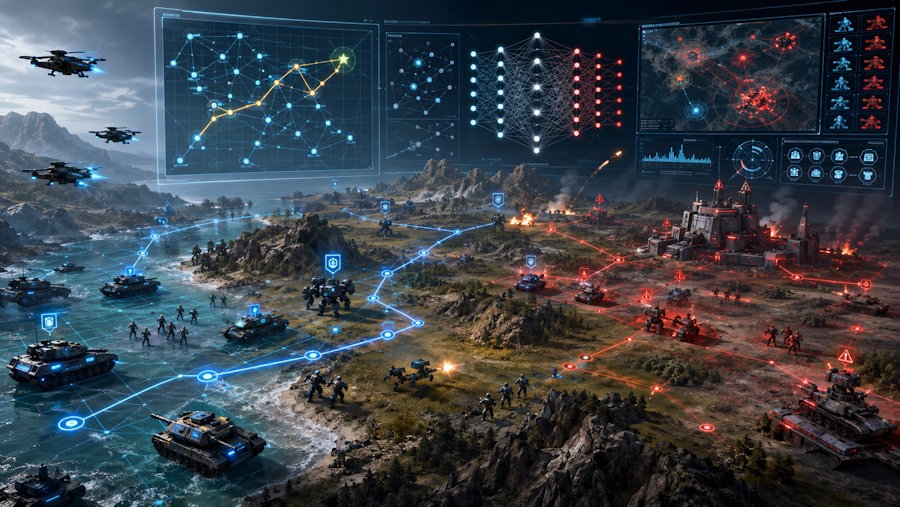
Strategy games sit at an interesting intersection of game design and computer science. The genre demands AI systems that can plan over long horizons, manage hundreds of agents simultaneously, weigh competing priorities and adapt to player behavior across hours of play. An AI gaming companion can similarly use these capabilities to assist players through dynamic, context-aware interactions. The algorithms that make this possible have evolved into a substantial body of practical work that draws on classical computer science, modern decision theory and a fair amount of engineering pragmatism. For developers interested in how the strategy genre functions under the hood, the algorithmic stack is worth understanding in detail.
The foundational layer is pathfinding. Before any tactical or strategic reasoning can happen, units in a strategy game need to know how to get from point A to point B without walking through walls, falling off cliffs or colliding pointlessly with friendly units. Pathfinding remains one of the most studied problems in game development, and the standard solution has been the A* algorithm in its various refined forms. The Global Gaming Industry will grow USD 510.69 Billion by 2031.
A* and the pathfinding revolution
The A* algorithm, first published by Peter Hart, Nils Nilsson and Bertram Raphael in 1968, is the workhorse of game pathfinding. It works by maintaining an open list of candidate path nodes and a closed list of evaluated ones, expanding nodes in order of estimated total cost (the cost so far plus a heuristic estimate of the remaining path to the goal). The heuristic is what makes A* fast: a well-designed heuristic dramatically reduces the search space compared to naive Dijkstra's algorithm, while remaining admissible enough to guarantee an optimal path when one exists.
In production strategy games, raw A* is rarely deployed unmodified. The implementations that ship are usually layered with optimizations: hierarchical pathfinding (HPA*) to handle large maps efficiently, jump point search (JPS) for grid worlds, navigation meshes (NavMesh) for continuous spaces, and various forms of path smoothing and post-processing to make the resulting movement look natural. Popular real-time strategy releases and major desktop titles such as Age of Empires IV, Company of Heroes 3 and the Total War series rely on heavily optimized variants of these techniques to keep hundreds of units moving smoothly across complex terrain.
From pathfinding to tactical AI
Pathfinding solves only the "how do I get there" problem. Strategy AI also has to handle "what should I do" and "what should I do next," which is where the field becomes more algorithmically interesting. The dominant tools for tactical AI are behavior trees and goal-oriented action planning (GOAP).
Behavior trees, common in the tactical AI behind war games online and similar real-time strategy releases, are hierarchical decision structures that encode unit behavior as a tree of nodes, each representing either a condition to check, an action to perform or a control-flow node that determines how children are evaluated. They became popular because they are easy to author, easy to debug and modular enough for designers to edit without breaking the rest of the AI. Halo 2 famously popularized the technique for FPS combat, and the strategy genre adopted it widely afterward, with implementations across multiple languages following the same patterns seen in other classical algorithm work.
GOAP takes a different approach. Instead of pre-defining decision logic, GOAP gives each agent a set of available actions with preconditions and effects, then lets the AI plan a sequence of actions to satisfy a goal. The classic implementation comes from F.E.A.R., but the same techniques have spread into strategy AI where individual unit goals (capture this point, retreat to base, support an ally) can be solved with planning rather than hardcoded logic.
Strategic AI at the macro level
The strategy genre's most distinctive AI challenge sits at the macro level. A 4X game like Civilization or Stellaris has to model economic decisions, diplomatic stances, military expansion priorities and long-term plans across hundreds of turns. The algorithms here look less like classic pathfinding and more like decision theory and search. Minimax with alpha-beta pruning powers turn-based combat resolution. Influence maps approximate territorial control. Utility-based AI systems weigh competing priorities (build economy, build military, develop technology) using continuously evaluated score functions.
The macro AI for major 4X titles is often the most resource-intensive part of the entire game. The decision logic that runs between turns in a late-game Civilization match can take seconds of compute time even on modern hardware, and the design tradeoff between AI quality and turn responsiveness is one of the genre's persistent engineering challenges.
Engines, tooling and the practical stack
The tooling around strategy AI has matured considerably over the past decade. Unity ships with a built-in NavMesh system, and asset store offerings like the A* Pathfinding Project cover most pathfinding needs out of the box. Unreal Engine includes navigation, behavior tree and environment query system (EQS) tooling natively. Independent developers building 2D strategy titles have a range of options when picking the best game engine for 2D games, with Godot, Unity 2D, Defold and MonoGame all offering credible support for the genre.
Why machine learning is finally entering the strategy AI playbook
The classical algorithms covered above still power the majority of strategy AI shipping today, but machine learning has begun to make serious inroads. DeepMind's AlphaStar demonstrated that reinforcement learning could reach professional human level in StarCraft II, and the techniques behind it are gradually filtering into commercial development. The current generation of strategy AI work mixes classical pathfinding and behavior trees with learned subsystems that handle specific tasks better than handcrafted logic could. The next decade will likely see hybrid systems become the norm, with A*-style pathfinding still handling the deterministic geometric work, behavior trees and GOAP covering the structured decision logic, and learned models taking on the parts of strategy AI too messy to encode by hand. The discipline is changing fast, but the fundamentals built over the past five decades are not going anywhere.

