

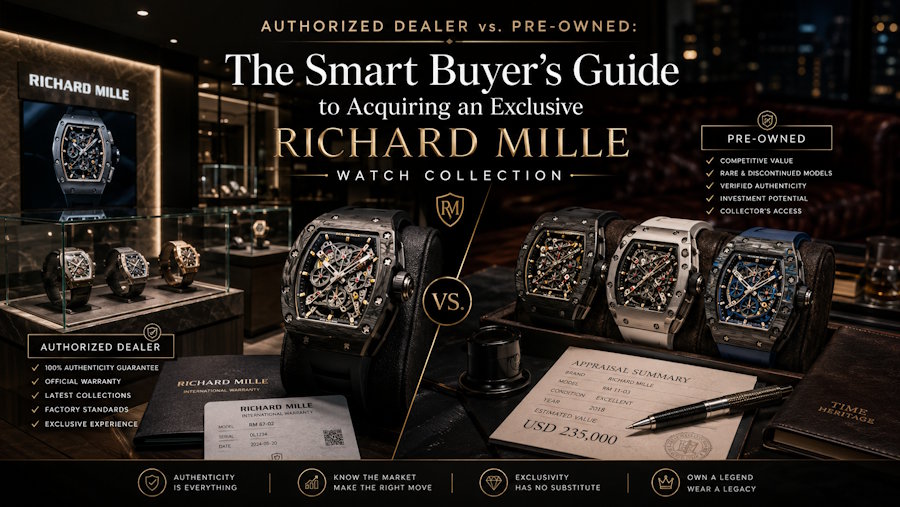
Spend enough time in serious watch circles and you'll hear the same frustration repeated: someone walks into an authorized dealer for a specific reference, gets told it's unavailable, and is quietly encouraged to buy something else first. For certain brands, particularly Richard Mille, that dynamic isn't the exception. It's the standard.
For first-time luxury watch buyers, this creates a genuine dilemma. The authorized dealer feels like the "safe" choice. The pre-owned market feels like a compromise. But that framing is often wrong, and it can cost buyers real money, real time, and real opportunity.
This article breaks down both routes honestly, covering waitlists, pricing transparency, access, and total cost of ownership, so you can make an informed decision rather than a reflexive one.
The Authorized Dealer Experience: What You're Actually Getting
The Prestige (and the Reality)
Authorized dealers (ADs) represent a direct relationship with the brand. You're buying new, factory-fresh, with full manufacturer warranty. For some buyers, that matters enormously, and for good reason. The provenance is unquestionable, the warranty is intact, and the retail experience is designed to feel premium.
But "authorized" does not mean "available."
For brands like Richard Mille, Patek Philippe, and Audemars Piguet, the most sought-after references are routinely allocated in quantities that bear no relationship to demand. A boutique might receive a handful of RM 11-03 flyback chronographs in a year, if that. The Patek 5711 nautilus situation before its discontinuation became almost comical in how widely it was discussed across publications like Robb Report and Hodinkee.
Waitlists: What They Really Mean
The waitlist conversation is worth understanding clearly. For top references at authorized dealers:
- There is rarely a formal, transparent queue
- Priority is often given to clients with existing purchase history at that boutique
- "Relationship buying" is real: buying a less desirable piece to earn access to a more desirable one is common practice
- Wait times for certain references can stretch from one to several years, with no guarantee of allocation
This is not a criticism of ADs specifically. It's the reality of how ultra-luxury brands manage scarcity as part of their brand strategy. But for a first-time buyer without an established dealer relationship, the authorized route for a specific coveted reference is often a dead end in practice, not just in theory.
Pricing at Retail: The Floor, Not the Ceiling
Retail price sounds straightforward. You pay the manufacturer's suggested retail price. But for watches trading significantly above retail on the secondary market, buying new at MSRP sounds like a win.
Here's the complication: you often can't, unless you have the right relationship. And even when you can, some of these pieces appreciate so quickly after purchase that the "savings" versus secondary market pricing is smaller than it appears once you factor in the time spent waiting and the opportunity cost of capital.
The Pre-Owned Route: Reframing the Compromise
Access Is the Defining Advantage
The secondary market's most important feature isn't price. It's availability. When a collector decides to sell their RM 035 Americas, or an estate liquidates a Patek 5726A annual calendar, that watch becomes available to anyone willing to pay market value, regardless of purchase history or boutique relationship.
For buyers targeting specific references, this matters more than almost any other factor. The pre-owned market is where you find what you actually want, on a timeline that works for you, rather than waiting indefinitely for an allocation that may never come.
Reputable pre-owned dealers who specialize in ultra-luxury references, like Wrist Aficionado, combine authentication protocols with global sourcing networks that no single authorized dealer can match. That reach is the core practical value for collectors hunting specific pieces.
Pricing Transparency in the Secondary Market
Pre-owned pricing has a reputation for opacity. And historically, that reputation was partly earned. But the market has matured significantly.
A few factors now make secondary market pricing more transparent than many buyers expect:
- Public pricing databases: Platforms like Chrono24 and WatchCharts aggregate real transaction data, so buyers can benchmark any reference before committing
- Auction records: Major houses (Christie's, Phillips, Sotheby's) publish realized prices, creating public reference points for key references
- Dealer pricing consistency: Established dealers publishing inventory online have incentive to price competitively, because comparison is one browser tab away
The result is that a prepared buyer today can walk into a pre-owned transaction knowing roughly what a fair price looks like. That wasn't always true a decade ago.
Condition, Authentication, and What to Actually Verify
The legitimate concern with pre-owned purchases is condition and authenticity. Both are real issues that deserve serious attention, not dismissal.
On authenticity: the counterfeit problem is real, particularly for Richard Mille, which commands prices that make faking worthwhile. This is why working with dealers who perform documented authentication processes matters. A piece should come with clear detail on its authentication procedure, ideally including case number verification, movement inspection, and material testing for cases involving carbon composites or titanium.
On condition, key factors to review include:
- Case and bezel condition: Polishing history matters. Original brushed surfaces that have been re-polished can reduce value meaningfully
- Dial originality: Confirmed unrestored dials are worth more to collectors
- Service history: Full documented service history is ideal; incomplete records aren't a dealbreaker but affect value
- Box and papers: For most references, original box and papers add 10-20% to value at resale
None of these concerns are reasons to avoid pre-owned purchases. They're reasons to buy from sources that address them transparently.
Total Cost of Ownership: Running the Real Numbers
What "Retail Price" Actually Costs You
For a Richard Mille reference trading at, say, $250,000 retail but sitting at $300,000-plus on the secondary market (which describes a significant portion of the RM catalog), buying at retail sounds like a $50,000 advantage. But:
- If you spend 18 months cultivating a dealer relationship to get the allocation, the cost of time is real
- If you buy other pieces to earn priority, those purchases have their own costs
- If the watch continues to appreciate during your wait period, the "savings" narrows
Pre-owned in this scenario may be the more economically rational path, particularly if you're buying as a collector rather than an investor.
Depreciation and Resale Value
Standard consumer logic says "new depreciates immediately." For most products, that's true. For ultra-luxury watches from brands with constrained supply, it often isn't.
Well-maintained pieces from Richard Mille, Patek Philippe, and Audemars Piguet have historically held or increased their value on the secondary market. Buying pre-owned from a documented source doesn't meaningfully harm resale potential compared to retail, particularly if box and papers are included.
The realistic depreciation risk is higher for mid-tier luxury watches and for references with lower demand. For the most coveted pieces, pre-owned buyers face minimal depreciation risk, assuming they buy at fair market value from a credible source.
When the Secondary Market Is the Smarter Choice
For first-time buyers targeting specific high-demand references, the secondary market is often not a fallback. It's the primary route that actually works. Here's when it makes the clearest sense:
- You want a specific reference, not whatever the AD has in stock
- You don't have an existing boutique relationship and don't want to spend years building one
- You're looking at a discontinued reference that simply isn't available new
- The retail-to-secondary price gap is close enough that availability outweighs any marginal savings
- You're targeting vintage pieces or early production references that have additional collector significance
For buyers exploring Richard Mille specifically, browsing an exclusive Richard Mille watch collection curated by a specialist dealer gives you a real sense of what's actually available at any given moment, rather than what a boutique might theoretically source in the future.
Key Takeaways
- Authorized dealers offer warranty and new condition, but access to the most coveted references depends heavily on existing client relationships, which first-time buyers often don't have
- The pre-owned market provides immediate access to specific references, often with competitive pricing once you account for the real costs of waiting for retail allocation
- Secondary market pricing is more transparent than many buyers assume, thanks to public pricing databases and auction records
- Authentication and condition verification are legitimate concerns, but they're solvable by buying through reputable specialists with documented processes
- For ultra-high-demand references from brands like Richard Mille, pre-owned purchases carry lower depreciation risk than most buyers expect
FAQ
Is buying pre-owned a red flag for high-value watches?
Not at all, and most serious collectors would tell you the opposite. The pre-owned market is where sophisticated buyers access specific references, discontinued pieces, and early production variants that simply aren't available through retail channels. The key is buying from a dealer with a documented authentication process and transparent condition reporting.
How do I know if a pre-owned Richard Mille is authentic?
Authentication for Richard Mille should include case number verification against manufacturer records, movement inspection by a qualified watchmaker, and material verification for composite cases. Reputable dealers perform these checks as standard and should be able to walk you through their process in detail. If they can't, that's a signal to look elsewhere.
Do pre-owned watches come with any warranty?
This varies by dealer. Many reputable pre-owned specialists offer their own warranty periods, typically 12 to 24 months, covering movement function. This isn't identical to a manufacturer warranty, but it provides meaningful protection. Always clarify warranty terms before purchasing.
Does buying pre-owned hurt resale value compared to buying new?
For high-demand references from top-tier brands, the difference is minimal, particularly when box and papers are included. Public resale data shows that authenticated pre-owned pieces from documented sources trade at comparable levels to pieces with full retail history, assuming condition is equivalent.
When should I buy through an authorized dealer instead?
If the reference you want is readily available at retail, if you value the manufacturer warranty specifically, or if you're buying a brand where the pre-owned market is less developed and authentication is more complex, the AD route makes clear sense. For mainstream luxury references with strong secondary market infrastructure, both routes deserve equal consideration.
Conclusion
The authorized dealer versus pre-owned debate isn't really a debate at all for most serious collectors. It's a question of what you're trying to accomplish. If you want a specific, hard-to-allocate reference on a timeline that works for you, the secondary market is almost always the more practical path. Not a compromise, just a smarter approach.
First-time buyers tend to assume that "new from an AD" is inherently safer. In practice, a well-authenticated pre-owned piece from a specialist dealer with documented provenance and clear condition reporting can be just as secure, and significantly more accessible. Do the research, understand what fair market value looks like for your target reference, and work with sources who can answer detailed questions without hesitation.
For reference, exploring what's currently available through a respected specialist like Wrist Aficionado gives a useful benchmark for how the pre-owned market operates at the higher end of the price spectrum.

