

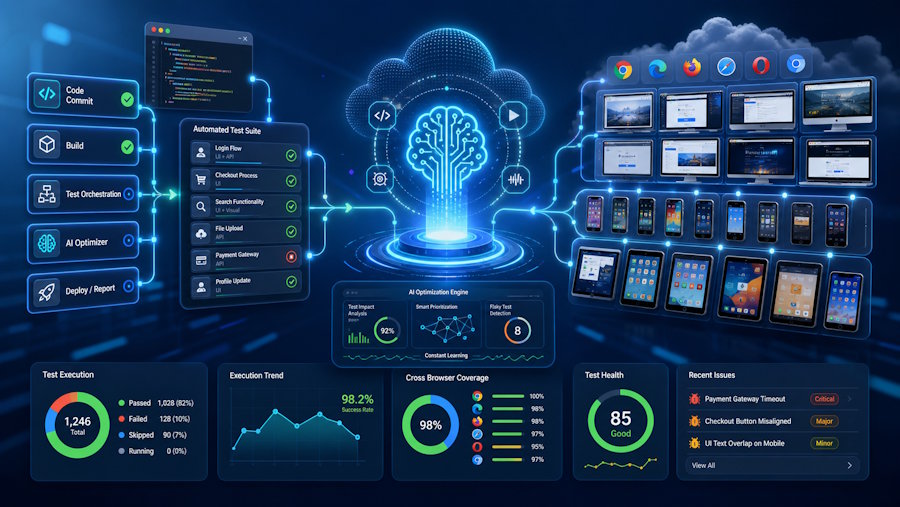
For years, teams struggled with how to test applications systematically without decreasing delivery speed. LambdaTest provided a cloud-based solution that modified how organizations executed automation testing. It brought scale, simplicity, and speed to a process that had long been requiring high-maintenance and was time-consuming.
In January 2026, LambdaTest came with a new identity, that is TestMu AI. It was not an update, but a complete evolution in what the platform represents. Where LambdaTest focused on executing tests efficiently, TestMu AI focuses on making testing intelligent.
This article walks through that journey, from where LambdaTest began to what TestMu AI means for automation testing today.
What Did LambdaTest Offer For Automation Testing?
The concept behind the LambdaTest platform, when it was founded in 2018, was very simple yet innovative. Cross-browser testing was both resource-intensive and time-consuming.
Organizations needed to invest in hardware, set up, and spend hours configuring everything for the test to start. However, LambdaTest redefined everything by moving things to the cloud.
By the year 2023, LambdaTest had processed around billions of tests per year in over 90 nations. By then, it became one of the heavily relied-upon cloud testing platforms worldwide. Its automation-driven features were much more than just executing tests in different web browsers.
It was a unified platform for all steps in the testing workflow. Here are some reasons why it was widely adopted by automation testing teams:
- Cross-Browser Testing- Teams gained direct access to over 3000 browser and OS combinations on the cloud. Application behavior could be validated across configurations without any manual setup. Every test is run in a consistent, reliable cloud-based system.
- Real Device Cloud- Actual Android and iOS devices were made available for remote testing. Testers could run automation scripts on production-grade hardware rather than depending on emulators. This gave far more accurate results for mobile application testing.
Parallel Test Execution- Multiple tests could run in parallel across various configurations at once. Large test suites that once took hours were completed in drastically reduced duration. Faster execution meant development teams received the validation report much quicker. - Accessibility Testing- Built-in accessibility audits helped teams figure out standardization gaps early. Applications could be validated against usability guidelines without slowing down releases. This ensured that the platform was broadly accessible and efficient for all users from the beginning.
These features made LambdaTest automation testing a trusted platform for automation testing at scale. However, one thing still required high manual involvement: creating and managing the tests themselves. As development progressed rapidly, that gap started to show.
Why Did LambdaTest Transform To TestMu AI?
The transformation did not come from within the platform. It came from a change happening around. AI-assisted development tools began allowing developers to automate code creation, build features, and release updates at an unmatched pace. Testing workflows, still largely dependent on manual scripts, could not remain competitive.
This created a clear process gap. Code was being written quicker than it could be tested. The manual work required to maintain, write, and fix test scripts became an obstacle. LambdaTest recognized that simply running tests faster was no longer enough. The way tests were created and maintained had to change entirely.
Three specific pressures made this shift urgent:
- Flaky Test Scripts- The test scripts would break every single time there was even a slight change in any UI element or any updates to the application. The amount of time being spent fixing test scripts was greater than the time spent running them.
- Fragmented Workflows- There was fragmentation within the entire testing process due to the use of various tools for testing, analyzing, and generating reports from results. The testing process data was scattered on various platforms, making it impossible for anyone to track their progress.
- Scaling Limitations- With applications becoming increasingly complex, test scripts were difficult to manage. Adding more tests without compromising the functionality of already existing test scripts became increasingly difficult.
These pressures collectively pointed toward one conclusion: automation testing needed to become intelligent, not just fast. LambdaTest began building toward that conclusion with the introduction of KaneAI in August 2024. That was the first clear signal that the platform was evolving into something fundamentally different.
Automation Testing with TestMu AI: What Changed?
When TestMu AI was made public on January 12, 2026, it brought with it a completely re-architected platform. The focus shifted from test execution to test intelligence. Autonomous AI agents were presented across various stages of the testing lifecycle. Manual intervention, which had long been inevitable, was now something the platform proactively worked to eliminate.
The new capabilities introduced under TestMu AI include:
- KaneAI- The world's first GenAI-native end-to-end testing agent was made central to the platform. Testers can now describe what they want to test in plain English and receive executable test steps instantly. Natural language replaced scripting as the primary interface for automation testing.
- HyperExecute- A next-generation test orchestration engine was introduced to dramatically speed up execution. Tests run up to 70% faster than on traditional automation grids. Intelligent distribution across configurations ensures optimal use of available resources.
- SmartUI- Visual regression testing was introduced to catch UI discrepancies automatically. Even the smallest visual changes across browsers and viewports are detected and flagged. Testers no longer need to manually compare screenshots across releases.
- Vibe Testing- A new testing approach was introduced for developers who build using AI tools. These developers move fast and need testing that matches their pace. KaneAI's agents support this style of development by enabling testing at the speed of thought.
- Agent-to-Agent Testing- TestMu AI was the first automation testing tool that allowed testing of AI agents themselves. Conversational agents, along with voice assistants and other systems driven by AI, can undergo testing in practical conditions. Uniformity, accuracy, and performance can all be assessed automatically.
- Enhanced Accessibility Testing Suite- TestMu AI made accessible testing tools much more intelligent and continuous. It means that teams can ensure adherence without introducing added workload into their release workflow.
The recognition from both the 2025 Gartner Magic Quadrant for AI-Augmented Software Testing Tools and the Forrester Wave for Autonomous Testing Platforms confirmed this strategy. TestMu AI was not just changing its name; it was setting a new benchmark for what automation testing platforms could be.
What Does This Transition Mean For Users Today?
For testers and developers who are just starting, TestMu AI decreases the difficulty of automation greatly. Writing scripts from scratch is no longer the only starting point for automated-driven testing. KaneAI's natural language interface means anyone can begin authoring tests from day one. The learning curve that once came with automation testing has been reduced.
For teams already experienced with automation, the transition adds intelligence to workflows they already trust. Here is what the shift means in practical terms for users at every level:
- Self-Healing Tests- When the application changes, KaneAI identifies the affected tests and updates them automatically. Testers no longer need to manually hunt down and fix broken scripts after every release. Test suites stay current without constant human oversight.
- Faster Feedback for Developers- HyperExecute delivers results up to 70% faster than standard execution grids. Developers receive test feedback beforehand in the development cycle. Issues are detected and handled before they reach production.
What Remains the Same?
One of the most important aspects of this transition is what has not changed. TestMu AI was built to extend LambdaTest, not replace it. Every workflow, integration, and framework that teams relied on under LambdaTest continues to work exactly as before. There is no disturbance to existing automation structures.
- All Frameworks Still Supported- Selenium, Playwright, Cypress, Appium, and Puppeteer remain fully consistent with the platform. Existing automation scripts function without any changes or reconfiguration. Teams can continue their current workflows while gradually exploring new capabilities.
- Real Device Access Continues- The full library of real Android and iOS devices remains available for remote testing. All previously supported device and OS combinations are still accessible. Mobile automation workflows continue without any adjustments needed.
- Cross-Browser Coverage Unchanged- Access to over 3000 browser and OS combinations remains fully available. Teams can validate application behavior across configurations exactly as before. No modifications in the existing cross-browser test layout are required.
Conclusion
LambdaTest gave automation testing something it had long required: a cloud-based platform that reduced the complexity of handling local setups. It made reliable, scalable test execution available to organizations of every size. For years, it served as the foundation on which countless automation workflows were built. That foundation remains fully intact today.
TestMu AI builds on that foundation with a layer of intelligence that changes what automation testing can accomplish. It is no longer just about executing tests at a faster rate; it is about making testing more adaptive, smarter, and more convenient. TestMu AI offers a starting point that is both familiar and forward-looking in its capabilities.

