

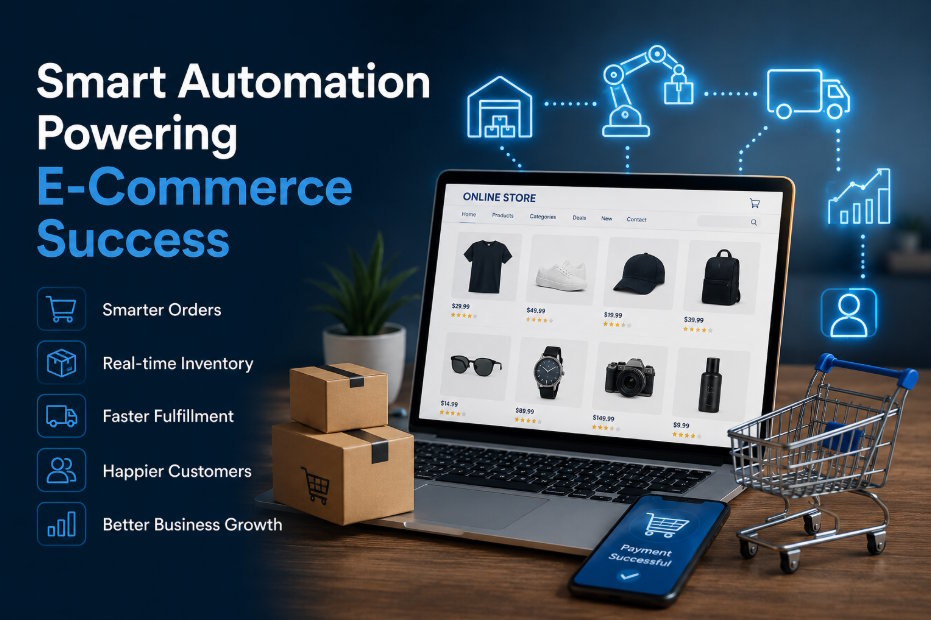
Most people think e-commerce is all about the website.
They notice the product photos, the checkout page, the discount codes, and maybe the delivery tracking link. If everything works smoothly, they rarely think about what happens after clicking the "Buy Now" button.
But that single click triggers a surprising amount of activity behind the scenes.
An inventory system checks stock levels. Payment platforms verify transactions. Warehouse teams receive instructions. Shipping providers get updated automatically. Customer records change in real time. Marketing tools begin collecting new data that might influence future recommendations.
The customer sees a simple shopping experience. The business sees dozens of connected systems working together.
As online shopping becomes more competitive, the businesses that succeed are often the ones that make these invisible operations run efficiently.
E-Commerce Has Become a Speed Game
A few years ago, customers were willing to wait several days for a response to a support request or a week for a package to arrive.
Today, expectations are very different.
Customers want fast shipping, quick answers, accurate stock information, and personalized experiences. They expect online stores to remember their preferences and make relevant recommendations.
The challenge is that customer expectations continue to increase while businesses try to keep costs under control.
Hiring more employees can help for a while, but eventually growth creates complexity. More orders mean more opportunities for mistakes. More products mean more inventory management. More customers mean more support requests.
At a certain point, businesses need systems that can handle the workload without requiring constant manual intervention.
That is why automation has become one of the most important investments in modern e-commerce.
The Best Technology Is Often Invisible
Many business owners assume innovation means launching a flashy new website feature.
Sometimes it does.
But some of the most valuable improvements happen where customers never see them.
Imagine a business that receives 500 orders every day.
If employees manually process each order, update inventory spreadsheets, create shipping labels, and send confirmation emails, the process quickly becomes overwhelming.
Now imagine those same tasks happening automatically.
Orders flow directly into fulfillment systems. Inventory updates instantly. Customers receive tracking information without anyone touching a keyboard.
Nothing changes from the customer's perspective except that everything feels faster and more reliable.
That is often what great technology looks like. It quietly removes friction.
Finding Problems You Didn't Know Existed
One of the most difficult parts of running an online store is identifying what is slowing things down.
Many businesses know they have inefficiencies but struggle to pinpoint where they originate.
Maybe orders are taking longer to ship.
Maybe customers abandon carts more frequently than expected.
Maybe support tickets keep increasing.
The problem is that these issues often involve multiple departments and systems.
This is why many companies have started using process mining software.
Instead of relying on assumptions, these tools analyze actual operational data and show how work moves through an organization.
Business leaders can see exactly where delays occur, where approvals take too long, or where processes become unnecessarily complicated.
Sometimes the biggest improvements come from discovering bottlenecks that nobody realized existed.
Customers Expect Personalization Now
Remember when online stores treated every visitor the same?
Those days are largely gone.
Customers have become accustomed to personalized experiences.
If someone buys running shoes, they expect recommendations for related products. If they browse a category multiple times, they expect to see relevant suggestions later.
This level of personalization used to require large marketing teams and extensive manual work.
Today, much of it happens automatically.
Artificial intelligence helps businesses understand customer behavior, identify patterns, and deliver more relevant experiences.
The goal is not simply to sell more products.
It is to make shopping easier by helping customers find what they actually want.
When personalization is done well, it feels helpful rather than intrusive.
Growth Creates New Challenges
One of the most exciting moments for an e-commerce business is seeing sales increase.
Ironically, growth can also create serious operational problems.
A company that comfortably handles 50 orders per day may struggle with 500.
Warehouse operations become more complicated.
Customer inquiries increase.
Inventory management becomes more difficult.
Shipping costs become harder to control.
Many businesses discover that the systems that helped them get started are not strong enough to support long-term growth.
This is often when technology becomes a strategic priority instead of simply a support function.
The companies that scale successfully usually invest in better processes before problems become crises.
Real-World Operations Still Matter
E-commerce often feels like a purely digital industry, but physical infrastructure remains extremely important.
Products still need to be stored, packed, and shipped.
Warehouses need electricity, equipment maintenance, and reliable facilities.
Businesses operating internationally frequently depend on local specialists to keep operations running smoothly.
For example, a company managing fulfillment centers in Finland might work with a sähkömies espoo professional to ensure critical electrical systems remain safe and operational.
Customers may never think about these details, but every successful online order depends on a chain of real-world activities happening correctly.
Digital businesses are still businesses in the physical world.
Small Improvements Create Big Results
Many business owners search for a breakthrough idea that will instantly transform performance.
In reality, long-term success usually comes from small improvements repeated consistently.
Think about fitness.
Someone doesn't become stronger after one workout.
Progress comes from showing up repeatedly and improving gradually over time.
A kettlebell is a perfect example. It looks simple, but regular training with proper technique can produce remarkable results.
Business operations work the same way.
Reducing fulfillment time by a few minutes.
Improving inventory accuracy by a small percentage.
Responding to customer inquiries slightly faster.
Optimizing checkout processes.
Each improvement may seem minor on its own, but together they can dramatically improve profitability and customer satisfaction.
The businesses that win are often the ones that never stop refining their processes.
Artificial Intelligence Is Changing the Rules
Few technologies have generated as much discussion as artificial intelligence.
Some predictions are exaggerated, but there is no doubt that AI is already changing how e-commerce operates.
Businesses use AI to forecast demand, generate marketing content, improve customer service, and recommend products.
Customer support teams use AI-powered tools to answer common questions quickly.
Marketing teams use AI to analyze campaign performance and identify opportunities.
Operations teams use AI to predict inventory requirements before shortages occur.
What makes this shift particularly interesting is that advanced capabilities are becoming available to businesses of all sizes.
You no longer need the budget of a global retailer to benefit from intelligent technology.
Small and medium-sized companies now have access to tools that would have seemed impossible just a few years ago.
The Future Belongs to Businesses That Work Smarter
The next phase of e-commerce growth will not be driven solely by bigger advertising budgets or larger product catalogs.
Instead, it will be driven by efficiency.
Businesses that understand their operations, automate repetitive tasks, and use data effectively will have a significant advantage.
Customers may never notice the technology working behind the scenes.
They will simply experience faster deliveries, better recommendations, smoother checkouts, and more reliable service.
And that is the ultimate goal.
The best e-commerce technology is not the technology customers see.
It is the technology they never have to think about because everything simply works.
Meta Title: The Invisible Technology That Keeps Modern E-Commerce Running
Meta Description: Discover how automation, AI, data analysis, and modern operational tools are helping e-commerce businesses scale faster, improve customer experiences, and stay competitive in a rapidly evolving market.

