

Developers building products for the interior design, real estate, or hospitality verticals face a specific content problem that general-purpose development tools do not solve: their applications need spatial visualizations, branded imagery, and ambient audio to demonstrate value, and producing that content at prototype stage usually requires resources the project does not have yet.
A property listing app needs sample interior visualizations before it has real property data. A hospitality management platform needs representative room imagery before a single hotel has onboarded. A home design tool needs ambient audio for its design mode experience before there is a user base to generate it. In each case, the content gap is real and the production timeline for closing it — with traditional design and audio services — is measured in weeks, not hours.
Three AI tools are shortening that gap significantly for developers in this space.
Spatial Visualization Without a 3D Pipeline
The central feature of any product in the interior design or property vertical is the ability to show what a space looks like. Building a proprietary 3D rendering pipeline is one path to this capability, but it is expensive, slow to develop, and requires ongoing maintenance that pulls engineering resources away from the core product.
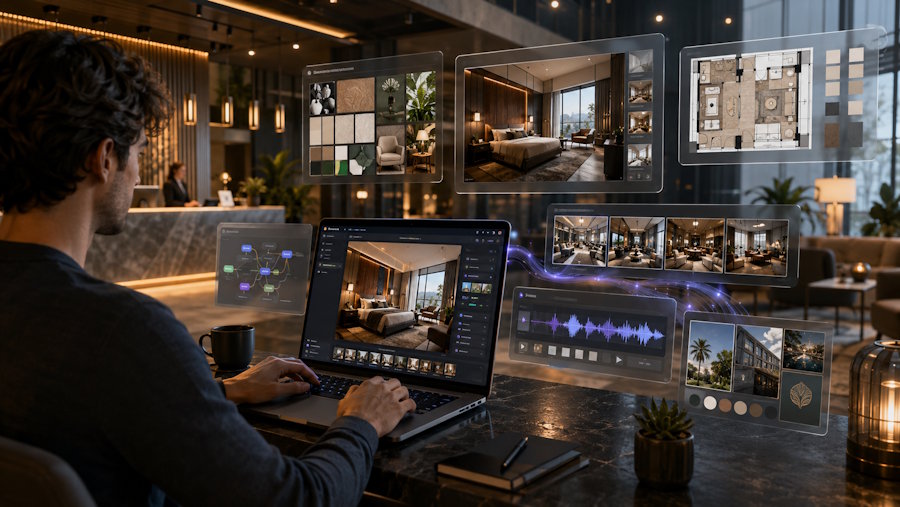
AI interior designer provides spatial visualization as a service. The platform generates photorealistic images of interior environments from text descriptions — specifying the room type, the material palette, the lighting character, and the spatial atmosphere produces a rendered output that reads as real interior photography. For developers prototyping applications in this space, this immediately solves the demo content problem: you can populate your prototype with generated spatial visuals that represent the kind of output your product will eventually produce, without building the rendering infrastructure first.
There are two practical integration patterns worth considering:
Demo and onboarding content. For the first version of a product, hand-generating a set of representative spatial visualizations for different room types, styles, and price points gives the application realistic content that communicates the product's value proposition to early users and investors. This is faster and cheaper than commissioning professional architectural photography.
Feature validation before infrastructure investment. If the spatial visualization feature is the core differentiable value of the product, testing whether users actually engage with it — and in what ways — using AI-generated visualizations as a proxy is a lower-risk approach than building the full rendering pipeline first. Learn what users need before engineering the production-grade version of the feature.
Branded Visuals for Product Marketing and Demo Environments
Developers shipping products in design-adjacent verticals also face the challenge of marketing and presenting the product itself. A dashboard that shows a property management platform needs branded example content. A landing page for an interior design tool needs images that communicate the product's aesthetic intelligence. A pitch deck for a hospitality tech product needs visuals that set the right tone for the investment audience.
Pomelli visual generates on-brand marketing imagery from a brief describing the product, the brand aesthetic, and the intended audience. For a developer or founding team building in this space, this provides a way to produce marketing-quality visual content without contracting a designer for every asset — generating landing page headers, social media cards, App Store screenshots, and investor presentation imagery from a consistent brand brief.
The format flexibility is directly useful in the development context. Generating images sized for specific UI components — a hero banner at a particular pixel dimension, a card thumbnail, a background image at the right aspect ratio — from the same session removes the manual resizing step that adds friction to every round of visual asset production. For developers who are also managing their own marketing, this is the kind of operational efficiency that compounds over a release cycle.
Ambient Audio for Design-Mode Experiences
A detail that design and hospitality applications often get right in late-stage development but should address earlier: the audio environment of the application itself. Tools that put users into a design or selection mode — browsing room styles, configuring space layouts, choosing material palettes — benefit from ambient audio that reinforces the experiential register of the activity. The difference between a silent design tool and one that plays contextually appropriate ambient audio is a perceptible difference in how focused and immersive the experience feels.
Musik audio generates original background tracks from descriptive prompts. For a developer building the ambient audio layer of a design application, this means describing the emotional register of the design mode — calm and focused, slightly elevated to communicate premium positioning, warm and unhurried — and receiving audio built for that specification. The generated audio is owned outright, which removes the licensing overhead that makes background music integration a recurring compliance concern in commercial applications.
The practical integration path is straightforward: generate several audio options for different modes or sections of the application, evaluate them against the actual UI during development, and integrate the best-fitting tracks directly. The iteration cycle is fast enough to include audio evaluation in a regular sprint rather than treating it as a separate production project.
From Prototype to Production
None of these tools replaces the infrastructure that a mature product in the design or hospitality vertical will eventually need. Production-grade spatial rendering, a scalable image generation pipeline, and a professionally managed audio experience are engineering and product investments that become appropriate as the product scales.
What they enable is the stage before that: shipping a prototype that actually demonstrates the product's value, testing assumptions with real users before building the expensive infrastructure, and presenting the product to investors and early customers with the visual and experiential quality that communicates seriousness.
The developers who ship fastest in verticals like these are the ones who learn to use available services to accelerate the early stages while building the differentiated infrastructure only for the things that actually need to be proprietary. These three tools are the kind of services that fit that pattern — capable enough to carry the product through validation, and easy enough to replace or extend once the requirements are better understood.

