

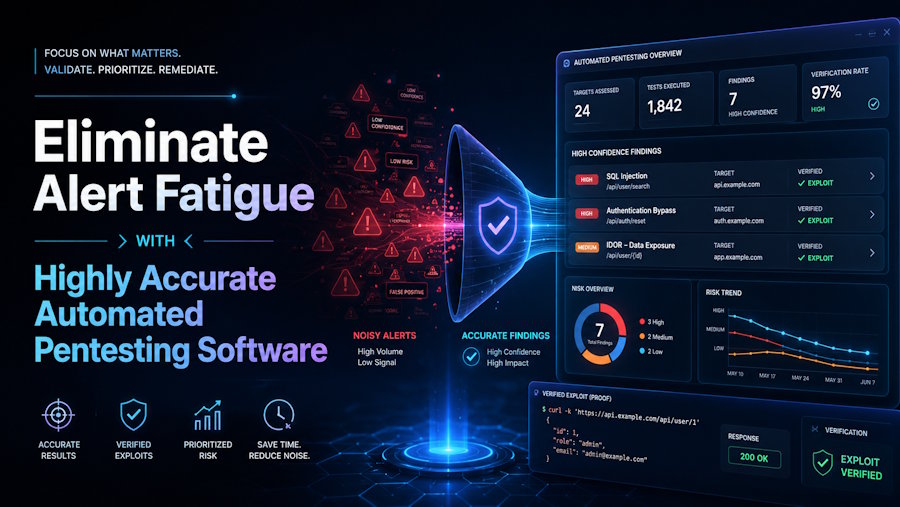
The typical mid-market vulnerability queue is not a prioritization tool; it is an operational hazard. Security teams lose significant time triaging false positives from traditional scanners, turning their daily workflow into a draining exercise of checking boxes rather than stopping threats. When your lean team spends forty hours a week verifying whether a "Critical" alert is actually reachable or just a phantom configuration artifact, the engineering pipeline stalls and real exposure vectors remain unpatched. The 2026 Verizon Data Breach Investigations Report highlights the structural nature of this breakdown, revealing that vulnerability exploitation is now the leading initial access vector, driving 31% of all confirmed breaches. Organizations are simply hitting their manual patching and triaging capacity limit.
This operational bottleneck stems directly from how legacy tools evaluate code and environments. Attackers operate adaptively, adjusting their tactics dynamically as an asset landscape shifts. Conversely, static, rule-based scanning relies entirely on signature matching and theoretical risk metrics, whereas automated penetration testing can simulate more realistic attack behavior and identify exploitable paths. This legacy design fails to mirror how real attack paths unfold across modern web applications.
The Core Deficiencies of Traditional Scanning
Traditional vulnerability scanners provide a flat, context-blind list of vulnerabilities. They flag an outdated library or a missing header without understanding if the underlying machine can execute that code path. In practice, this becomes the real bottleneck for security managers who must defend their remediation requests to engineering leads. If a vulnerability cannot be weaponized within your specific network architecture, routing it to a developer is a waste of scarce resources.
Furthermore, traditional crawlers routinely undertest authenticated flows, complex APIs, and advanced business logic. This is not a niche edge case; it is a known structural gap that creates massive risk exposure. When a scanner encounters a multi-step checkout funnel, a JSON Web Token authorization boundary, or a dynamic API endpoint, it often fails to authenticate properly or drops the session entirely. The result is a clean report that masks an untested, highly vulnerable application layer.
Operationalizing Continuous Security Testing
Manual penetration testing is periodic by nature, leaving massive coverage gaps between annual or semi-annual cycles. To shrink this window of vulnerability, mid-market security teams are actively shifting toward continuous, automated attack simulation. By utilizing an automated penetration testing tool, security departments can evaluate their external and internal attack surfaces on an ongoing basis rather than relying on a static point-in-time assessment.
Transitioning from manual, scheduled assessments to automated, continuous execution requires a clear framework. Managing this shift without expanding headcount involves analyzing five distinct operational dimensions.
1. Proof-Based Vulnerability Validation
Treating proof-based vulnerability validation as an established operational practice is essential to protecting your team's time. Instead of alerting on a theoretical vulnerability, an automated testing approach safely executes a benign exploit to confirm actual exploitability before a finding ever enters the remediation queue. If the tool cannot prove exploitability, the alert is automatically deprioritized or filtered out.
2. Algorithmic Attack Path Mapping
Attackers do not look at vulnerabilities in isolation; they chain them together to achieve privilege escalation or unauthorized data access. Modern automated platforms mimic this behavior by mapping entire attack paths. This methodology traces how a minor informational leak on an unauthenticated endpoint can be used to compromise an authenticated API downstream.
3. Deep API and Business Logic Parsing
Testing modern applications requires tools that can ingest OpenAPI specifications, maintain state across authenticated sessions, and fuzz business logic parameters. Platforms like ZeroThreat.ai operationalize this through Playwright-powered application journeys that mirror real user behavior across authenticated flows and complex business logic. This depth ensures that complex application pathways receive the same rigorous analysis as standard network ports, closing the visibility gap that legacy crawlers leave behind.
4. Direct Integration into Remediation Workflows
To maintain a high operational tempo, verified findings must flow directly into engineering ticket queues like Jira with reproduction steps and localized context. The measure of a mature security program is verified findings, not raw vulnerability counts.
5. Continuous Drift Detection
In a continuous deployment environment, a single production push can introduce new endpoints or misconfigurations overnight. Automated testing operates continuously in the background, identifying infrastructure and application drift within hours of a code deployment rather than months later during a manual audit cycle.
Measuring Maturity Through True Remediation Efficiency
The assumption that more security data equals better protection no longer holds. Shifting the security team's focus from tracking raw vulnerability counts to executing validated remediation improves internal credibility and engineering alignment. According to the IBM Cost of a Data Breach Report, organizations that extensively deploy security AI and automation reduce their breach lifecycles by an average of 80 days and save significant capital in containment costs.
True security efficiency means that every ticket pushed to your engineering team represents a verified, actionable exposure. By eliminating the manual triage phase through automated validation, security managers can transform their department from a source of endless alert noise into a precise, risk-reduction unit that protects the business without burning out its staff.

