

There's a meaningful gap between manufacturers who talk about digital transformation and those actually living it. Walk into a forward-thinking facility today and you won't see a single dramatic moment where 'AI took over.' Instead, you'll find dozens of small, intelligent decisions happening simultaneously — a sensor flagging an anomaly three weeks before a machine fails, a scheduling algorithm quietly reshuffling production runs to absorb a supplier delay, a vision system catching a surface defect the human eye would miss after hour six of a shift.
That cumulative intelligence is what AI in manufacturing actually looks like in practice. It's not one technology. It's an ecosystem of machine learning models, computer vision systems, natural language interfaces, and — increasingly — autonomous agents that can reason, plan, and act without waiting for a human to issue each instruction.
This shift matters more now than it did even three years ago. Global supply chains remain volatile. Labor shortages in skilled trades are real and persistent. Energy costs have pushed manufacturers to optimize every kilowatt. And competition from low-cost regions hasn't disappeared. The manufacturers pulling ahead aren't necessarily the biggest — they're the ones using AI to make smarter decisions faster than anyone else.
Why Manufacturers Are Investing in AI
The investment case for AI in manufacturing isn't abstract anymore. McKinsey's 2024 manufacturing survey found that companies deploying AI at scale reported productivity gains of 15–20% in targeted operations, with some facilities seeing defect rates drop by more than 40% within 18 months of implementation. These aren't pilot-project numbers — they're production floor results.
Three forces are converging to make this investment urgent rather than optional.
First, operational complexity has outgrown human-scale decision-making. A mid-sized manufacturer managing 5,000 SKUs across three facilities, with 200 active suppliers and 50 daily production orders, is dealing with a combinatorial problem that no team of planners can fully optimize manually. AI doesn't get fatigued, doesn't miss patterns in data, and doesn't need to sleep between shifts.
Second, sensor and data infrastructure has matured. The cost of industrial IoT hardware has dropped sharply, and most modern equipment ships with connectivity built in. That means the raw material AI needs — real-time operational data — is finally available at the scale required to train useful models.
Third, the technology itself has crossed a practical threshold. Large language models have made AI systems conversational and accessible to non-technical operators. Computer vision has become reliable enough for production-critical quality control. And reinforcement learning has proven itself in production scheduling contexts where the optimization landscape is too complex for traditional approaches.
Key Applications of AI in Manufacturing
Predictive Maintenance
Equipment downtime is one of the most expensive problems in manufacturing, and it's largely preventable. Traditional maintenance approaches — either fixing things when they break or replacing components on fixed schedules — are both wasteful. Predictive maintenance uses AI to find the middle ground: intervene exactly when needed, not before, not after.
The technical approach typically involves training models on historical failure data combined with real-time sensor readings — vibration signatures, temperature profiles, acoustic emissions, and current draw. Effective context engineering ensures AI systems combine this operational data with maintenance histories, equipment metadata, and business rules to improve prediction accuracy. The model learns what "normal" looks like for each piece of equipment and flags deviations that historically precede failures. A well-tuned system can give maintenance teams a reliable two-to-four week warning window, enough time to schedule the work without disrupting production.
The compounding benefit is the capture of institutional knowledge. When an experienced technician retires, decades of intuition about how equipment 'sounds' when something is wrong walk out the door with them. AI systems trained on that equipment's data retain some of that knowledge in a transferable form.
Quality Control
Computer vision has made AI-powered quality control viable at speeds and scales human inspectors can't match. Systems built on convolutional neural networks can inspect thousands of parts per hour, flagging surface defects, dimensional deviations, and assembly errors with consistency that doesn't degrade over a long shift.
What's changed recently is the cost of entry. Camera hardware, lighting rigs, and inference computing have all dropped in price while getting more capable. A vision inspection system that would have required significant capital investment five years ago can now be deployed on a fraction of that budget, making the ROI case viable for mid-market manufacturers, not just tier-one automotive or aerospace suppliers.
The more sophisticated implementations go beyond pass/fail decisions. They correlate defect patterns with upstream process variables — identifying, for instance, that a particular surface finish issue appears disproportionately when ambient temperature exceeds a threshold during a specific material batch. That kind of causal analysis accelerates process improvement in ways that post-hoc manual inspection never could.
Production Planning
Production scheduling is where AI has arguably the highest potential impact and the longest implementation road. The problem is genuinely hard: balance machine capacity, labor availability, material supply, due dates, changeover times, and energy costs simultaneously, and do it in near-real-time as conditions change throughout the day.
AI-based scheduling systems use a combination of optimization algorithms and machine learning to generate plans that traditional MRP systems can't produce. They can model the cascading effects of a supplier delay, a machine breakdown, or a rush order and suggest a revised schedule within minutes rather than hours. Over time, they improve by learning from actual outcomes — understanding, for example, that a particular changeover consistently takes 20% longer than the system default, and adjusting future plans accordingly.
The Rise of AI Agents in Manufacturing
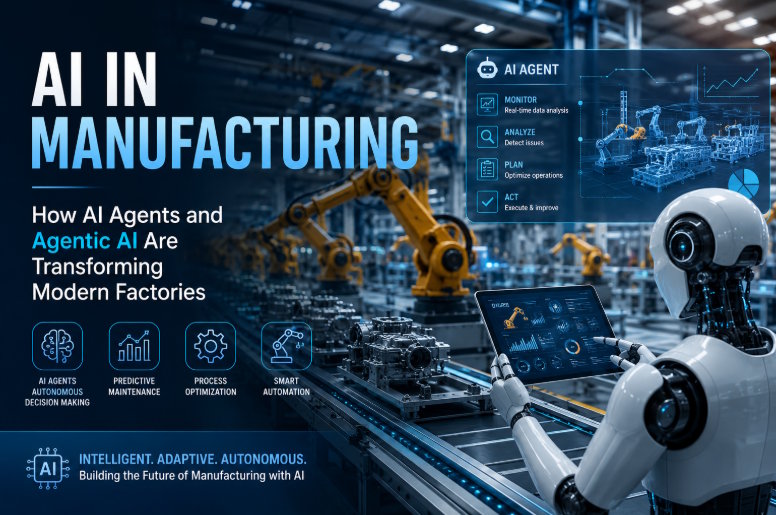
There's a meaningful distinction between AI as a decision-support tool and AI as an autonomous actor. AI agents in manufacturing represent the latter — systems that can perceive their environment, reason about a situation, decide on a course of action, and execute that action without requiring a human to approve each step.
In practice, this looks like a maintenance agent that detects an anomaly, cross-references the maintenance history, checks parts inventory, identifies the closest qualified technician, and schedules the repair — all without a human initiating any of those steps. Or a quality agent that catches a defect trend, traces it to a specific upstream process parameter, adjusts that parameter within defined bounds, and flags the intervention for human review after the fact.
The distinction matters because it changes the economics of AI deployment. Decision-support tools require a human in the loop for every significant decision, which limits throughput. Agents can handle high-frequency, bounded decisions autonomously, freeing human attention for genuinely novel situations that require judgment.
Implementation requires careful design of the agent's authority boundaries. The most successful deployments give agents autonomy within clearly defined operating envelopes — they can adjust machine parameters within ±10% of nominal, they can reschedule work orders within a 24-hour window, they can place replenishment orders below a certain value threshold — and require human approval for anything outside those bounds. This isn't a limitation of the technology; it's good engineering practice.
How Agentic AI Improves Supply Chain Operations
The supply chain is where manufacturing complexity meets external volatility, and it's where agentic AI in supply chain management delivers some of its most compelling value.
Traditional supply chain systems are reactive. They identify what happened — a shipment is delayed, a supplier is out of stock — and alert a human planner who then figures out what to do. Agentic systems are proactive. They monitor leading indicators (port congestion data, supplier financial health signals, commodity price forecasts, weather patterns) and begin developing contingency responses before the disruption actually occurs.
Consider a scenario where a tier-two supplier shows early signs of financial stress — delayed payments to their own suppliers, reduced order volumes with logistics partners. An agentic system monitoring those signals can flag the risk weeks before a disruption occurs, model the impact on production plans, identify alternative suppliers, and pre-qualify them against quality and cost criteria. By the time the disruption becomes official, the response plan is ready.
On the demand side, agentic AI can continuously reconcile sales forecasts, customer order patterns, and promotion schedules to generate replenishment signals that actually reflect what the market is doing rather than what a static forecast predicted six months ago. The result is better service levels with lower inventory — a combination that was historically impossible to achieve simultaneously.
Benefits of AI-Driven Manufacturing
The benefits of AI-driven manufacturing compound in ways that aren't obvious from looking at individual use cases in isolation.
- Productivity gains from predictive maintenance and optimized scheduling free capacity that can be directed toward higher-value work or increased output.
- Quality improvements reduce rework and scrap, which improves margins directly and reduces the hidden cost of managing customer complaints.
- Supply chain resilience lowers the safety stock manufacturers need to carry, freeing working capital while actually improving service levels.
- Energy optimization — AI systems that schedule energy-intensive processes around peak pricing windows — reduces utility costs without affecting throughput.
- Data flywheel effects mean that AI systems improve as they accumulate operating experience, creating competitive advantages that widen over time.
The manufacturers who will struggle are those treating AI as a point solution for a single problem. The real leverage comes from building an integrated data and AI infrastructure where insights from one system inform the operation of others — where quality data feeds back into production planning, where maintenance predictions inform supply chain decisions, where customer demand signals shape every upstream process.
Challenges and Implementation Considerations
None of this is without difficulty. The manufacturers who have succeeded with AI share a pattern: they were honest about the challenges before they started.
Data quality is the most common early obstacle. AI models are only as good as the data they're trained on, and most manufacturing operations have data that's fragmented, inconsistently formatted, and partially missing. Getting the data infrastructure right before deploying AI isn't glamorous work, but it's foundational.
Change management is equally important and often underestimated. Operators who've worked a line for fifteen years have their own mental models of how things work, and an AI system that contradicts those models — even when it's right — will face resistance. The most successful implementations involve frontline workers in the design process and create genuine feedback loops between operators and the AI system.
Integration complexity is real, particularly in facilities with legacy equipment. Modern machines with native connectivity are straightforward to connect. Older equipment often requires retrofitting with sensor packages and edge computing hardware, which adds cost and project duration.
And finally, there's the question of AI governance. As AI systems gain more autonomy, manufacturers need clear frameworks for defining what decisions they can make independently, how those decisions are logged, and how humans can intervene when needed. This isn't just a technical problem — it's an organizational and compliance challenge that requires executive attention.
Future of Autonomous Manufacturing
The trajectory is toward what some in the industry call 'lights-out' manufacturing — facilities that can run without human intervention for extended periods. But the more accurate picture of where AI is taking manufacturing is toward 'human-optimal' operations: environments where AI handles everything that doesn't require human judgment, leaving people to focus on the decisions, relationships, and innovations that machines genuinely can't replace.
In the near term, expect to see multi-agent systems become more common — ecosystems of specialized AI agents that coordinate with each other to optimize across the full production system, not just individual workstations or departments. Expect natural language interfaces to make AI systems accessible to every operator, not just data scientists. And expect the line between digital simulation and physical operation to blur further, as digital twins become sophisticated enough to test changes virtually before deploying them on the floor.
The manufacturers investing in AI infrastructure now are building capabilities that will be difficult to replicate quickly. AI systems improve with data, and data accumulates with time. A competitor who starts building that infrastructure two years from now will be starting from behind.
Conclusion
AI isn't arriving in manufacturing — it's already here, and the gap between early adopters and laggards is already measurable. The question isn't whether manufacturers should invest in AI, but how to do it intelligently: building data foundations first, deploying in areas where the ROI is clear and fast, and progressively expanding the scope of what AI systems handle autonomously as trust and capability grow.
The factories that will lead their industries over the next decade are the ones making those investments today. Not because AI is a magic solution to every operational challenge, but because better decisions, made faster, with more information — consistently, at scale — is a genuine competitive advantage that compounds over time.

