

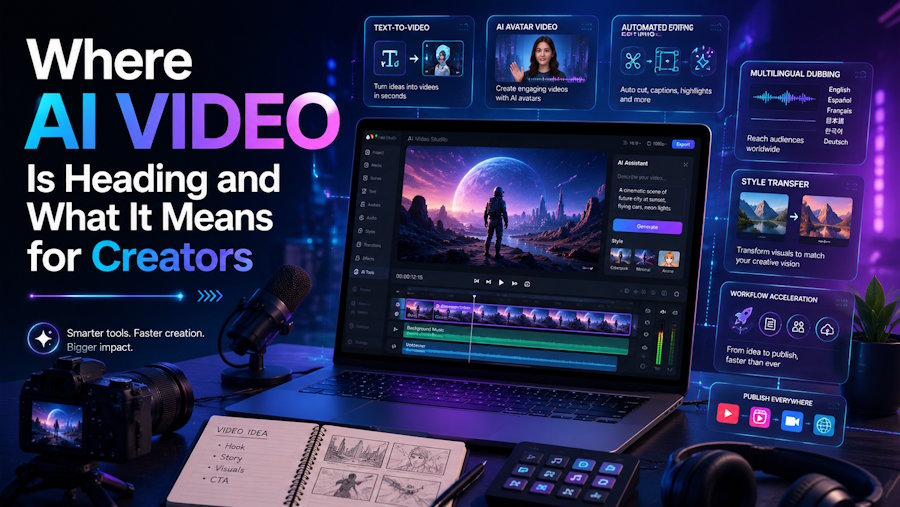
Predicting technology is a good way to look foolish in a year. Still, some directions are clear enough that ignoring them would be the bigger mistake. AI video has moved from a curiosity to a working tool in a remarkably short stretch, and the path ahead has a shape worth reading. I am less interested in wild forecasts than in the practical question underneath them. If this is where things are going, what should a creator or a brand actually do about it.
Seedance 2.5 was released today, a useful marker for where things stand right now. Let me lay out the shifts I see coming and, more importantly, what each one means for the people doing the work.
The clip gets longer and the seams disappear
The most obvious trajectory is duration and continuity. Not long ago, a few seconds of coherent motion was impressive. Then complete scenes that hold for half a minute became real, which is why platforms such as Seedance 2.5 now build around longer single clips with a proper beginning, middle, and end. The direction does not stop there. Expect clips to keep stretching while staying coherent, until the difference between a generated shot and a filmed one becomes hard to spot for everyday content.
For creators, this means the unit of work changes. You stop thinking in fragments to be stitched together and start thinking in complete shots, even complete sequences. The skill shifts from assembling pieces toward directing whole scenes, which is closer to traditional filmmaking than to the early days of clip generation.
Control becomes the battleground, not realism
Here is a prediction I am confident about. The competition will move away from raw realism and toward control. Most serious tools already produce footage that looks convincing. What still frustrates people is getting exactly the shot they pictured, with the right product, the right motion, the right consistency across variations.
So the next wave of progress will be about steering. Deeper reference systems, finer camera control, better ways to lock a character or a brand across an entire campaign. The winners will not be whoever makes the prettiest random clip. They will be whoever lets a creator land a specific vision on purpose, again and again. For anyone building a craft here, that is good news. It rewards intention over luck.
Taste becomes the scarce resource
When making video was expensive, the bottleneck was production. You needed gear, crews, and time. As generation removes that bottleneck, the scarce thing flips. Suddenly anyone can produce a hundred clips in an afternoon, which means the hard part is no longer making footage. It is knowing which footage is worth keeping.
This is the shift people underestimate. In a world flooded with easy video, judgment becomes the premium skill. Knowing what serves a message, what holds attention, what a client will actually approve, that taste cannot be generated on demand. Creators who lean only on volume will produce forgettable noise. The ones who pair the tools with genuine editorial judgment will stand out more, not less, because the contrast with the noise grows sharper every month.
The economics quietly rewrite who can compete
There is a business shift hiding underneath the technical one. When a small brand can produce a season of video for the cost of a few coffees, the advantage that big budgets once bought starts to erode. A two person team can now ship the kind of motion library that used to require an agency retainer.
This does not erase the value of premium work. A flagship campaign with real people and real locations still carries weight that generation cannot fully replace. What changes is the floor. The baseline expectation rises. Customers will start to assume every product has motion, every brand has a video presence, because the cost of providing it has fallen through the floor. Brands that treat video as a rare luxury will simply look absent next to competitors who treat it as a default.
Personalization is the quieter half of this shift. When producing a variation costs almost nothing, the same core idea can be tailored for different audiences, regions, and formats without a separate production each time. A message that once shipped as a single clip can become a dozen tuned versions, each speaking a little more directly to the person watching. That kind of tailoring used to be a luxury reserved for the biggest advertisers. As it becomes ordinary, audiences will quietly come to expect content that feels made for them, and the brands still shipping one generic clip to everyone will feel increasingly out of step.
New questions arrive with the new power
It would be naive to paint only a bright picture. As generated video becomes ordinary, harder questions move to the front. Audiences are getting sharper at sensing synthetic content, and trust is fragile. Disclosure norms are still forming. Rules around commercial use, likeness, and honesty in advertising will keep evolving, and the creators who ignore them are taking a real risk with their reputation.
My honest read is that this rewards the straightforward operators. If your work is honest, your products are shown truthfully, and you respect the terms you agreed to, you have little to fear from tighter norms. The people who should worry are the ones hoping to cut corners with synthetic shortcuts. As scrutiny rises, that approach ages badly.
What a sensible creator does right now
Forecasts are only useful if they change behavior, so here is the practical part. Build the habit of directing whole scenes, not just generating fragments, because that is where the tools are heading. Invest in your own taste and editorial judgment, since that is the skill that will keep its value as production gets cheap. Start a reusable library of references and briefs now, so your craft compounds instead of resetting with every project. And keep your work honest, because the norms are tightening and reputation is the one asset you cannot regenerate.
The future of AI video is not really a story about software getting better, though it will. It is a story about where human value moves once the mechanical part gets solved. The mechanical part is solving fast. The human part, knowing what to make and having the judgment to make it well, is exactly where thoughtful creators should be planting their flag today.
Frequently Asked Questions
1. Will AI video keep getting longer and more realistic? Almost certainly. The clear trajectory is longer, coherent clips and footage that becomes hard to distinguish from filmed video for everyday use.
2. What skill will matter most as the tools improve? Taste and editorial judgment. When anyone can generate volume, knowing which footage is worth keeping becomes the premium skill.
3. Does cheap AI video hurt professional creators? It removes routine production work but raises the value of judgment, direction, and honest craft, which is where thoughtful creators should focus.
4. How does this change things for small brands? It lowers the cost barrier dramatically, letting small teams build the kind of video presence that once required an agency budget.
5. What is the biggest risk ahead? Trust and disclosure. As audiences grow sharper and rules tighten, honest, transparent use of the technology protects your reputation.

