

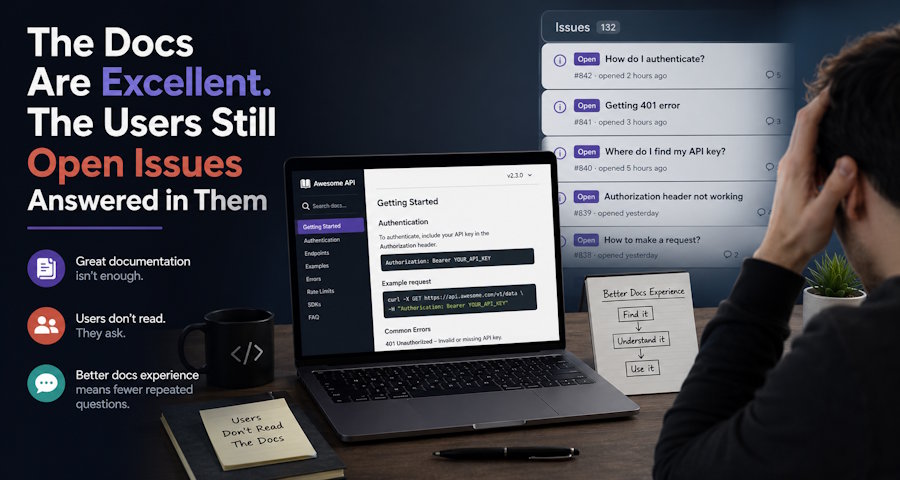
Anyone who has maintained a library or an internal tool knows the specific irritation of a well-answered question showing up anyway. You wrote the setup guide. It is accurate, it is thorough, it is linked from the README. And still the issues arrive: "how do I configure this," "getting started doesn't work for me," questions whose answers are three paragraphs into a doc the person never opened. The documentation is good. A meaningful share of your users just will not read it.
This is not a documentation problem, exactly. It is a format problem. A portion of any audience, developers included, would rather watch a short walkthrough than read a page, and there is usually no watchable version because producing one by hand is a project nobody has time for. So the docs stay text-only, and the same answered questions keep coming back.
Why some users skip the written docs
Reading documentation is a linear, effortful task, and people under time pressure skim for the one line they need and miss the surrounding context that would actually solve their problem. A short video removes that friction. It shows the steps in order, paces the viewer, and demonstrates a setup rather than describing it. The reason maintainers rarely make one for every guide is that the traditional route, recording and editing a walkthrough per topic, does not scale for a team already stretched thin. So the flagship intro video gets made, if that, and the rest of the docs stay as prose.
Generating video straight from the doc
The practical shift is to treat the document you already wrote as the source and generate the video from it. You supply the guide, and the software drafts the structure and the narration.
A doc to video tool like Leadde works this way. You upload a Word file, a PDF, a slide deck, or pasted text, and it drafts an outline, builds the on-screen scenes, and generates the voiceover. You set the narrative style and the level of detail, and name the audience, so a getting-started guide comes out as a gentle walkthrough while a deeper reference comes out more thorough. The property that matters for docs specifically: because the input is the document, updating the video means editing the source and regenerating, not re-recording, which is the only way a video survives contact with a project that changes.
Support for a large set of languages also helps a global user base. A walkthrough can be reissued for users who read another language by translating the finished video rather than rewriting and re-recording it.
Where it fits for developer and technical content
The uses are concrete. A maintainer turns the setup guide into a short video linked at the top of the README, and the "getting started doesn't work" issues drop. A tooling team converts an internal onboarding doc into a walkthrough new engineers watch before their first task. A product with a technical audience makes its most-referenced how-to available as a two-minute clip for the users who never open the docs. In each case the written content already existed. The video just met the people who were never going to read it.
Where it falls short
Straight talk saves everyone time. This is better at explaining concepts and procedures than at showing genuine live, in-product interaction. When a guide really needs an actual screen recording of a terminal session or a UI flow, a real capture is the right tool and this is not. AI presenters have improved but still read as slightly synthetic on close attention, so for anything customer-facing where polish sells the product, weigh that. And the output only reflects the input: a rambling or outdated doc produces a rambling video, so the discipline of keeping your documentation accurate still does the foundational work. Dense reference material, a full API table, belongs as text you can search, not a narrated scene.
A small first test
Don't convert the whole docs site. Take the single guide that generates the most repeat questions despite already answering them, generate a short video from that one document through a free tier, and link it right where the confusion starts. Watch whether the repeat issues taper over a couple of weeks. If a watchable version measurably reduces the questions your docs already answer, it is worth doing for the rest of the high-traffic guides, and your documentation finally reaches the users who were never going to read it.

