

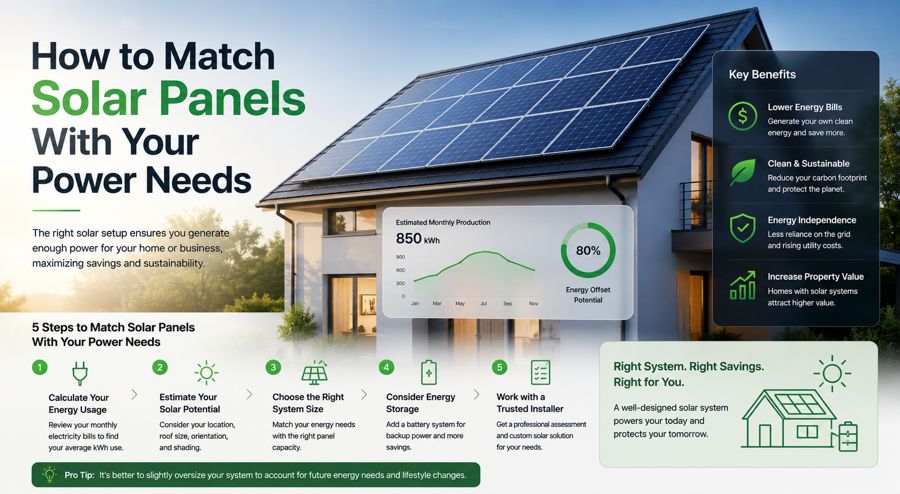
Matching solar panels to your power needs starts with a simple question: what do you need to run, and for how long? The right panel is not always the biggest or most expensive option. It is the one that can generate enough energy for your devices, fit your routine, and work reliably in the places you use it. A small setup may be perfect for charging phones, lights, and power stations during trips, while larger needs such as home backup or off-grid equipment require more output and storage planning. By understanding your daily energy use, panel performance, charging conditions, and portability requirements, you can choose a solar panel system that performs efficiently and avoids wasted money, space, and charging time.
Know Your Power Needs Before Choosing Solar Panels
Estimate Your Daily Energy Consumption
Start by listing every device you want to power or recharge in a typical day. Note each item’s wattage and estimate how many hours it runs. Multiply watts by hours to get watt-hours. For example, a 10W light used for 5 hours consumes 50Wh, and a 60W laptop used for 3 hours consumes 180Wh. Add everything together to find your daily total. If you are charging a power station, include conversion losses so your target is realistic. This step gives you a clear energy goal and helps you size your panel more accurately. It also shows whether your needs are light, moderate, or heavy. Once you know that number, you can compare it with expected solar production based on your location, sun exposure, and available charging time.
Match Power Output to Your Devices and Usage
After calculating your daily energy use, match it to a solar panel that can realistically replenish that amount. A 100W panel will not deliver 100W all day; actual output changes with sunlight angle, cloud cover, temperature, and shading. In strong conditions, a 100W portable panel may collect several hundred watt-hours over the course of a sunny day, which can be enough for phones, tablets, cameras, lights, and small battery packs. If you run higher-draw devices or need faster recharge times for a portable power station, you may need multiple panels or a larger setup. Also think about how you use power. Short trips with light electronics favor compact panels, while regular travel, field work, or backup planning calls for more dependable generation. The goal is straightforward: choose a panel whose real-world output aligns with your daily load and your tolerance for charging speed.
Compare the Key Factors That Affect Solar Panel Selection
Panel Wattage, Efficiency, and Portability
Panel wattage gives you a baseline for output, but efficiency and portability often decide whether a panel is truly practical. Higher-efficiency panels generate more energy from a similar footprint, which is useful when space is limited on an RV, campsite, or work vehicle. For portable use, weight and packability matter just as much. The anker solix solar panel PS100 is built for this kind of use, with a foldable design and a weight of just 7 lb including the stand. That makes it 10% lighter than the previous version and more than 30% lighter than typical 100W panels. It also uses next-generation N-type solar cells with 25%+ conversion efficiency to reduce energy loss and improve output in high temperatures. In practical terms, that means a 100W panel can be easier to carry, quicker to set up, and more productive in a smaller portable format.
Weather Conditions, Charging Speed, and Compatibility
Solar charging conditions are rarely perfect, so durability and environmental performance should be part of your comparison. Weather resistance matters if you plan to use panels for travel, backup, or outdoor work where sudden rain, dust, or muddy ground are common. A reinforced frame and strong sealing help protect long-term performance. Charging speed also depends on how well a panel handles less-than-ideal conditions and whether it can capture available light efficiently. Bifacial designs can improve output by using reflected light from surfaces such as sand, snow, or concrete. The Anker SOLIX PS100 offers dual-sided output for up to 10% more power in those environments, along with IP68 water and dust resistance, a reinforced aluminium frame, and impact-resistant materials. Compatibility is the final check: make sure connector types and cable lengths suit your power station or battery setup. Included charging cables can simplify deployment and reduce the need for extra adapters.
Choose the Right Solar Panel for Different Scenarios
Home Backup, RV Travel, and Camping
For home backup, prioritize enough panel output to keep a portable power station charged for essentials such as lights, communication devices, routers, and small appliances. For RV travel, portability still matters, but so does the ability to collect meaningful energy during stops without a complex setup. Campers usually benefit from compact, foldable panels that can handle phones, lanterns, cameras, and small battery packs. A 100W class portable panel often fits these lighter to moderate needs well, especially for users who value fast deployment and easy transport. If your camping style includes longer stays or higher use, pairing the panel with a capable power station improves flexibility and lets you store energy for nighttime charging.
Outdoor Work, Emergency Preparedness, and Off-Grid Use
Outdoor work setups often require dependable daytime charging for tools, radios, laptops, and monitoring equipment. Here, durability and efficient output in changing conditions matter more than ultra-compact size alone. For emergency preparedness, choose a panel that is easy to store, quick to deploy, and rugged enough to operate after storms or during extended outages. Off-grid use raises the bar further because the panel becomes part of your daily energy system rather than a backup accessory. In these cases, calculate your load carefully and select enough solar capacity to recharge your battery reserve consistently. Portable panels can still play an important role, especially when mobility matters, but success depends on matching realistic solar generation to your essential devices and charging schedule.
Conclusion
To match solar panels with your power needs, start with your daily energy use, then compare panel wattage, efficiency, durability, and compatibility in the context of how you actually plan to use them. This approach gives you a clear answer: light device charging calls for compact portable output, while backup, travel, and off-grid routines require more generation and storage planning. Features such as foldability, weather resistance, and higher conversion efficiency can make a major difference in real-world performance. When you choose a panel based on actual usage instead of guesswork, you get faster charging, better reliability, and a solar setup that works where and when you need it.

