

Apart from creating dirt and disorder, sanding dust also settles in freshly applied finishing products and gets lodged in the machines. This fine dust remains in the air after work completion; that's precisely why both OSHA and NIOSH identify wood dust as a respiratory hazard worth managing.
A good dust extraction system can solve this problem at its source rather than after it happens. Dust is collected directly at its source, which not only helps clean the working surface but also minimizes the amount of dust inhaled by workers, protecting their respiratory systems from harm. This system also ensures machine cleanliness and makes the sanding process more visible and easier to perform.
Here are ten brands worth knowing, starting with the one built specifically around sanding workflows.
1. SurfPrep
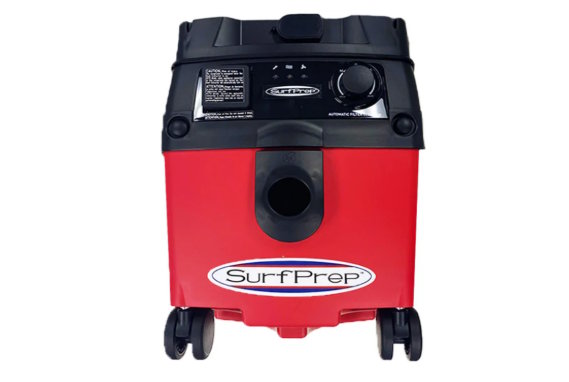
SurfPrep designs its dust extractor to pair directly with its own sander line, both electric and pneumatic, rather than functioning as a generic shop vacuum. The POV-8 caters to one-person sites and has an 8-gallon capacity and a static-safe hose, which is suitable for fine dust. Meanwhile, the PIV-12 is built for production lines that need two operators running sanders at the same time.
These two utilize HEPA-certified filtration systems that remove 99.97% of dust, along with self-cleaning features that maintain continuous suction throughout a day’s work. Because the equipment is built specifically for sanding, it tends to fit woodworking and finishing work more precisely than a general-purpose shop vacuum would.
Each model suits a different shop setup. The POV-8 ships ready to use, with a 12-foot static-conductive hose, five replacement collection bags, and a hose-and-cord organizer that keeps a workstation tidy between jobs. The PIV-12 is built for higher-demand shop floors instead. It draws just 12 amps, so it runs on a standard 15-amp circuit alongside two electric sanders without extra wiring.
Both units work with SurfPrep's full sander lineup, including the Ray, Storm, and Trident, across electric and pneumatic models, so switching sanders down the line doesn't mean rethinking the dust collection setup either.
2. Serious Grit
Serious Grit isn't a dust extractor manufacturer itself, but it plays a real supporting role in how shops actually use one. This firm provides sanding accessories specifically designed to improve dust extraction system performance. This includes quick-connect hose clips that prevent entanglement between the sander cord and the vacuum hose, and inline speed controls that reduce suction power to prevent swirl marks during sanding. If you already have your Festool, SurfPrep, or another similar extractor, you can overcome some minor irritations.
3. Festool USA
A large part of Festool’s reputation in North America revolves around its CT series of dust extractors. This line of products comes equipped with HEPA filters, and many models also include an autoclean system that prevents the filter from clogging during heavy use. The CT MIDI has become an everyday shop favorite. It is a product that combines portability with powerful suction. There is also the cordless CTC series of dust extractors, suitable for field technicians. This product line works together with an anti-static smooth hose that doesn’t tangle easily.
The model name also means something in the line of CT extractors. The number following the CT designation usually indicates the container's capacity in liters. So the CT 15 has less capacity than the CT 26 and CT 36, making it easier to find the right model based on shop size rather than wattage alone. This is unique about the Festool brand: it has created a complete line of products using the same technology.
4. Sandpaper.com
Sandpaper.com, operated by Uneeda, sells its own EKASAND Series 2 dust extractors alongside its abrasives lineup. This model comes in a 10-gallon capacity and can be attached to an electric or pneumatic sander, or both, simultaneously, using an auto-start mechanism that begins operation upon tool activation. The collection also features a rack system designed to organize your sanders and abrasives near the dust collector. It is certainly a complete solution for a company known mainly for sandpaper and abrasive discs.
5. Fein
Fein holds an important place in the history of the dust extractor because it produced the very first electric vacuum cleaner in the 1920s and has since continuously improved its industrial vacuum cleaners. The Fein Turbo line is widely used in workshops where constant suction is required during several hours of work. Fein enjoys popularity due to the reliability and durability of its products.
6. Bosch
Bosch's VAC line targets contractors who need dependable wet- and dry-extraction on job sites rather than in a fixed shop setting. The units are built to handle transitions between job types, from drywall dust to standard debris, and Bosch pairs many of its extractors with its own line of corded and cordless tools for a more integrated setup.
7. DeWalt
DeWalt's dust extractors lean heavily into job-site durability, with rugged housings and wheeled bases designed to withstand hauling between locations. The brand's extractors are a common sight on construction crews already using DeWalt's broader tool lineup, since many models are built to communicate with compatible DeWalt power tools for automatic start-and-stop functionality.
8. Milwaukee
Milwaukee's approach centers on its M18 FUEL battery platform, which powers several of its cordless dust-extraction tools. This matters most for crews working in spaces without easy access to outlets, since the same battery system that powers Milwaukee's drills and saws also powers its dust extraction line. The AIR-TIP accessory system also lets users switch quickly between different attachments depending on the task.
9. Makita
The Makita range of dust extractors is available with both corded and 18V LXT power source types. There are also multiple HEPA filter-equipped models capable of extracting 99.97% of dust particles of 0.3 microns. The VC4210L model features a 12-amp motor and a soundproof design, making it quieter than many competing products because vacuum noise itself causes fatigue.
10. RIDGID
RIDGID has earned a reputation among contractors mainly because of its wet-dry shop vacs, which trade some of the advanced HEPA filtration of purpose-built dust extractors for durability and affordability. Although not always marketed as dust extractors like Festool's and SurfPrep's, RIDGID’s vacuums remain a familiar sight on construction sites where debris removal and dust extraction take precedence over fine-particulate filtration.
Final Thought
The choice of dust extractor largely hinges on how the shop operates. The requirements of a one-person finishing shop are totally different from those of a production line where two sanders operate simultaneously, and the requirements for the latter will also differ from those for a mobile dust extractor used by a field team.
What sets the products listed above apart is not only their suction force but also the care with which they were designed for sanding and finishing.

