

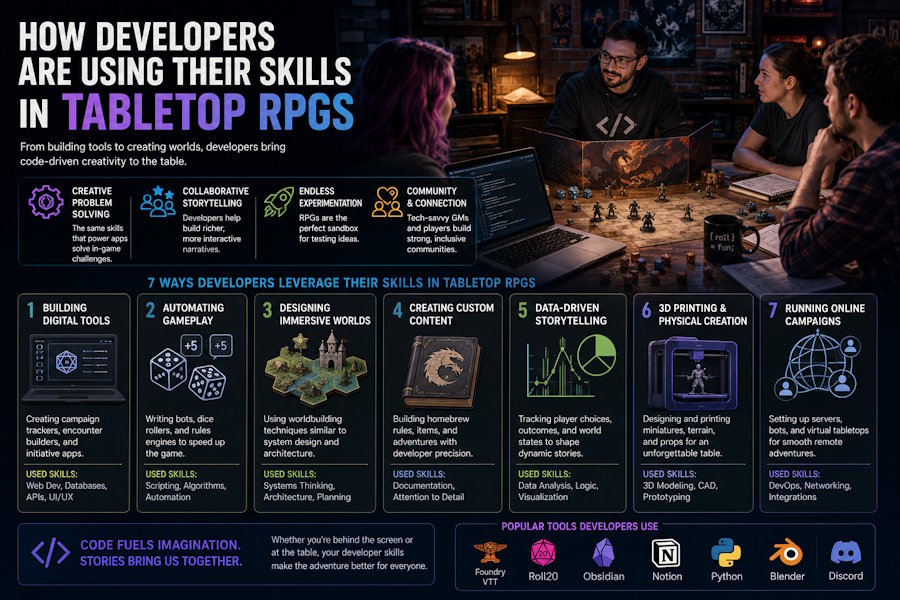
The shift from a terminal to a gaming table is more natural than most people realize. Professional developers often spend most of their time navigating logic and collaborative environments. These are the same pillars that keep tabletop role-playing games. Recent academic reviews show how these professionals are using their skills to master the art of play.
Engineering Leadership and Narrative Management
Many lead engineers find that the role of a Dungeon Master mirrors the responsibilities of a technical lead or project manager. TTRPGs usually function as sophisticated organizational simulations. In these environments, leaders must balance player expectations with system constraints.
Just as a developer manages a sprint, a Dungeon Master manages the flow of a session to ensure every participant feels challenged.
Logical Analysis and Systems Thinking
Tabletop games are built on a foundation of mathematical odds and interlocking mechanics. Playing these games helps individuals refine their critical thinking.
Developers tend to view character builds as optimization problems where they seek the most efficient way to achieve a goal. This approach debugs complex narrative situations as it breaks them down into smaller variables.
When a programmer looks at a rulebook, they come across a set of functions and conditional statements. Whenever a character acts, the game engine must process the input and return a result. This compels developers to steer high-pressure gaming scenarios with a calm and calculated demeanor.
They aren’t just guessing their way through an encounter but are instead running mental simulations in order to find the highest probability of success.
Collaborative Problem Solving and Team Dynamics
In the software space, success depends on the ability of a team to work together. TTRPGs provide a safe environment to practice these social and cognitive dimensions of learning. Developers often use their experience with version control and documentation in order to keep the party organized.
The concept of pair programming even finds its way when players combine their capacities for maximum impact. A developer might recognize that their wizard's spell can act as a buffer for the fighter's attack. Such a level of synchronization requires the know-how of each teammate's skills.
Psychological Safety and Professional Growth
The gaming table serves as a creative lab for social interaction and emotional intelligence. These kinds of sessions offer a medium for communication for developers who spend most of their time in solitary work. The "Beyond Play" scoping review of 2025 notes that TTRPGs are transformative tools for personal development. They allow professionals to try different roles and practice empathy in ways that their daily job might not require.
Understanding what drives a fictional character helps a developer learn what drives a real-world user. This crossover improves their ability to design inventive interfaces and features. The skills gained from role-playing aren't just for fun but are actively making these individuals better at their careers.
Algorithmic Thinking on Game Design
Many developers don't stop at just playing the games but rather start to adjust them through homebrew content. They apply excellent algorithmic thinking in order to create balanced encounters that scale or upgrade with the level of the party. A software engineer might write a script to simulate combat rounds to make sure that the new monster is challenging. This data-backed approach leads to more enjoyable experiences for everyone at the table.
Automation tools, such as digital tabletops and Discord bots, have become a staple for techy groups. Developers often spend their leisure time writing custom inputs to handle inventory management or tracking.
Future Trends in Technical Gaming
AI and mixed reality in tabletop gaming are making headlines these days. And, developers are at the forefront of this movement.
They are introducing AI-driven game masters and procedurally generated maps, and taking the analog experience and enhancing it with the latest advancements.
The community is also witnessing a rise in workshops related to coding for games. Similar frameworks allow students to learn about variables and objects. This educational pipeline creates a feedback loop that lets gamers become developers and developers become gamers.
Finding Your Party
If you want to apply your professional logic, then you need to find the right community. It can be tricky to locate a group that respects a highly analytical and structured style of play. But you can easily find Dungeons and Dragons groups to start off!
Wrapping Up
The intersection of software development and tabletop gaming is a productive space for many. For coding, skills such as systems thinking and technical logic are the same skills that drive a successful campaign.
When you participate in these games, developers aren't just engaging in a hobby but are actually refining their soft skills and analytical frameworks. This unique synergy between technology and imagination is what makes the modern developer a formidable force at any table.

