

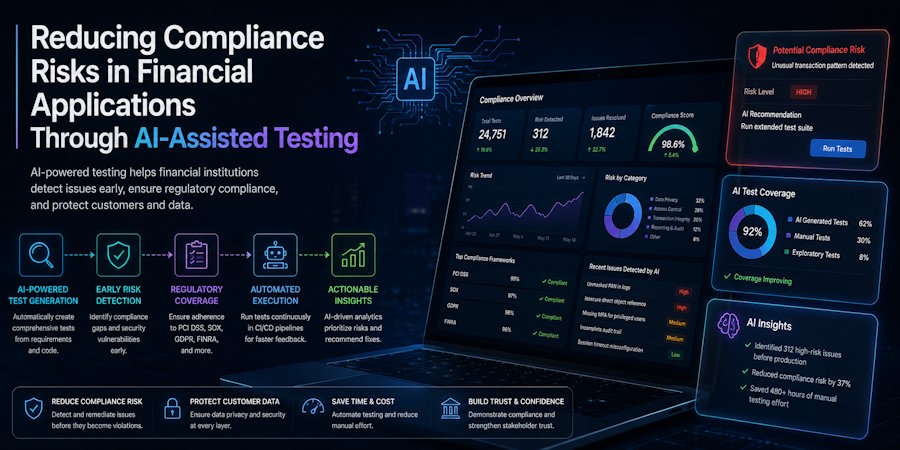
Financial applications operate in one of the most heavily regulated environments, where even small software defects can result in compliance violations, security vulnerabilities, or audit findings. As financial platforms continue to evolve, testing has become essential for ensuring both software quality and regulatory readiness. Many organizations are adopting AI testing services to strengthen quality assurance, improve testing efficiency, and support financial compliance automation across modern financial systems. AI-assisted testing helps identify issues earlier while improving financial software validation before applications reach production.
Rather than replacing traditional quality assurance, AI enhances testing by identifying high-risk areas, improving test coverage, and supporting faster validation of complex financial workflows. Combined with experienced QA teams, AI-assisted testing helps organizations build more reliable and compliant financial applications.
Why Financial Software Testing Requires a Compliance-First Approach
Banks, insurance providers, fintech companies, and other financial organizations must comply with strict industry regulations while maintaining secure and reliable digital services. Software quality directly affects an organization's ability to meet these requirements, making testing an important part of compliance rather than simply a final development step.
Missed defects can result in inaccurate calculations, reporting errors, security weaknesses, or failed audits. A compliance-first testing approach helps identify these risks before software is released.
Strong financial software validation supports reliable system behavior while ensuring applications align with established business rules and regulatory expectations. Effective testing also verifies internal controls, confirms policy enforcement, strengthens the overall governance framework, and improves the accuracy of regulatory reporting.
By incorporating compliance objectives throughout development and testing, financial organizations reduce operational risks while improving confidence in software quality.
How AI Improves Test Coverage for Financial Applications
AI enhances software testing by identifying application areas most likely to introduce compliance risks. Instead of executing the same test cases repeatedly, AI analyzes code changes and recommends additional tests where they are needed most.
This improves regression testing efficiency while helping teams prioritize high-risk scenarios. AI also supports financial compliance automation by making testing more consistent across software releases.
Capabilities such as anomaly detection help uncover unusual application behavior, while automated evidence collection simplifies documentation for future audits. Combined with continuous integration, continuous delivery, and DevSecOps practices, AI enables faster software validation without compromising quality.
Features such as explainable AI (XAI) further improve transparency by helping QA teams understand why AI recommends specific testing actions or identifies potential risks.
Common Financial Software Defects That Lead to Compliance Issues
Many compliance problems originate from software defects that appear relatively minor during development but have significant operational consequences after deployment. Incorrect financial calculations, missing validation rules, permission errors, broken audit trail functionality, inconsistent data integrity, and inaccurate reporting can all affect regulatory software compliance.
Testing should also verify role-based access control (RBAC), proper segregation of duties (SoD), secure digital identity management, effective access governance, and reliable security controls. Maintaining accurate data lineage further strengthens reporting consistency and traceability.
Additional activities such as vulnerability assessment and penetration testing complement functional testing by identifying security weaknesses before applications are released into production.
Balancing Automated and Human-Led Testing in Finserv
AI significantly improves testing speed and consistency, but it cannot replace the expertise of experienced quality assurance professionals. Financial applications often involve complex business rules, regulatory requirements, and operational scenarios that require human judgment.
AI is highly effective at analyzing application changes, identifying repetitive defects, and prioritizing testing efforts. Human testers, however, remain essential for evaluating business logic, interpreting compliance requirements, validating user workflows, and assessing real-world application behavior.
Combining AI with manual testing creates a more balanced quality assurance process. While AI handles repetitive validation activities efficiently, experienced testers focus on higher-level analysis and compliance decision-making.
Financial organizations must also manage model governance carefully when AI capabilities evolve. At the same time, structured change management processes ensure that software updates continue supporting compliance objectives without introducing unnecessary operational risks.
Working together, AI and human expertise create stronger testing outcomes than either approach could achieve independently.
Preparing Financial Applications for Regulatory Audits Through Better QA
Well-documented testing practices help financial organizations prepare more effectively for regulatory audits. Maintaining accurate testing records provides evidence that critical business functions have been properly validated before software deployment.
Comprehensive audit trail records improve transparency throughout the testing lifecycle, while cryptographic verification helps confirm the integrity of important compliance information. Many organizations also use regulatory technology (RegTech) solutions alongside compliance automation to simplify documentation and ongoing regulatory reporting.
Consistent quality assurance practices strengthen compliance risk reduction by ensuring software meets both technical and regulatory expectations before every release.
Conclusion
Financial software must deliver both reliable functionality and consistent regulatory compliance. A compliance-focused testing strategy helps organizations identify risks early, improve software quality, and reduce the likelihood of security issues or audit findings.
By combining AI-assisted testing with experienced QA professionals, organizations can strengthen financial compliance automation, improve financial application security, support effective financial software validation, and achieve meaningful compliance risk reduction. As financial systems continue to evolve, balancing intelligent automation with human expertise will remain essential for building secure, reliable, and compliant financial applications.

