

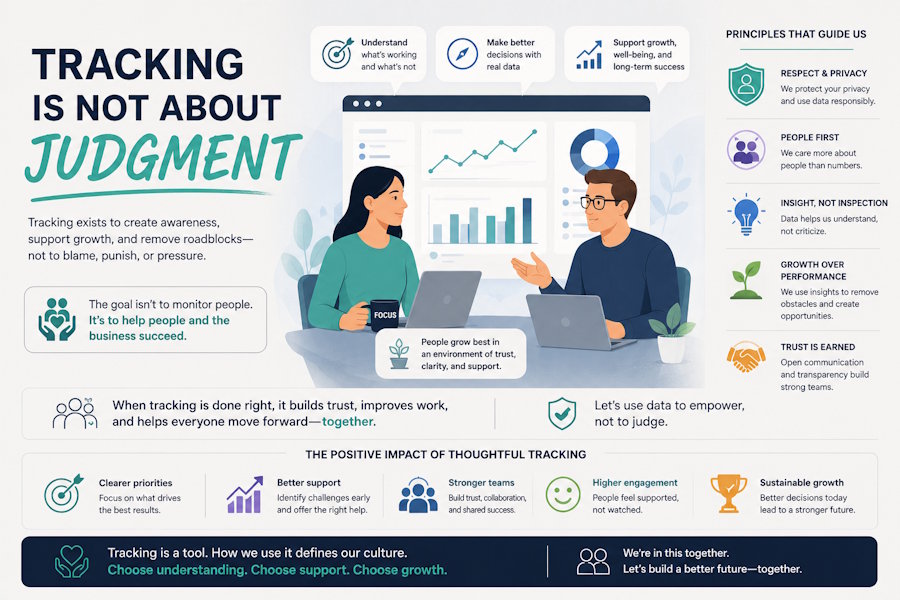
Most people think tracking is for people who want to “get serious” and finally become disciplined. That is part of why so many budgeting apps, food logs, fitness watches, and habit charts start to feel heavy after a while. The moment you write something down, it can feel like you are creating evidence against yourself. One skipped workout becomes proof that you are lazy. One expensive week becomes proof that you are irresponsible. One rough month becomes proof that you are failing.
But that whole framework is off. Tracking is not supposed to act like a courtroom. It is supposed to act like a dashboard. That distinction matters in money just as much as it does in health. If you are trying to understand where your paycheck goes, decide whether to use a loan to pay off credit card debt, or simply stop feeling confused every time bills pile up, tracking can give you a clearer starting point.
It does not tell you whether you are a good person. It tells you what is happening in the system you live inside every day. When people stop treating data like a moral verdict, they usually become more consistent. That is because consistency grows better in calm observation than in shame. Researchers have found that self monitoring can improve awareness and support behavior change, especially when it helps make automatic patterns more visible instead of keeping them vague and emotional. You can see that principle reflected in research on self monitoring and behavior change from the National Library of Medicine.
A mirror is not an insult
If you stand in front of a mirror on a rushed morning, the mirror is not criticizing your hair. It is just showing you what is there. Tracking works the same way, at least when used well.
Your bank statement is not calling you careless. Your calorie log is not calling you weak. Your step count is not calling you lazy. Those numbers may reveal something uncomfortable, but discomfort is not the same thing as judgment.
A lot of people quietly blend the two. They see a result, then instantly attach a story to it. “I spent too much on takeout, so I must have no self control.” “I only exercised twice this week, so I clearly never follow through.” “I forgot to track for five days, so I blew it.”
That leap from fact to identity is where tracking becomes exhausting.
A more useful move is to separate observation from interpretation. Observation says, “I ordered takeout four times this week.” Interpretation says, “I am bad with money.” Observation says, “I was too drained to cook after work.” Interpretation says, “I am hopeless.” If you can keep returning to observation first, the data stays usable.
Good tracking is closer to science than self criticism
The most sustainable trackers often think more like mechanics than judges. A mechanic does not get offended by an engine problem. They look for patterns, conditions, and pressure points. What happened first? What keeps repeating? What changed? Which part is under strain?
That is the energy that makes tracking helpful.
If you keep overspending every Thursday, that does not automatically mean you lack discipline. Maybe Thursday is your longest workday and you are buying convenience because your decision making is shot by 7 p.m. If your workouts keep disappearing after two strong weeks, maybe your plan asks too much too soon. If you snack late at night, maybe the real issue is that lunch was tiny and dinner came too early.
This is why broad health guidance often emphasizes small, steady habits instead of dramatic overhauls. Sustainable change usually works better when it fits real life and builds gradually, which is a theme echoed in MedlinePlus guidance on healthy living.
When tracking is treated as an experiment, it becomes easier to ask better questions. Not, “What is wrong with me?” but, “What conditions keep producing this result?” That one shift can lower defensiveness and open the door to actual problem solving.
The starting line is not a verdict
Many people avoid tracking because they are afraid of what they will find. That fear makes sense. If you already feel behind, uncertain, or stretched thin, seeing exact numbers can feel like confirmation of your worst thoughts.
But the starting line is useful precisely because it is real.
If you do not know how much you spend on groceries, dining out, subscriptions, or impulse buys, then any plan you make is built on fog. If you do not know how often you actually move your body, sleep enough, or drink water, then your goals are guesses. Tracking is not there to embarrass you. It is there to replace vague dread with visible reality.
And visible reality is easier to work with than fear.
There is something strangely comforting about a clear baseline. Even when the numbers are not what you hoped, at least you are no longer wrestling with mystery. You can respond to a fact. Facts are often less scary than the stories we invent around them.
Why shame makes people quit
Shame is loud, but it is not especially strategic.
It might create a burst of motivation for a day or two, but it usually does not support the long game. If every tracking session feels like opening a report card you are afraid to read, sooner or later you will stop opening it. That is not laziness. It is avoidance, and avoidance is predictable when a tool feels punishing.
This is why some people can handle detailed spreadsheets but others do better with softer systems. A weekly review may work better than daily logging. A few categories may work better than twenty. Pen and paper may feel less loaded than an app full of alerts. The best system is not the one that looks the most impressive. It is the one you can return to honestly.
The goal is not perfect compliance. The goal is reliable information.
That may sound like a small difference, but it changes everything. Once the purpose of tracking becomes “learn what is going on,” you no longer need to perform for your own chart. You just need enough honesty to spot patterns.
Neutral data can still lead to compassionate action
Some people hear “tracking is neutral” and think it means cold. It does not. Neutral data is actually what allows compassion to show up in a useful way.
If your numbers show that your spending spikes during stressful weeks, compassion does not mean ignoring it. It means responding with curiosity and support instead of insults. Maybe you need easier meal options at home. Maybe you need to automate a bill so your mental load drops. Maybe you need a smaller discretionary category that still gives you breathing room. Maybe you need help restructuring debt so you can create more space in your monthly budget.
Compassion says, “This pattern makes sense in context. Now what would help?”
That is a much stronger question than, “Why can’t I get it together?”
Tracking should make you wiser, not harsher
The best outcome of tracking is not that you become stricter with yourself. It is that you become more informed. You notice friction sooner. You catch drift earlier. You learn which situations throw you off and which routines steady you. Over time, you build self trust, not because you are perfect, but because you are paying attention without flinching.
That is a very different kind of growth.
It is quieter than dramatic self improvement talk. It is less flashy than a total reset. But it is also more durable. When tracking becomes a neutral mirror instead of a moral scorecard, you stop using information as a weapon. You start using it as guidance.
And that is when the habit can actually last.
Because in the end, the numbers were never the problem. The harsh story wrapped around them was.

