

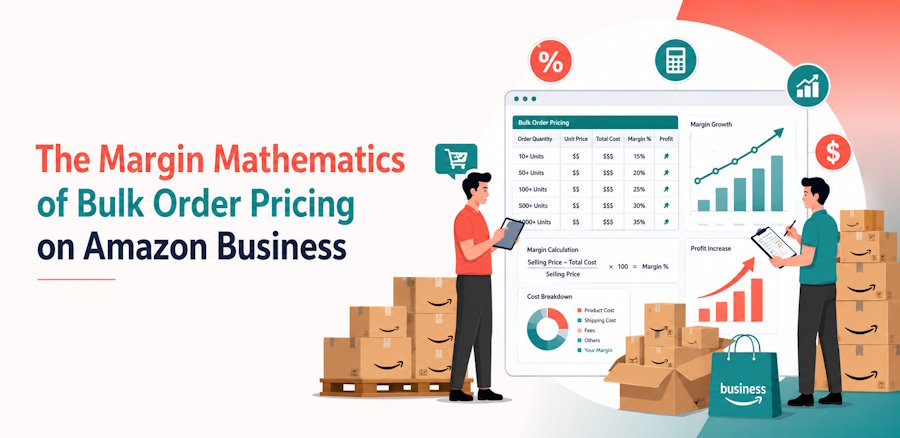
Selling in bulk on Amazon Business sounds like straightforward arithmetic. You sell more units per order, so you should be making more money per order. The reality is that bulk order pricing on Amazon Business introduces a set of margin problems that do not exist in single-unit consumer selling and most sellers discover them only after they have already accepted a bulk order that cost them margin they had not planned to give away.
The problem is not that bulk pricing is unprofitable. The problem is that the economics of a 50-unit order are materially different from the economics of a 1-unit order, and most quantity tier configurations do not reflect those differences. Amazon B2B quantity tier repricing exists precisely to manage this complexity, adjusting tier price points in real time based on competitive changes while respecting the distinct margin structure of each volume band. Without it, sellers are either leaving margin on the table at tiers where they could price higher, or destroying margin at tiers where their floor calculation was never correct to begin with.
The Per-Unit Economics That Change at Volume
Three cost components behave differently at different order sizes on Amazon Business, and understanding each one is the starting point for any rational tier pricing configuration.
FBA fee allocation changes at volume
Amazon's FBA fees are charged per unit not per order. This means the FBA fee cost as a percentage of revenue changes as the per-unit price decreases across tiers. A product with a $2.50 FBA fee at a $25 consumer price carries a 10% fee burden. At a tier-discounted price of $20 for orders of 10 or more, the same $2.50 fee now represents 12.5% of revenue. A seller who calculated their tier floor at 10% fee burden is now operating at 12.5% on bulk orders, a margin erosion that occurs on every qualifying order without any visible signal that it is happening.
Inbound shipping allocation changes at volume
Sellers who ship products to FBA fulfillment centers allocate inbound shipping cost as part of their per-unit landed cost. Most sellers do this as a fixed allocation of $0.30 per unit regardless of order size. But inbound shipping cost per unit is not fixed when viewed across the catalog; it varies by shipment size and product weight distribution. A seller whose inbound cost actually varies across different shipment sizes is applying a fixed cost allocation that may be accurate on average but is wrong at any specific tier.
That volatility isn't hypothetical. The BLS data (via FRED) shows the producer price index for courier and express delivery services jumped from 359.7 in October 2025 to a peak of 389.6 in January 2026, before easing back to the mid-380s by March. Either way you look at it, this is not a cost that holds still, which is exactly what a fixed $0.30-per-unit shipping allocation assumes.
Return rate behaviour changes for bulk orders
Bulk orders from business buyers have different return dynamics than single-unit consumer orders. A procurement buyer who receives a defective unit in a 50-unit order is more likely to raise a formal dispute or return the entire order than a consumer who received one defective unit. The risk profile of a bulk order is not the same as the risk profile of 50 individual consumer orders, and sellers who do not account for the higher per-incident cost of bulk order returns are understating their effective cost of goods at scale.
Why Standard Floor Calculations Fail at Higher Tiers
The most common floor calculation error in Amazon B2B tier pricing is applying a single floor across all tiers. A seller sets their standard consumer price floor at $18 on a product that costs $14 landed. The $4 margin covers their FBA fee, Amazon referral fee, and acceptable return risk. They then configure quantity tiers 5% off for 5+ units, 10% off for 10+ units, 15% off for 20+ units and apply the same $18 floor to all tiers.
At the 15% discount tier with a $25 standard price, the discounted price is $21.25 well above the $18 floor, so the configuration seems safe. But the FBA fee has not changed. The referral fee percentage now applies to $21.25 instead of $25. The inbound shipping allocation is the same. And the return risk on a 20+ unit order is higher than on a single unit. The actual break-even for a 20+ unit order, when all costs are calculated correctly against the discounted revenue, may be $19.50 not $18.
The Competitive Dimension That Makes Automation Necessary
The floor calculation problem is a one-time correction – recalculate, reset, move on. The competitive dimension is the ongoing problem that makes automation the correct solution rather than a convenience.
Amazon Business is a competitive marketplace. Competitors enter listings, exit listings, change their tier pricing, win and lose the B2B Featured Offer continuously. A seller who sets their tier pricing correctly today and leaves it unchanged is not repricing, they are maintaining a static price list while the competitive environment around them changes.
The specific dynamics of tier repricing make static pricing more costly in B2B than in standard Amazon selling. In standard repricing, a competitor price change affects one price point per listing. In B2B tier repricing, a competitor who restructures their tiers changing discount percentages, adding a new tier threshold, adjusting their business-specific price may affect the competitive position at every tier simultaneously. A static configuration has no mechanism to respond to this.
Automated tier repricing manages each tier as an independent price point with its own competitive logic observing changes in B2B competitor pricing at each volume level, adjusting within the correct floor and ceiling for that tier, and maintaining Featured Offer competitiveness across all tiers simultaneously without requiring manual intervention at each tier level.
The Practical Implication for Amazon Business Sellers
The sellers who get this right are not necessarily the sellers with the largest catalogs or the most sophisticated pricing teams. They are the sellers who recognised early that the per-unit economics of bulk order pricing cannot be managed with the same floor calculation methodology as single-unit consumer pricing and who automated tier management before the competitive consequences of static configuration showed up in their B2B Featured Offer win rate.
The concrete starting point is a tier-by-tier cost audit: for each active tier on each B2B-active SKU, calculate the true break-even at that volume level using the correct fee structure at that price point. Most sellers who complete this audit find that at least one of their tiers is priced below true break-even not because they made an obvious error, but because they applied a floor calculation built for one economic context to a different one.
Correcting the floors is the first step. Automating the adjustment process within those floors is what keeps the correction valid as the competitive environment changes.

