

I spoke with a Product Director about a year ago, and he had this entire wall covered in sticky notes. All of the notes were color-coded by product line and then by market, and even by development phase within a market. There were strings connecting up photos and a large red “WHY?” scrawled across the top of the wall. He was quite proud of it because it was the only way he had to see all of the products in his portfolio.
This was not a case of the Product Director at this manufacturer lacking the intelligence to run a large number of products. What she lacked was proper tooling to manage her portfolio of products.
The visibility problem nobody talks about enough
Making decisions on a product portfolio of dozens of SKUs is hard to get right as a manufacturing company. Obviously, there are a lot of different decisions to make as part of a portfolio of products. You want to make good product decisions. You want to get engineering, sales, and supply chain working together well. You want to monitor the market while at the same time making a number of strategic decisions about where to invest and where to cut back. Most product leaders today try to run their product decisions with a patchwork of spreadsheets, email threads, and quarterly review with PowerPoint slides that are already a week or two old by the time the review actually takes place.
I think you can manage a lot of product decisions with a variety of tools. The problem is that most of a product portfolio in manufacturing gets managed by a product leader. So if the product leader is trying to make all of these decisions with a variety of tools, and those tools are not connected, then it is like trying to make decisions in a city with 6 different maps. All of the maps are of the same city, but they are all drawn to different scales. So you can end up missing turns. You can end up being very slow. And it is often the case that the cost of being slow in product strategy is invisible until it is too late. The cost of being slow in product strategy is lost market share. It is postmortem meetings where people are uncomfortable.
So what actually helps?
Roadmapping
Many road mapping tools are little more than colorful Gantt charts with a modern look and feel. They quickly lose relevance as the underlying product decisions get out of sync with reality.
Roadmapping tools that enable decision making around a product portfolio do more than create a nice looking timeline. They tie the roadmap into the business such that when you delay a product line, for example, you can see the impact to your revenue targets, the impact to your resource allocation, the impact to customer commitments, etc. The tool supports the decision making around your product portfolio. The roadmap becomes a decision making tool as opposed to just a communication tool that gets posted to a Confluence page and never opened.
While decision making around prioritization of different products, in different markets and at different stages of development can be managed by creating models of scenarios around what may happen if a particular product is put first (and so, other products are deprioritised) and then using the outputs of such models to come up with the best decisions around the use of resource, tools that support road mapping of such products are essential to understanding the full implications of the decisions around the prioritization of such products. So look for tools that support scenario modeling of such a similar nature to the models that you would use to help make decisions around the prioritization of the products that you offer in the markets that you serve. Such tools will allow you to look at the potential of all of your products, to prioritize them, and to come up with the best set of options for deployment of resources across all of your products in all of your markets, in order to come up with the best possible returns for your investments in the products that you sell in the markets in which you sell.
Prioritization frameworks, and why the tool matters less than you think
It’s also worth noting that the method for prioritizing (i.e. weighted scoring, opportunity scoring, RICE, etc) is less important than the team believing in and consistently using a given framework for prioritizing. Thus tools that enforce consistent use of prioritization frameworks (and allow for the resulting reasoning to be visible and auditable to stakeholders) are a huge increase in visibility into why a product was prioritized over others, and why it was subsequently ‘de-prioritized’.
On the other hand, there are a variety of prioritization methods that can be used for making portfolio decisions. Product leaders use methods such as weighted scoring, opportunity scoring, RICE scoring, and more. What’s more important than the particular prioritization method that you choose is that your team trusts the method and can apply it consistently. It does not have to be complicated in order to be effective. The fact that you have a clear methodology for prioritizing products and services allows for more transparent and fair decision making for cross functional teams. If no clear method for prioritization is in place, then political fighting between various departments is likely to win out. In the end, the department with the most influence in the decision making process will typically be able to get what they want, regardless of the data.
Speaking of which…
Teams that want to stay ahead of evolving product management practices often benefit from following trusted sources that regularly publish product technology insights on emerging tools, digital innovation, and strategic decision-making.
Cross-functional alignment is where decisions go to die
A second frustration for me in many manufacturing companies is that the product portfolio strategy is managed by the product organization and then communicated down to other parts of the company such as engineering, sales, etc. Tools used by product strategy teams for creating roadmaps are typically within the product organization and do not easily support input from other parts of the company such as resource constraints, cross-functional trade-offs, etc. As a result, product portfolio strategy is worked out by the product organization and then communicated down to the rest of the company through PowerPoint roadmaps (typically exported as PDFs a week or so before a meeting where they are to be presented and then summarized by someone in the meeting). As a result, leadership, engineering, sales, etc. all view the product portfolio strategy through somewhat different lenses.
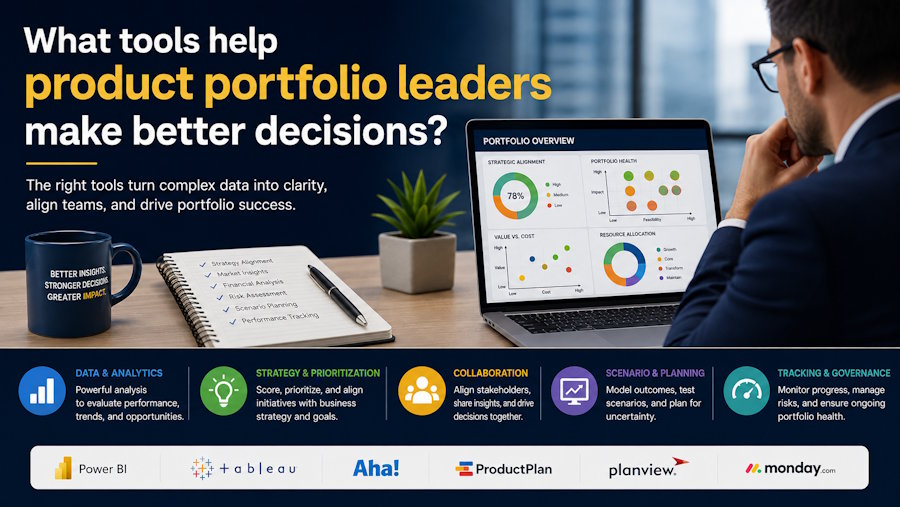
Then there is a class of software typically referred to as ‘product portfolio software‘ for the Product Portfolio leader. These tools enable the Product Strategy, Resource Planning and Cross-functional input to be managed within a single environment allowing the Portfolio leader to make the best decisions with the most relevant up to date information.
By bringing all of the information about the products that are currently in your portfolio and what’s happening with the different parts of your organization around a single environment, your sales team can see what’s in your product pipeline, when things are expected to launch into production, your engineering teams can flag potential capacity problems before they actually become problems for you as a portfolio leader, and you can use all of that information to make the best possible decisions about where to go and how to grow.
A quick comparison: reactive vs. connected decision-making
|
Situation |
Reactive approach |
Connected tooling approach |
|
Market shift signals a product needs rethinking |
Discovery happens weeks later in a quarterly review |
Real-time data flags the change; team adjusts roadmap immediately |
|
Resource constraint in engineering |
Product leader finds out when a deadline slips |
Constraint is visible in planning; priorities adjusted proactively |
|
New product opportunity identified |
Evaluated in isolation, without portfolio context |
Scored against existing portfolio commitments and capacity |
|
Leadership asks for portfolio performance update |
Someone spends two days compiling spreadsheets |
Report pulled directly from live data in minutes |
What good decision-making actually looks like in practice
All great Product Portfolio Leaders have a number of common habits. I don’t believe that the highest quality of decision making comes from having the most sophisticated portfolio of tools. I have worked with a number of Product Portfolio Leaders that have very good portfolios of products and yet they don’t have the most advanced tools at their disposal. These leaders make appear to make the highest quality of decisions and they do this by practicing on a regular basis a number of key habits. By practicing these habits on a regular basis you will also become a great Product Portfolio Leader.
- They've replaced opinion-based prioritization with a shared scoring model their whole team understands and, honestly, trusts enough to actually follow when the pressure's on
- Their roadmap is treated as a living document, reviewed frequently and updated without ceremony, not a slide deck dusted off every quarter like holiday decorations
- They've built genuine feedback loops between customer-facing teams and product strategy, so the people closest to the market have a real channel into planning decisions rather than shouting into a void
- They can run "what if" scenarios quickly, which means they're never caught flat-footed when leadership asks about trade-offs at the worst possible moment
And to your point, there is no single product that is going to fix all of these problems. What the best portfolio managers do is tie together all of the disparate tools that their organization currently uses to manage the product portfolio. In other words, the best portfolio managers are very effective at leveraging the tool set currently in place at their organization in order to make good decisions regarding the products within their portfolio. And so the image of a portfolio manager with sticky notes on the wall of their office is a pretty sad one, but it is a symptom of a larger problem. The root cause of that problem is that there is no single system in place at that organization providing the necessary information to the portfolio manager to make good decisions.
Sticky notes on a wall? That’s just a symptom of a problem. And I have found that the root cause of this problem is almost always the same: no single system provides the necessary information for a portfolio leader to make good decisions. And until that changes, someone somewhere will have to spend his or her time with a lot of sticky notes on a wall, trying to keep a jumble of information in his or her head.

