

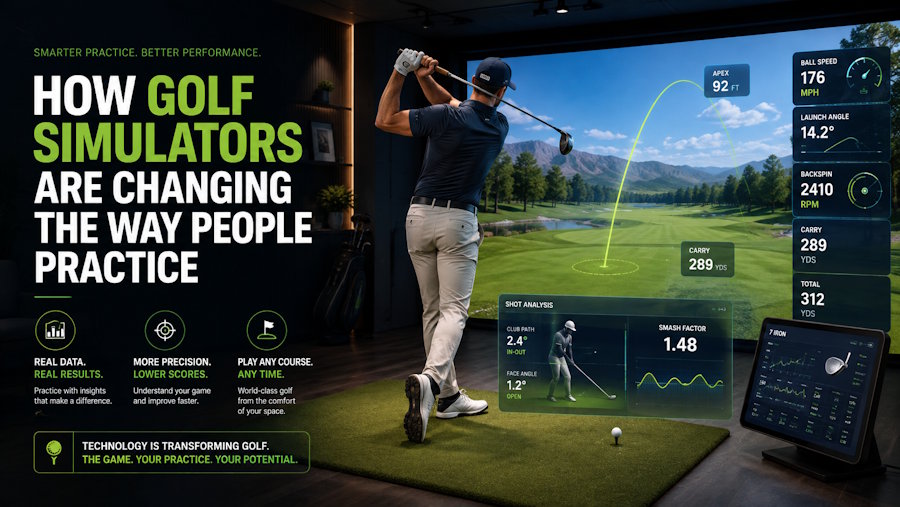
For decades, improving at golf meant one thing: driving to a range, hitting bucket after bucket of balls, and guessing at what was actually going wrong with your swing. That model is quietly being replaced. Golfers now have access to data-driven feedback, year-round availability, and a social experience that traditional ranges never offered. A modern golf simulator Toronto golfers are turning to is proof of how far practice has evolved , and why so many players aren't going back to guesswork.
From Guessing to Knowing
The biggest shift simulators have brought to golf practice is precision. On a traditional range, a golfer might notice their shots are curving right, but they're left guessing why. Was it clubface angle? Swing path? Attack angle? Without real data, most players end up making adjustments based on feel , which is exactly how bad habits get reinforced instead of corrected.
Simulator technology, particularly systems like TrackMan, changes that entirely. Every swing generates real numbers: ball speed, spin rate, launch angle, clubface angle at impact, and more. Instead of guessing, a golfer can see exactly what happened on that swing and adjust accordingly. That immediate, specific feedback loop is something a bucket of range balls simply can't replicate.
Practice Isn't Limited by Weather or Daylight Anymore
Golf has always been a seasonal frustration for anyone living somewhere with real winters. Months of cold, rain, or early sunsets used to mean months without meaningful practice , and every golfer knows how much rust builds up over an off-season. Simulators remove that limitation entirely. A golfer can work on their swing in January just as easily as in July, with consistent lighting, consistent conditions, and zero risk of getting rained out mid-session.
This year-round access matters more than casual golfers often realize. Skill retention and improvement come from consistency, and simulators make it possible to maintain that consistency regardless of the calendar.
Every Course, Without the Travel
Simulators don't just replicate a driving range experience , many let golfers play virtual rounds on world-famous courses without leaving the building. That capability turns a practice session into something closer to an actual round, complete with course strategy, different lies, and varied hole layouts. For golfers trying to prepare for a specific course before an upcoming trip or tournament, this kind of rehearsal has real value that a flat range simply can't offer.
It also keeps practice interesting. Hitting the same shot into the same net can get repetitive fast; playing a virtual round adds variety and a sense of progress that keeps golfers coming back.
Lessons Get More Effective With Data in the Room
Simulators haven't just changed solo practice , they've changed how lessons work. When an instructor can point to exact numbers on a screen instead of relying purely on visual observation, feedback becomes far more specific and actionable. A student doesn't just hear "swing more from the inside" , they can see the swing path number improve in real time as they make the adjustment.
This turns lessons into a much tighter feedback loop between instructor and student, and it gives golfers something concrete to work on between sessions rather than a vague mental note.
A Social Experience, Not Just a Training Tool
One of the more unexpected shifts simulators have brought to golf is the social dimension. Indoor golf lounges have increasingly become gathering spots , places where friends book a bay together, order food and drinks, and treat the session as much like a social outing as a training exercise. That combination of practice and hangout has broadened who shows up. Casual players, beginners, and groups looking for something different to do on a weeknight are now walking into golf facilities that once catered almost exclusively to serious players working on their handicap.
This shift matters for the sport's growth. Lowering the barrier to entry , no green fees, no dress code pressure, no worrying about pace of play , makes golf more approachable for people who might never have picked up a club at a traditional course.
The Bottom Line
Golf simulators haven't replaced the course, but they've fundamentally changed how people prepare for it. Real-time data replaces guesswork, year-round access replaces seasonal rust, and a more social, approachable format is bringing new players into the game. For golfers serious about improvement, and for anyone who simply enjoys the game socially, simulator technology has become less of a novelty and more of a standard part of how golf gets practiced and enjoyed.
Whether the goal is shaving strokes off a handicap or just finding a fun way to spend an evening with friends, simulators have made golf practice more accessible, more data-driven, and more enjoyable than the traditional range ever was.

