


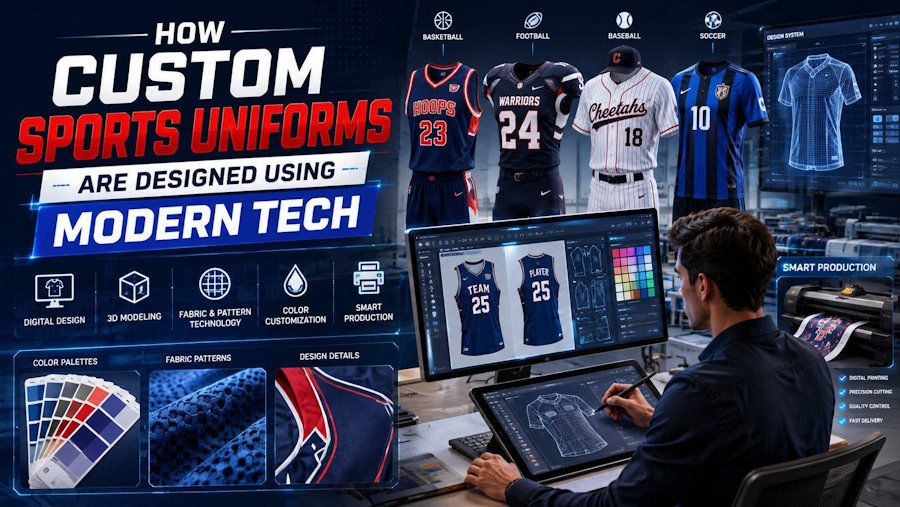
Not long ago, designing a team uniform meant sketching ideas by hand, mailing physical samples back and forth, and hoping the final product matched what the coach had in mind. The process was slow, expensive, and full of guesswork. One wrong measurement or a color that printed differently than expected could set a team back weeks.
Today, that entire journey looks nothing like it used to. Modern technology has reshaped every stage of uniform design, from the first digital sketch to the finished jersey that lands on the field. This article walks you through that journey stage by stage, so you can see exactly how a modern custom sports uniform comes to life and why the results are faster, sharper, and better-fitting than ever before.
Stage 1: Digital Design & CAD Software
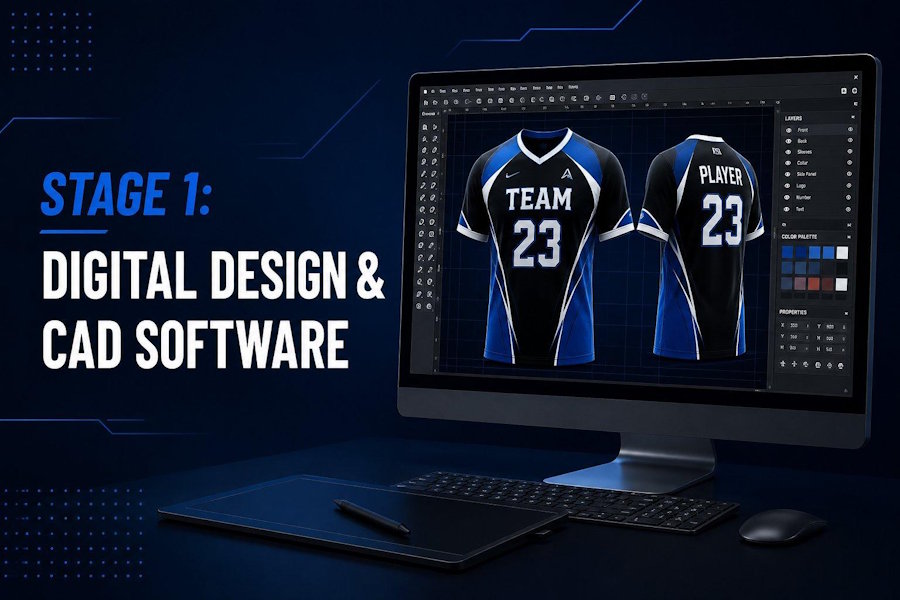
Everything starts on a screen. Instead of pencil-and-paper sketches, designers now build uniforms inside professional design and CAD (computer-aided design) software. This shift matters more than it sounds.
With digital tools, every color is defined by an exact code, so what a client approves is what actually gets produced. Panel lines, logo placement, and proportions are measured to the millimeter. And when a coach wants the stripe moved up two inches or the shade of blue darkened, the change happens in minutes instead of requiring a whole new sample.
This precision at the foundation stage is what makes everything downstream possible. A clean, accurate digital file is the blueprint the rest of the process depends on.
Stage 2: 3D Virtual Prototyping & Mockups
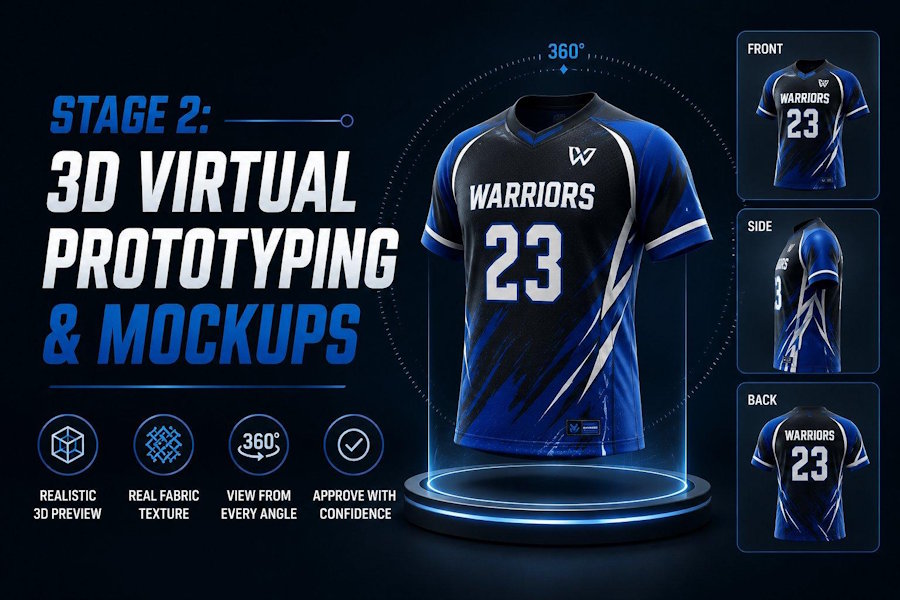
This is where modern uniform design really pulls ahead of the old way of doing things.
Before a single yard of fabric is cut, designers can now generate a true-to-life 3D mockup of the uniform. The client sees the jersey rendered from every angle, with realistic fabric texture, stitching, and how the design wraps around the body. It looks like a photograph of a garment that does not physically exist yet.
The benefit is huge. Teams no longer approve designs based on a flat drawing and hope for the best. They see the finished product virtually, catch issues early, and sign off with confidence. This cuts down on revisions, speeds up approvals, reduces fabric waste, and lowers costs, all before production even begins.
Stage 3: 3D Body-Scanning for the Perfect Fit
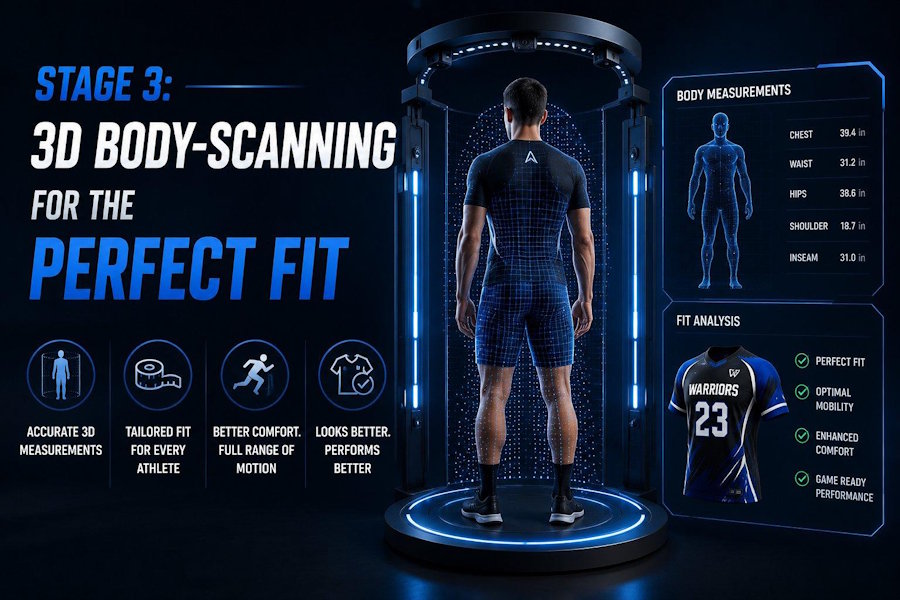
Fit has always been the hardest part of team uniforms. A roster can include a wide range of body shapes, and a uniform that fits one athlete perfectly can feel wrong on the next.
Across the industry, 3D body-scanning technology is changing that. Instead of relying on generic size charts alone, scanning captures accurate body measurements and helps tailor cuts to how athletes are actually built and how they move. The result is a uniform that fits properly, allows a full range of motion, and feels comfortable through an entire game rather than fighting the athlete at every turn.
Better fit is not just about comfort. A well-fitted uniform moves with the player, resists being grabbed by opponents, and simply looks more professional on the field.
Stage 4: Sublimation Printing Technology
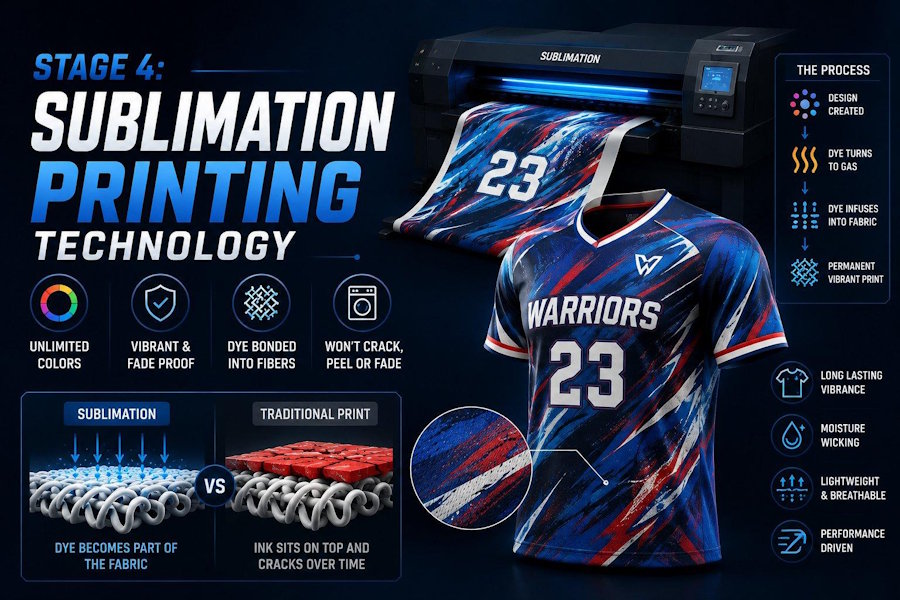
If there is one technology that defines the modern custom uniform, it is sublimation printing.
Traditional screen printing and heat transfer sit on top of the fabric. Over time, they crack, peel, and fade, especially after repeated washing across a long season. Sublimation works completely differently. The dye is converted into a gas and bonded directly into the fabric fibers, so the design literally becomes part of the material.
The advantages are significant. Sublimation allows unlimited colors, gradients, and full-panel graphics that screen printing simply cannot produce. Because the ink is embedded in the fabric rather than layered on top, the design stays vibrant and never cracks or peels. For teams that want a uniform still looking brand new at the end of a 30-game season, this is the technology that makes it happen.
Stage 5: AI-Assisted Pattern Making & Automated Cutting
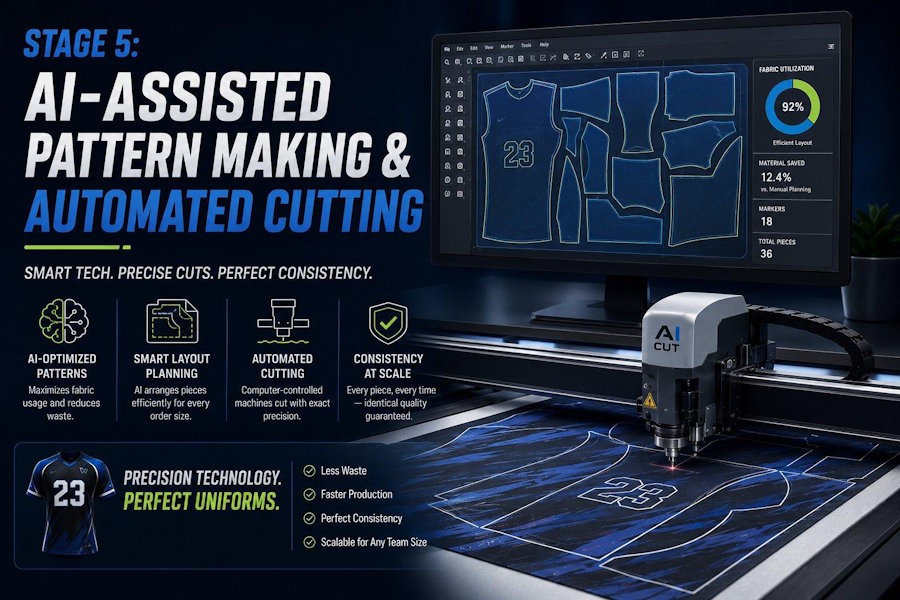
Once the design is locked in, the uniform has to be turned into physical panels, and this is where automation takes over.
Increasingly, AI-assisted tools help optimize pattern layouts, arranging pieces to use fabric efficiently and reduce waste. From there, computer-controlled cutting machines take over the actual cutting. Every panel is cut to exact specifications with a level of consistency that hand-cutting cannot match.
The real payoff is repeatability. Whether an order is 20 pieces or 2,000, each garment comes out to the same precise measurements. This consistency is what separates a professional production run from a batch of uniforms that all fit slightly differently.
Stage 6: Performance & Smart Fabrics
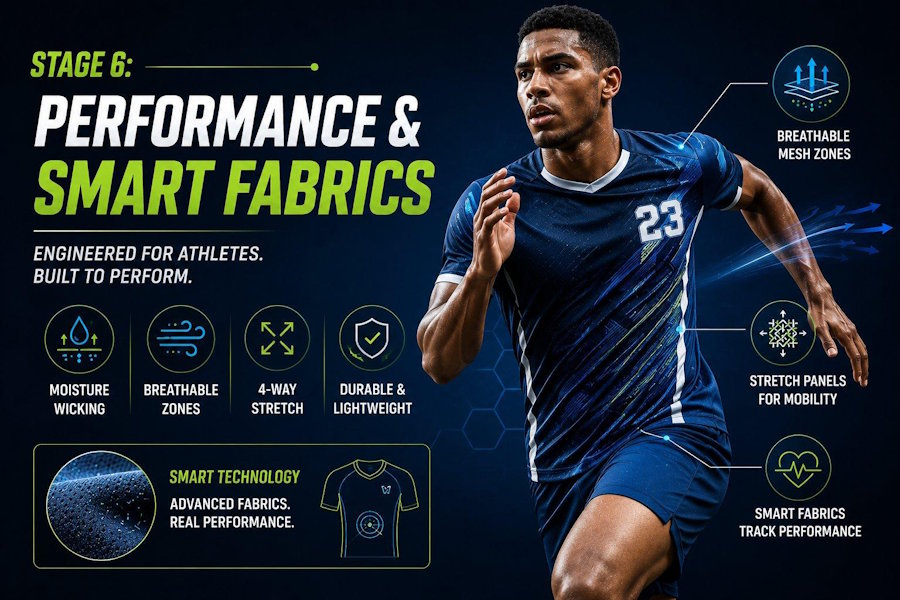
Modern sports fabric is engineered, not just chosen. The materials used in today's uniforms are the product of serious textile science.
Moisture-wicking fabrics pull sweat away from the body to keep athletes dry. Breathable mesh zones are placed where the body runs hottest. Stretch panels are added at points of movement so the uniform flexes with the athlete rather than restricting them. On the cutting edge, smart textiles are beginning to appear, with fabrics capable of temperature regulation and even sensors that track performance data.
The takeaway is simple: a modern uniform is designed around how the athlete performs, not just how the garment looks hanging on a rack.
Sustainability: The Tech Making It Greener
Technology has not only made uniforms better, it has made them more responsible to produce.
Recycled polyester and recycled nylon are now common choices, giving discarded materials a second life as performance fabric. Water-based inks reduce the chemical footprint of printing. And on-demand production, made possible by digital design and efficient cutting, means fewer wasted garments and less overproduction.
For brands and organizations that care about their environmental impact, these advances make it possible to build a sharp-looking uniform program without the waste that used to come with it.
Why This Matters for Teams & Brands
Put all of these technologies together and the advantages become clear. Faster approvals thanks to 3D mockups. Better fit from precise digital patterns. Designs that stay vibrant season after season through sublimation. Consistent quality across every unit, whether the order is small or large. And lower barriers to entry, because modern production can handle smaller runs without the huge minimums of the past.
This is exactly why working with a technology-forward partner makes such a difference. A modern custom team uniform manufacturer can take a program from concept to finished kit with in-house design, sublimation, embroidery, and quality control at every step, turning a rough idea into game-ready gear without the delays and surprises that used to define the industry.
Conclusion
Custom sports uniform design has come a long way from hand sketches and guesswork. Digital design, 3D prototyping, body-scanning, sublimation, automation, and engineered fabrics have combined to make uniforms that are faster to produce, better fitting, longer lasting, and truer to a team's vision.
And the technology is still moving forward. Augmented reality fan experiences, fully integrated smart fabrics, and even more advanced on-demand production are already on the horizon. For teams and brands, there has never been a better time to build a uniform program, because the tools finally match the ambition.

