


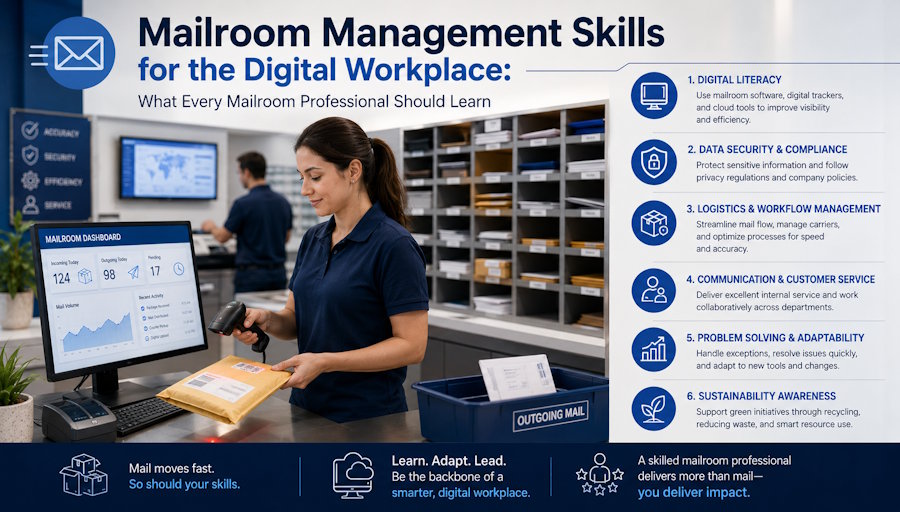
The role of a mailroom professional has changed dramatically over the past decade. Today's mailrooms process far more than traditional letters, handling everything from employee deliveries and business supplies to confidential documents and high-value packages. As organizations adopt digital workflows, knowing how to use mailroom management software has become one of the most valuable skills a mailroom employee can possess.
Learning how to use a digital mailroom software in the traditional mailroom operations allow staff to work more efficiently, improve delivery accuracy, and provide better service across the organization. While organizational skills and customer service remain important, digital proficiency is now essential for anyone working in a modern mailroom.
The most valuable mailroom skill today is knowing how to combine efficient customer service with digital technology.
Why Digital Skills Matter in Modern Mailrooms
Many organizations have replaced paper logs, spreadsheets, and handwritten delivery records with dedicated mailroom management systems. These platforms simplify package processing while providing complete visibility into every delivery.
Mailroom staff who understand digital workflows can process higher delivery volumes with fewer errors while reducing the administrative workload for the entire organization.
As package volumes continue to grow, digital competency has become a core job requirement rather than an optional technical skill.
Skill 1: Registering Deliveries Quickly and Accurately
Every package begins its journey with accurate registration.
Mailroom professionals should know how to enter delivery information into a digital system, assign packages to the correct recipient, and verify shipment details before storing the item.
This includes learning how to:
- Record courier deliveries
- Search for recipients
- Capture package details
- Assign storage locations
- Verify delivery information
Accurate registration ensures every package can be tracked throughout its lifecycle.
Skill 2: Managing Digital Package Records
One of the biggest advantages of mailroom management software is maintaining centralized package records.
Staff should understand how to search delivery histories, update package status, and retrieve information whenever questions arise.
Instead of relying on memory or paper files, digital records allow employees to locate information within seconds, improving both productivity and customer service.
|
Traditional Mailroom Skills |
Digital Mailroom Skills |
|
Paper delivery logs |
Digital package registration |
|
Manual filing |
Electronic package records |
|
Handwritten updates |
Real-time status management |
|
Physical record searches |
Instant digital lookup |
|
Manual tracking |
Centralized package visibility |
Skill 3: Using Automated Notification Systems
Modern mailroom software automatically informs recipients when their packages arrive.
Mailroom staff should understand how notification systems work, verify recipient information, and ensure alerts are sent successfully.
Learning to manage automated notifications helps:
- Reduce manual communication
- Speed up package collection
- Improve recipient satisfaction
- Minimize follow-up inquiries
Understanding this feature allows mailroom staff to deliver faster, more efficient service without increasing their workload.
Digital notifications keep packages moving and free mailroom staff to focus on higher-value responsibilities.
Skill 4: Tracking Packages Throughout Their Lifecycle
Mailroom professionals should be comfortable monitoring packages from arrival through collection.
This includes updating delivery status, confirming package pickups, and maintaining accurate digital records throughout every stage of the process.
Being able to track package history helps staff quickly answer recipient questions while maintaining complete accountability for every delivery.
Skill 5: Generating and Using Operational Information
Modern mailroom software provides valuable operational data that helps organizations improve efficiency.
Mailroom employees should understand how to access information such as:
- Outstanding packages
- Daily delivery volumes
- Collection history
- Delivery timelines
- Package status
- Activity reports
Even if managers use these reports for decision-making, staff who understand operational data can identify workflow improvements and support better mailroom performance.
Skill 6: Maintaining Digital Accuracy and Accountability
Technology only works well when the information entered is accurate.
Mailroom professionals should develop habits that ensure digital records remain reliable by:
- Verifying recipient details
- Recording deliveries immediately
- Updating package status promptly
- Confirming collections accurately
- Following standardized digital procedures
Consistent data accuracy strengthens accountability while reducing package disputes and administrative work.
Skill 7: Adapting to New Mailroom Technology
Mailroom technology continues to evolve with features such as barcode scanning, mobile access, automated workflows, and cloud-based management systems.
Professionals who are willing to learn new software features and digital processes become more valuable as organizations modernize their operations.
Developing confidence with technology also makes it easier to adapt as mailroom systems continue to improve.
Digital Skills Are Becoming Essential
Mailroom management is no longer defined solely by sorting mail and organizing packages. Today's professionals are expected to work confidently with digital systems that improve visibility, automate routine tasks, and support efficient package handling.
By learning how to use mailroom management software effectively, staff can process deliveries more accurately, communicate more efficiently with recipients, and contribute to smoother day-to-day operations.
As organizations continue investing in digital transformation, proficiency with mailroom management software will become one of the most important skills every mailroom professional can bring to the workplace.

