

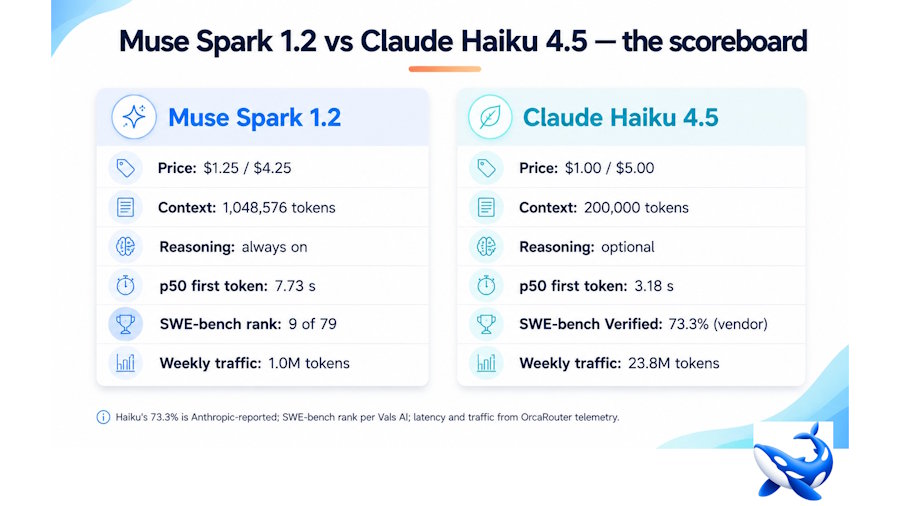
Claude Haiku 4.5 costs $1.00 per million input tokens and $5.00 per million output; Muse Spark 1.2 costs $1.25 and $4.25. Depending on your input-to-output ratio either one can come out cheaper — they are that close. What isn't close is the design: Haiku treats thinking as an option you switch on for hard problems, while Muse Spark 1.2 cannot stop thinking at all. We covered the matchup from the routing angle in Muse Spark 1.2 vs Claude Haiku 4.5.
Two models, near-identical rate cards, completely different theories of what a model should do with your money — and that single difference produces everything else, including a first-token latency gap of more than two to one.
A warning about the benchmark comparison you'll see quoted
Before any numbers, a caveat that matters more than the numbers.
Artificial Analysis' current entry for Claude Haiku 4.5 scores it at 24 on the Intelligence Index — and that entry is the non-reasoning configuration, flagged on AA's own page as an estimate. Muse Spark 1.2's 57 is its xhigh configuration, maximum effort.
So "57 versus 24" compares a model running flat out against a model that has been explicitly told not to think. It is not a like-for-like result and should never be quoted as one. Older AA figures from a previous index version put Haiku 4.5 around 55 with reasoning enabled and 42 without, but those come from a different scale and cannot be placed beside a current-version score either.
The honest position: there is no clean, current, apples-to-apples index comparison between these two models. Anyone presenting one has skipped a step.
What we can compare cleanly
Price — Muse Spark 1.2 at $1.25 / $4.25 with $0.15 cached input; Claude Haiku 4.5 at $1.00 / $5.00. Muse is 25% more on input and 15% less on output. On a typical 5:1 input-to-output workload the blended cost lands within a few percent either way. Cached input is where Muse pulls ahead for repository-heavy work.
Context window — 1,048,576 tokens against 200,000. This is the largest clean gap between them, and it's a 5× advantage for Muse Spark 1.2. If your work involves handing a model an entire codebase or a large document set, that is decisive.
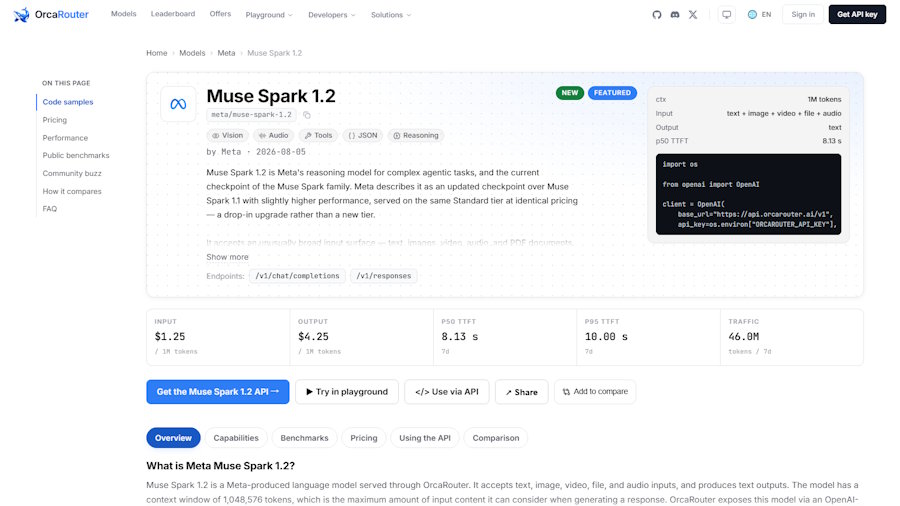
Latency — OrcaRouter's seven-day production telemetry shows Claude Haiku 4.5 at p50 3.18 s to first token and Muse Spark 1.2 at 7.73 s. Artificial Analysis measures Haiku's median output at around 84 tokens per second and publishes no speed figure for Muse Spark 1.2 at all.
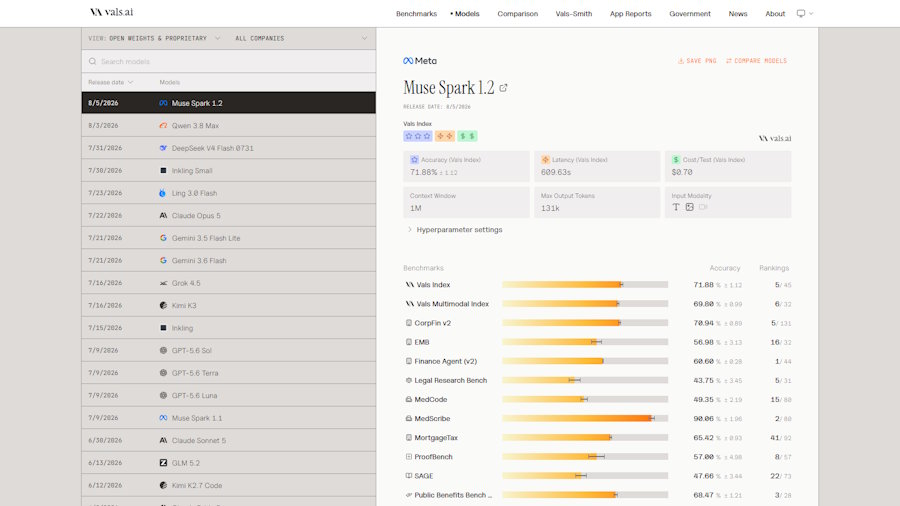
Coding evidence — Anthropic reports Claude Haiku 4.5 at 73.3% on SWE-bench Verified (its own figure, from 50 trials with a 128K thinking budget). Vals AI, running a neutral common harness, places Muse Spark 1.2 #9 of 79 on SWE-bench and #14 of 50 on Terminal-Bench 2.1. Different measurements of different things — but both are real evidence, and both suggest these models are in a similar competence band on code.
Optional thinking versus mandatory thinking
This is the real distinction, and it determines which model belongs in which slot.
Claude Haiku 4.5 lets you choose. Reasoning is a parameter. Turn it off for classification, extraction and routing; turn it on with a thinking budget for the hard cases. One model, two modes, and you pay for depth only when you asked for it.
Muse Spark 1.2 always reasons. The dial runs `minimal` through `xhigh` with `medium` as the default, but there is no off. Even at `minimal` you are paying for some deliberation, and reasoning tokens bill at the output rate. Artificial Analysis measured the model consuming 95 million output tokens to complete its Intelligence Index, against a roughly 70-million median for its tier, at $0.40 per task.
That has a practical consequence for anything simple and high-volume. On a task where the correct behaviour is "answer immediately from the input," Haiku with thinking disabled will be faster and cheaper, and there is no configuration of Muse Spark 1.2 that closes that gap.
Where mandatory reasoning pays off is the opposite case: long-horizon agent runs, multi-step tool use, and structured professional analysis. On Vals AI's common harness Muse Spark 1.2 ranks 5th of 45 overall at 71.88% and #1 of 44 on Finance Agent (v2), #1 of 136 on TaxEval v2 and #1 of 31 on Harvey's Legal Agent Benchmark. Those are exactly the tasks where you *want* a model that refuses to answer without thinking first.
What production traffic suggests
One more data point, offered for what it is rather than as a quality ranking. On our own platform over seven days, Claude Haiku 4.5 moved 23.8 million tokens against Muse Spark 1.2's 1.0 million.
Some of that is simply age — Haiku has been available far longer, and Muse Spark 1.2 is four weeks old. But a twenty-fold gap also reflects where teams are comfortable putting each model. Haiku sits in hot paths. Muse Spark 1.2, so far, sits in pipelines.
How to choose
Claude Haiku 4.5 if latency is part of the user experience, if your workload is dominated by simple high-volume tasks, if you want one model that can serve both fast and thoughtful modes, or if 200,000 tokens of context is genuinely enough.
Muse Spark 1.2 if you need the million-token window, if the work is long-horizon and agentic, if your domain is finance, tax, legal or medical documentation where its independent rankings are strongest, or if everything runs in the background anyway.
Both if you have a mixed workload, which most teams do. They're close enough in price that the routing decision can be made purely on task shape rather than budget — cheap and fast for the bulk, deliberate for the hard cases. Behind a single OpenAI-compatible key that carries both at 0% markup, with automatic failover, that's a configuration change rather than a second integration.
The takeaway
These two models cost nearly the same and are built for opposite jobs. Claude Haiku 4.5 makes thinking optional, answers in about three seconds, and is where most teams put their high-volume traffic. Muse Spark 1.2 always thinks, takes over seven seconds to start, holds five times the context, and is independently ranked first in class at exactly the kind of document-heavy professional work that rewards deliberation. Ignore any head-to-head index score you see quoted for this pair — the available numbers aren't measuring the same configuration. Choose on task shape instead, and if your workload has both shapes in it, route rather than pick.
Sourcing note: Claude Haiku 4.5's 73.3% SWE-bench Verified figure is Anthropic's own reported result. Artificial Analysis' current index entry for Haiku 4.5 is a non-reasoning configuration flagged as an estimate and is not comparable to Muse Spark 1.2's xhigh score — see the warning above. Vals ranks are from Vals AI; token consumption and cost per task from Artificial Analysis; pricing, latency and traffic figures are OrcaRouter's own, with provider list prices passed through at 0% markup. Checked August 7, 2026.

