

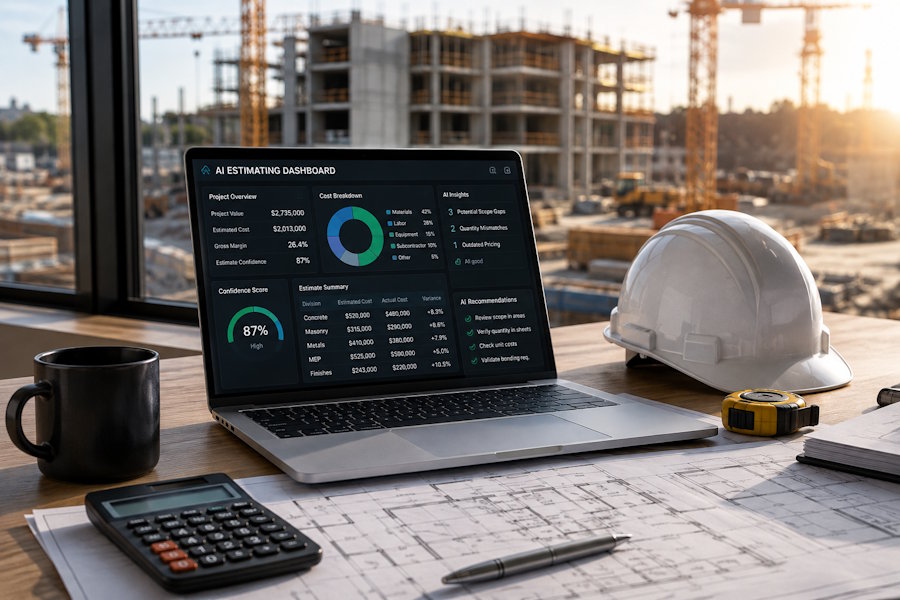
Construction estimating has always been part math, part judgment, and part information management. Contractors are not simply adding up materials and labor. They are reviewing plans, interpreting scope, checking quantities, comparing revisions, validating assumptions, pricing risk, and preparing a bid that has to hold up once the project moves into the field.
That makes estimating a strong example of where artificial intelligence can improve a real business workflow. AI is not useful because it replaces expert estimators. It is useful because it helps organize messy information, reduce repetitive review, identify missing details, and create a more consistent estimating process. In practical terms, as industry leader QuoteGoat explains, “AI improves construction estimates by giving estimators cleaner information before they make the final call.”
The biggest gains come from accuracy, speed, and repeatability. AI helps contractors move faster, but the real value is not speed alone. Better estimating happens when teams can see the scope clearly, review assumptions more easily, and reduce the risk of small omissions becoming expensive problems later.
Why Construction Estimating Is A Hard Data Problem
Construction estimating is difficult because the data is rarely clean. Information may be spread across drawings, specifications, addenda, subcontractor quotes, supplier files, emails, site notes, previous estimates, and internal pricing assumptions. Some of that information is structured, but much of it is not. Plans may arrive as PDFs. Scope notes may sit in a message thread. Pricing details may be saved in old spreadsheets. Revisions may change the project without every stakeholder noticing at the same time.
This poses a challenge familiar to anyone who works with software, data extraction, or workflow automation. Estimating requires document parsing, classification, comparison, exception detection, version control, and human validation. The final number depends on whether the right information was captured, reviewed, and interpreted correctly.
A simple estimating mistake is not always a math problem. It may be a missing scope item, an outdated price, an unclear exclusion, a missed plan revision, or a quantity that was copied from the wrong version of a drawing. These problems are hard to catch when the process depends too heavily on manual review and memory.
AI can help because it is well suited to pattern recognition, document organization, and repetitive comparison. It can support the estimator by making the work easier to review, not by pretending the project can be priced without human experience.
The Role Of AI In Modern Estimating Workflows
The best use of AI in estimating is support, not substitution. A good estimator still understands construction methods, labor conditions, supplier behavior, project risk, sequencing, site constraints, and margin strategy. AI does not replace that expertise. It gives the estimator a better starting point and a cleaner review process.
Modern AI estimating workflows can help with document understanding, takeoff assistance, quantity organization, plan comparison, scope review, and proposal preparation. Instead of asking an estimator to manually sort every document and rebuild every estimate from scratch, AI can help organize the inputs and highlight areas that need attention.
For example, AI can help identify related information across multiple files. It can speed up takeoff tasks by recognizing repeated elements or organizing measurements. It can help compare drawings against revisions. It can surface missing or unclear scope items for review. It can also support a more structured process where assumptions, exclusions, and changes are easier to track.
The important point is that AI should make the estimate more reviewable. Estimators need to see what the system found, adjust what needs correction, and decide what belongs in the final bid. Accuracy improves when technology gives experts better visibility instead of hiding the reasoning behind a black box.
How AI Improves Estimating Accuracy
Estimating accuracy improves when teams miss fewer details, review assumptions more carefully, and work within a repeatable process. AI supports all three.
One of the clearest ways AI improves accuracy is through better document review. Construction documents can be dense, fragmented, and frequently revised. AI can help organize them, identify relevant sections, and make it easier to compare information across plans and specifications. This reduces the chance that an estimator overlooks something important during a rushed bid window.
AI can also improve quantity capture. Manual takeoffs take time, and repetitive measuring creates room for human error. AI-supported takeoff tools can create a first pass that estimators review and adjust. That does not remove the estimator from the process. It gives them more time to validate the items that truly need judgment.
Another accuracy benefit is assumption visibility. Many estimates go wrong because assumptions are buried in old templates, copied notes, or disconnected files. AI-supported workflows can help keep exclusions, allowances, pricing notes, and revisions connected to the estimate. That makes it easier to audit the number before it goes out.
Stronger AI estimating accuracy usually comes from:
- Better document organization.
- More consistent quantity capture.
- Earlier identification of missing or unclear scope.
- Easier comparison between drawings and revisions.
- Cleaner review of assumptions and exclusions.
- Reduced copy-paste risk from old estimates.
- More visible changes and version history.
- Clearer handoff from estimating to operations.
AI does not guarantee a perfect estimate. Construction projects are too complex for that. It does improve the conditions that make accurate estimating more likely.
Scope Gaps Are Where Many Estimates Break Down
In construction, an estimate can be mathematically correct and still be wrong. That happens when the estimate does not include the right scope. A missed detail can create a pricing gap, a change-order dispute, a customer-expectation issue, or a margin problem after the project has already been awarded.
Scope gaps often occur when information is spread across multiple locations. A drawing may show one requirement while a specification adds another. An addendum may change the scope after an earlier takeoff was completed. A subcontractor quote may exclude a piece of work the estimator assumed was included. An old template may include exclusions that do not apply to the current job.
AI can help by making those gaps easier to spot. It can organize documents, compare information, and flag items that need review. It can help estimators identify inconsistencies, missing details, and areas where the scope is not clear enough to price confidently.
This is especially valuable because scope issues often become visible too late. Once the bid is submitted, the team may have limited room to correct assumptions. Once the project starts, those issues can become cost overruns, difficult conversations, or delays. AI gives estimators a better chance to catch problems before the bid becomes a commitment.
Faster Estimates Without Skipping Review
Speed matters in construction estimating. Contractors often have tight bid deadlines, busy teams, and multiple opportunities moving at once. Responding slowly can mean losing work. Responding quickly with a weak estimate can mean winning the wrong work.
AI helps by reducing the time spent on repetitive tasks. Document sorting, takeoff setup, quantity checks, revision comparison, and proposal preparation can all take hours when handled manually. AI-supported workflows can shorten those steps and give estimators more time for higher-value review.
That time savings should not be used to skip review. It should be used to improve review. If AI helps prepare a first pass faster, the estimator can spend more time checking scope, validating pricing, reviewing exclusions, and thinking through risk. The goal is not simply to send more bids. The goal is to send better bids with less manual strain.
Faster estimating can help teams:
- Respond to more opportunities.
- Reduce repeated setup work.
- Review plans and revisions more efficiently.
- Spend more time validating scope.
- Create proposals with fewer formatting delays.
- Improve customer or general contractor response time.
Speed only matters when the estimate still holds up. AI is valuable because it can help contractors move faster while keeping humans focused on the decisions that protect accuracy and margin.
From Manual Habits To Repeatable Estimating Systems
Many estimating processes grow from habit. A contractor starts with a spreadsheet, adds tabs over time, copies an old proposal, saves pricing in another file, and relies on one experienced person to remember how everything fits together. That can work for a small team for a while, but it becomes fragile as bid volume grows.
Manual habits are difficult to scale. They depend on memory, personal organization, and informal review. If one person is out, the process slows. If an old estimate is copied too quickly, outdated assumptions can move into a new bid. If revisions are tracked in email, teams may not know which version is current.
AI-supported estimating workflows help make the process more repeatable. They create more structure around intake, documents, takeoffs, review steps, tasks, revisions, and proposals. This makes estimating easier for the team to manage.
A repeatable estimating system may include:
- Standardized project intake.
- Centralized document organization.
- AI-supported takeoffs.
- Scope review checkpoints.
- Visible assumptions and exclusions.
- Task ownership.
- Revision history.
- Customer-ready proposal structure.
- Cleaner handoff after award.
This does not remove flexibility. Construction estimating always needs room for judgment. A repeatable system simply reduces the chaos around that judgment.
Why Human Review Still Decides The Final Estimate
AI can improve the accuracy of estimates, but construction estimates still need human oversight. Every project has context that software cannot fully understand on its own. Site conditions, labor availability, subcontractor reliability, weather risk, access constraints, customer expectations, and production strategy all affect the final number.
Estimators still need to decide whether labor assumptions are realistic. They need to know whether a supplier's quote is reliable. They need to decide whether an exclusion should be added, whether a contingency is appropriate, or whether a project carries risk that should affect markup. AI can organize information, but it cannot make business decisions.
Human review is also important for accountability. Contractors need to understand where the estimate came from and why the bid is defensible. If the process hides assumptions, teams may move faster but become less confident. A good AI workflow should make assumptions easier to inspect.
The strongest model is human-led and AI-supported. AI handles repetitive organization and review support. Estimators bring context, experience, and accountability. That balance is where technology creates value without weakening professional judgment.
What Contractors Should Look For In AI Estimating Software
Not all AI estimating software is equally useful. Contractors should look for tools that improve the entire estimating workflow, not just a single task. A tool that speeds up takeoff but does not help with scope, review, assumptions, revisions, or proposal clarity may not solve the larger problem.
The right software should work with real project documents, not just clean demo files. It should support human review at every important step. It should make estimates easier to audit, not harder to understand.
Contractors should ask:
- Can it organize drawings, specifications, notes, and revisions?
- Does it support takeoff without removing human validation?
- Can estimators review and adjust quantities?
- Does it help identify missing or unclear scope?
- Can assumptions, exclusions, and allowances stay connected to the estimate?
- Does it track changes and revisions?
- Can multiple team members review or own tasks?
- Does it support proposal creation and handoff?
- Is it easy enough to use during real bid deadlines?
The best AI estimating software should improve confidence. Contractors should be able to move faster while also explaining the number more clearly and defending the assumptions behind it.
The Bigger Impact: Better Bids, Cleaner Handoffs, Stronger Decisions
AI improves construction estimates by improving the workflow around the estimate. That has effects beyond the bid itself.
A clearer estimating process helps protect margin because teams are less likely to miss scope, carry outdated assumptions, or rush incomplete proposals. It helps customer-contractor relationships by making inclusions, exclusions, and pricing logic easier to explain. It also improves handoffs to operations by allowing the project team to see what was priced, assumed, excluded, or flagged during estimating.
Better bids create better projects. When the estimate is more complete and easier to understand, the team starts with fewer surprises. That does not eliminate risk, but it gives contractors a stronger foundation for decision-making.
The best use of AI in construction estimating is not blind automation. It is workflow intelligence. It helps people work with better information, better structure, and better review discipline.
AI Improves The Process Before It Improves The Number
AI improves construction estimating accuracy by improving the process behind the estimate. It helps teams organize documents, identify scope gaps, reduce repetitive work, review assumptions, compare revisions, and make better decisions before the bid goes out.
The estimate still belongs to the contractor. Human judgment remains essential. AI simply gives estimators a cleaner way to work through complex information and produce bids that are faster, clearer, and easier to defend.
For construction teams, that is the real value: not replacing expertise, but giving expertise a stronger system to work inside.

