

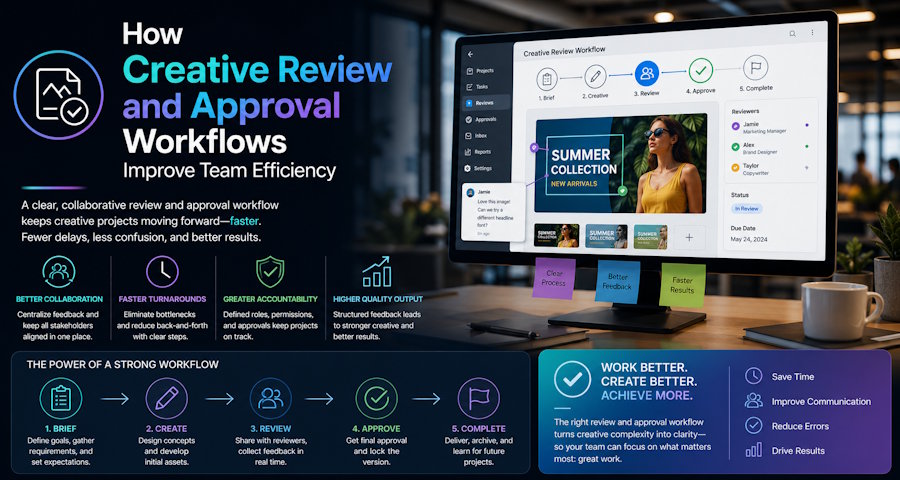
Creative teams are expected to deliver high-quality work quickly. From advertising campaigns and social media graphics to videos, presentations and branded content, every asset often passes through several people before it is ready to publish.
This process can become difficult when feedback is spread across emails, chat messages, documents and different file versions. Team members may spend more time chasing approvals than actually working on creative ideas.
This is where creative review and approval workflows can make a major difference.
A well-designed workflow gives every project a clear path from creation to final approval. It helps teams understand who needs to review an asset, what changes are required and when the work can move to the next stage.
Screendragon, for example, brings people, creative assets and approvals together in one workflow. Its platform supports online proofing, centralised feedback, automated approval routing, version control and audit trails.
Why Creative Review Processes Often Slow Teams Down
Creative work rarely follows a simple straight line.
A designer may finish a first draft and send it to a project manager. The project manager may ask for changes before sending it to the client. The client may then request another revision. Legal or compliance teams might also need to review the final version.
Without a structured process, this can create confusion.
Common problems include:
- Feedback arriving through several channels
- Too many people reviewing the same asset
- Unclear approval responsibilities
- Outdated versions being reviewed
- Missed comments
- Repeated revision rounds
- Delays caused by waiting for sign-off
These issues can affect both productivity and client satisfaction.
Screendragon's guidance explains that a structured approval workflow provides visibility and clear ownership while helping protect content quality, brand standards and campaign timelines.
What Are Creative Review and Approval Workflows?
Creative review and approval workflows are structured processes that guide creative work through review, feedback, revisions and final sign-off.
A basic workflow might look like this:
Brief → Creation → Internal Review → Client Review → Final Approval → Publishing
The exact process depends on the type of work.
A simple social media graphic may only require an internal creative review and client approval. A major advertising campaign could require creative, marketing, brand, legal and compliance reviews.
The important point is that everyone knows what happens next.
A good workflow also defines who is responsible for each stage. This removes uncertainty and reduces the need for project managers to chase people for updates.
Keep Feedback in One Central Location
One of the biggest advantages of creative review and approval workflows is centralised feedback.
Without a shared system, a designer may receive comments from email, Microsoft Teams, Slack, a phone call and a project management tool. It can be difficult to remember which comments have already been addressed.
A centralised review process keeps comments connected to the creative asset.
Screendragon provides centralised feedback and allows users to track comments, changes and versions in one place. Its proofing tools also support visual mark-ups and time-stamped comments for different types of creative content.
This makes feedback easier to understand.
Instead of saying, "Please change the image near the end", a reviewer can identify the exact part of the asset that needs attention.
Make Online Proofing Part of the Process
Creative teams work with many different formats.
These can include images, PDFs, videos, presentations, social media assets and rich media.
Traditional file sharing can make reviewing these assets difficult. People may need to download files, add comments separately and send them back by email.
Online proofing creates a smoother process.
Screendragon's platform allows teams to review static, video and rich media directly within the system. Reviewers can add visual mark-ups and time-stamped comments.
For video projects, this can be particularly useful.
Instead of explaining which part of a video needs changing, a reviewer can leave feedback at a specific point in the timeline.
This creates more precise communication between creative teams and stakeholders.
Improve Version Control
Version confusion is a common problem in creative operations.
A project might have several files with names such as:
- Campaign Final
- Campaign Final 2
- Campaign Final New
- Campaign Final Approved
- Campaign Final Approved 2
When several people are working on an asset, it can become difficult to know which version should be reviewed or published.
Effective creative review and approval workflows should include clear version control.
Screendragon provides version management and AI-powered version comparison. Its Proofing Agent can identify differences between asset versions and flag missing edits.
This can reduce the risk of approving an outdated asset.
It also gives creative teams a clearer history of how the work developed.
Automate Approval Routing
Approval routing can become complicated when several departments are involved.
For example, a campaign might need approval from:
- Creative
- Marketing
- Brand
- Legal
- Client
Manually moving the asset between each person can take time and create opportunities for delays.
Automation can make this process more efficient.
Screendragon allows creative content to be automatically routed to internal teams, clients or legal based on the organisation's workflow.
This means the system can determine what happens after each stage.
Once one person approves the asset, it can automatically move to the next reviewer.
This reduces administrative work and gives project managers better visibility.
Give Every Reviewer Clear Responsibility
A review process works best when everyone understands their role.
If nobody knows who has final approval, a project can sit waiting for a decision.
At the start of a project, teams should define:
- Who creates the asset
- Who conducts the internal review
- Who gives client approval
- Who checks compliance
- Who provides final sign-off
Clear responsibilities make workflows easier to manage.
Screendragon's workflow approach supports structured review paths and approval processes, helping teams maintain visibility and accountability throughout creative delivery.
This is particularly useful for larger teams where several departments may be involved.
Reduce Unnecessary Revision Rounds
Revisions are a normal part of creative work.
However, too many revision rounds can consume valuable time.
Screendragon's research into creative operations has found that creative assets commonly go through two to three rounds of revision before final approval. The same research highlights the potential efficiency gains from online proofing and automated workflows.
The goal is not to eliminate useful feedback.
Instead, teams should reduce unclear, duplicated or late feedback.
One way to do this is to consolidate feedback before sending it back to the creative team.
When reviewers work from the same version and provide comments in one place, designers can address feedback more efficiently.
Set Deadlines for Approvals
An approval without a deadline can easily become a delay.
A reviewer may have several other priorities and forget that an asset is waiting for their attention.
Effective creative review and approval workflows should include realistic deadlines for each stage.
For example:
Internal review: 1 business day
Client review: 2 business days
Legal review: 2 business days
Final sign-off: 1 business day
The exact deadlines will vary by organisation and project.
Screendragon recommends setting deadlines and response expectations as part of an efficient approval workflow.
Clear expectations help reviewers understand when action is required.
Match the Workflow to the Project
Not every creative project needs the same approval process.
A simple banner update should not require the same number of approval stages as a major product launch.
Overcomplicated workflows can actually reduce productivity.
For this reason, businesses should create different workflows based on the type and risk level of the content.
For example:
Simple Content
Creator → Creative Lead → Publish
Client Campaign
Creator → Creative Lead → Account Manager → Client → Publish
Regulated Campaign
Creator → Creative Lead → Brand → Legal → Client → Final Approval
Screendragon recommends matching workflow complexity to the type of content being produced.
This keeps the process efficient without removing important quality checks.
Improve Client Collaboration
Clients are often an important part of creative approval.
However, sending large files back and forth by email is not always convenient.
A better process gives clients a clear place to review work and provide comments.
Screendragon supports external collaboration with clients, partners and vendors while maintaining control over access and timelines.
This can make the client experience smoother.
Clients can understand what requires their attention, while creative teams can keep feedback connected to the correct asset.
Better visibility can also reduce unnecessary follow-up emails.
Support Brand and Compliance Checks
Creative work may need to meet specific brand or regulatory requirements.
A campaign could need legal approval before publication. A financial advertisement may need compliance checks. A global brand may need to ensure that content follows established brand guidelines.
Creative review and approval workflows can include these checks as part of the normal process.
Screendragon provides structured approval workflows and audit trails showing who approved content and when. Its Compliance Agent can also scan content for potentially non-compliant language, tone and claims.
This gives teams an additional layer of control.
It also creates a record that can be useful when organisations need to demonstrate how content was reviewed.
Use AI to Support Creative Reviews
Artificial intelligence is becoming increasingly useful in creative operations.
AI should not replace creative judgement. Instead, it can help teams handle repetitive checking and comparison tasks.
Screendragon's Proofing Agent is designed to compare versions, identify differences and highlight missing edits. Its Compliance Agent can also support compliance reviews.
This can help reviewers focus their attention on decisions that require human experience.
For example, an AI tool may identify that text has changed between two versions, while the creative director decides whether the change improves the campaign.
This combination of automation and human judgement can make reviews more efficient.
Track Approval Performance
Creative teams cannot improve their workflow without understanding where delays happen.
Useful metrics include:
- Average approval time
- Number of revision rounds
- Time spent waiting for feedback
- Percentage of approvals completed on time
- Number of rejected assets
- Rework levels
- Client response times
These measurements can identify bottlenecks.
For example, if most projects move quickly through internal review but regularly wait several days for client approval, the team knows where to focus its attention.
Screendragon's content operations approach includes tracking cycle times, bottlenecks and rework to help teams improve throughput.
Data turns workflow improvement from guesswork into a measurable process.
How to Build Better Creative Approval Workflows
Technology is only part of the solution.
Teams should first understand how their current process works.
Map the journey from the initial brief to final delivery. Identify where work waits, where feedback becomes unclear and where files are duplicated.
Then simplify the process.
Assign clear roles, reduce unnecessary reviewers and create realistic deadlines.
Centralise feedback and ensure everyone works from the latest version.
Finally, automate repetitive steps where possible.
Screendragon recommends defining roles, setting deadlines, using a single source of feedback and matching workflow complexity to the content type.
These principles can help creative teams create a workflow that is both efficient and easy to follow.
Key Features to Look For
When choosing software for creative review and approval workflows, businesses should look for features that solve real workflow problems.
Teams comparing DAM solutions should also consider how well those platforms support the review, approval and version-control processes that sit around the assets themselves.
Important capabilities include:
Online Proofing
Review creative assets directly within the platform.
Centralised Feedback
Keep comments and decisions connected to the relevant asset.
Version Control
Make it clear which version is current.
Automated Routing
Send work to the correct reviewer automatically.
Audit Trails
Record important decisions and approvals.
External Collaboration
Allow clients and partners to participate securely.
AI-Assisted Reviews
Use automation to identify version differences and support compliance checks.
Reporting
Measure approval times, bottlenecks and rework.
Screendragon combines these capabilities within its creative workflow and approvals solution.
Final Thoughts
Creative teams should spend more time creating and less time chasing feedback.
When reviews are managed through scattered emails, messages and file versions, even simple projects can become unnecessarily slow.
Well-designed creative review and approval workflows provide structure without restricting creativity.
They help teams centralise feedback, control versions, assign responsibility, automate approval routing and keep projects moving.
Screendragon's approach brings people, assets and approvals together in one workflow, with features such as online proofing, visual mark-ups, centralised feedback, automated routing, AI version comparison and audit trails.
The best workflow is not necessarily the most complicated one. It is the one that gives the right people the right information at the right time.
For agencies, marketing departments and in-house creative teams, a clear approval process can reduce rework, improve collaboration and help projects reach completion faster.
When smart workflows are combined with strong creative judgement, teams can maintain quality while working with greater speed, clarity and confidence.

