

I've been writing software for about 8 years now. Nobody tells you this when you're learning to code: your first version is always wrong. Not kinda wrong but completely, utterly wrong, and I've learned that's actually fine because that's how you figure out what people need instead of what you think they need.
My $12,000 Lesson in Overengineering
Back in 2019 I spent 4 months building what I thought was this brilliant project management tool with microservices and 47 database tables and unit tests for everything.
Want to know how many users actually wanted the core feature I'd built? Three.
Out of 200 beta testers. I'd architected this beautiful scalable system for a product nobody wanted. I rebuilt the whole thing in 11 days as a prototype, showed it to actual users, and learned more in those 11 days than I had in the previous 4 months of careful planning.
The Prototype-First Approach I Use Now
I'm not saying you should write garbage code. I'm saying you should write *throwaway* code first to figure out what you're actually building.
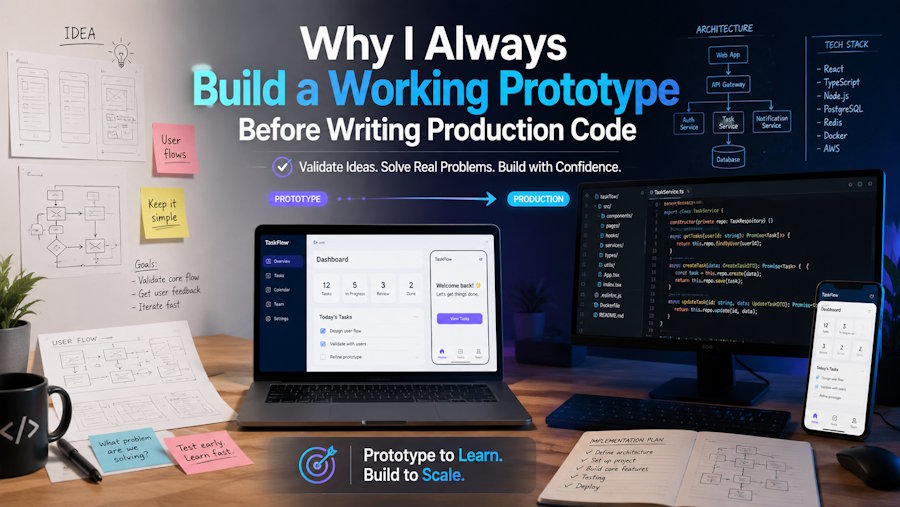
When I start a new project now or when clients come to me through Custom Web Development projects I always build what I call a "learning prototype" first with no fancy architecture and no scalability concerns. This saves about 60% of development time.
Here's how: First 3-5 days I build the ugliest version that demonstrates the core idea with hardcoded values and inline styles, whatever gets it working. Days 6-8 I show it to 5-10 real humans who aren't my team but actual potential users. Days 10-14 I rebuild based on what I learned and now I can think about proper architecture because I actually know what I'm building.
What Actually Changes When You Build This Way
I worked with a startup last year that wanted to build a restaurant ordering system and their original spec was 89 pages long.
We built a prototype in 6 days that let exactly one restaurant take exactly one type of order with no user accounts and no payment processing. Turns out restaurants didn't want what the spec described at all but wanted something 40% simpler with real-time kitchen notifications that wasn't even in the original spec. We would've spent $40,000 building the wrong thing.
The prototype cost them $2,800.
I've noticed this pattern maybe 20 times now where the spec and the actual user needs are completely different. People don't know what they want until they see something they can touch and click.
When Prototypes Become Technical Debt
You can't just "clean up" a prototype and ship it. I've tried multiple times and it never works out.
Prototypes are built with shortcuts that make sense for learning but become nightmares in production. I once hardcoded an API key directly in a JavaScript file because I was testing an integration quickly, which is fine for a 2-day prototype but catastrophic if that code makes it to production.
You've got to throw it away. Completely.
Some developers try to "refactor" their prototype into production code and I've watched this fail maybe 30 times. You end up with this weird hybrid that's too messy to maintain properly but too "finished" to justify a complete rebuild.
Professional development teams create real value when they extract the lessons from a prototype and rebuild the system properly from scratch.
The Validation Question Nobody Asks
Building software is cheap compared to building the *wrong* software.
A prototype costs you maybe 40 hours of work. A failed production system costs you 400 hours plus opportunity cost plus the psychological damage of launching something nobody uses.
I've seen companies spend $180,000 on production systems that never got 100 active users. I've also seen companies spend $8,000 on prototypes that saved them from building those failed systems by revealing the problems early. Last month I prototyped a new deployment pipeline in about 3 hours and we hated it immediately, but we learned exactly what we needed.
How I Know When the Prototype Phase Is Done
I use a pretty simple test: Can you describe exactly what you're building and why in under 2 minutes to a stranger? If you're still saying "well it might do this or maybe that depending on user feedback" then you're not done prototyping.
You need at least 15-20 people who've used your prototype and said "yes I'd pay for this" or use it regularly if it's an internal tool. Not "this is interesting" but actual commitment with their time or money.
And sometimes the answer is "don't build it at all" which I've learned the hard way. I've prototyped ideas that taught me the problem wasn't worth solving. That's a win.
What I'd Do Differently Now
If I could go back to 2017 and tell myself one thing it'd be this: stop trying to write perfect code on your first attempt because you don't even know what perfect means yet.
Write code that helps you learn what perfect means for this specific problem with these specific users. Your users don't care about your elegant architecture, they care whether your software solves their actual problem.
Figure out the problem first through prototyping. Build the solution second with proper architecture.
Prototypes give you permission to be wrong quickly instead of wrong slowly. And being wrong quickly is basically the entire skill of software development that nobody teaches you.

