

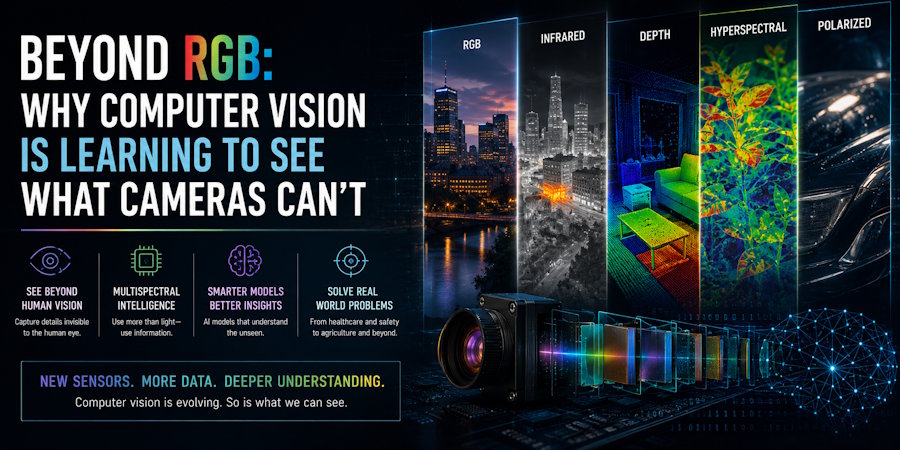
A standard camera, no matter how high its resolution, only captures a narrow sliver of the information available in a scene: visible light, reflected off surfaces, in three color channels. That's enough for the vast majority of everyday vision tasks — recognizing a face, reading a sign, spotting a defect on a painted surface. But an increasing number of business problems need information that visible light simply doesn't carry: the internal structure of an object, its chemical composition, its temperature, or details hidden beneath a surface coating. Solving those problems means moving computer vision beyond RGB altogether.
That shift is more than swapping one camera for another. Infrared, X-ray, hyperspectral, and thermal sensors each behave according to different physics, and the software built to interpret them has to be engineered around those differences rather than repurposed from an RGB model. This is precisely the kind of problem where working with an established computer vision development company pays off — one with the signal-processing background to configure unfamiliar sensors correctly and build models that actually make sense of the data they produce, rather than treating every input as if it were just another photograph.
Here's a closer look at why visible-light cameras hit a ceiling, what other sensing technologies bring to the table, and how businesses are already putting them to work.
The Limits of the Visible Spectrum
Ordinary cameras are excellent at answering "what does this look like?" but they consistently fall short on questions that matter just as much in industrial and scientific settings:
- What's inside this object? Visible light can't see through packaging, tissue, or solid materials.
- What is this material actually made of? Two surfaces can look identical in color and texture yet differ completely in chemical composition.
- How hot is this, and is that a problem? Temperature differences are invisible to a standard sensor unless something visibly changes, like smoke or discoloration.
- Can this system work in the dark, in fog, or through dust? Visible-light cameras degrade sharply once lighting conditions turn hostile.
These aren't rare edge cases — they're everyday requirements in food safety, medical diagnostics, industrial inspection, and security. Once a project needs to answer one of these questions, RGB imaging alone won't get there.
Sensor Types That Expand What Vision Systems Can Detect
Moving outside the visible spectrum opens up entirely different categories of information, each suited to a different class of problem:
- Infrared and thermal sensors capture heat signatures, making them effective for detecting equipment overheating, identifying people or animals in low-light conditions, and spotting insulation gaps in buildings.
- X-ray imaging reveals internal structure without physically opening an object, widely used in manufacturing quality control, security screening, and medical diagnostics.
- Hyperspectral sensors capture dozens or hundreds of narrow wavelength bands rather than just three, allowing systems to distinguish materials that are visually identical — useful in agriculture, recycling sorting, and pharmaceutical inspection.
- Ultraviolet (UV) sensors can highlight surface contamination, certain material defects, or biological markers invisible under normal light.
- Multispectral cameras sit between standard RGB and full hyperspectral imaging, capturing a handful of targeted bands for a good balance of detail and processing cost.
Each of these technologies requires its own calibration approach, its own noise characteristics, and often its own modeling strategy — a defect-detection model trained on RGB images generally can't be pointed at hyperspectral data and expected to work.
Where Specialized Sensing Is Already Paying Off
Businesses across several industries are already combining these sensor types with computer vision models to solve problems that visible light alone can't touch:
- Food and agriculture. Hyperspectral imaging detects bruising, contamination, or ripeness levels in produce well before they're visible to the human eye, while thermal sensors monitor livestock and greenhouse conditions.
- Manufacturing quality control. X-ray inspection catches internal voids, cracks, or foreign objects in cast or molded parts that a surface-level camera would miss entirely.
- Recycling and sorting. Near-infrared and hyperspectral sensors distinguish plastic types, metals, and other materials by composition, enabling automated sorting at speeds manual inspection can't match.
- Security and surveillance. Thermal cameras extend detection capability into darkness and adverse weather, where standard cameras become nearly useless.
- Healthcare and diagnostics. Beyond conventional X-ray and imaging modalities, near-infrared spectroscopy is being explored for non-invasive tissue and blood analysis.
Why Fusing Multiple Sensors Often Beats Any Single One
In practice, the most robust systems rarely rely on just one sensing technology. Combining, say, a standard RGB camera with a thermal sensor gives both visual context and temperature data in a single pass — useful for tasks like detecting a malfunctioning machine component that's both visually and thermally abnormal. Pairing hyperspectral data with deep learning classification can catch subtle material differences that neither modality would reveal on its own. This kind of sensor fusion adds engineering complexity, since each data stream needs to be aligned, synchronized, and interpreted together, but it consistently produces more reliable results than betting everything on a single sensing technology.
The Trade-Offs Worth Planning For
Working outside the visible spectrum isn't free of cost or complexity. Specialized sensors are typically far more expensive than standard cameras, and some — particularly hyperspectral and X-ray equipment — require careful safety and regulatory handling. Public datasets for training models on non-RGB data are far scarcer than for standard images, which often means investing more heavily in custom data collection from day one. Calibration is also less forgiving: a poorly configured thermal or hyperspectral system can produce data that looks plausible but is quietly wrong in ways that are hard to catch without domain expertise. None of this makes specialized sensing impractical — it just means these projects benefit from being scoped by people who understand the underlying physics, not only the machine learning layer on top of it.
Conclusion
Visible light will always be the default starting point for computer vision, and for good reason — it's cheap, well-understood, and sufficient for most everyday tasks. But as businesses push into problems involving internal structure, material composition, temperature, or poor visibility conditions, RGB cameras alone stop being enough. Infrared, X-ray, hyperspectral, and thermal sensing are moving from specialized research tools into practical, deployable components of everyday industrial and commercial systems. The companies getting ahead aren't necessarily the ones with the most exotic hardware — they're the ones that match the sensor to the actual problem, invest in the calibration and data work it demands, and treat non-visible-light imaging as a serious engineering discipline rather than an afterthought bolted onto a standard vision pipeline.

