

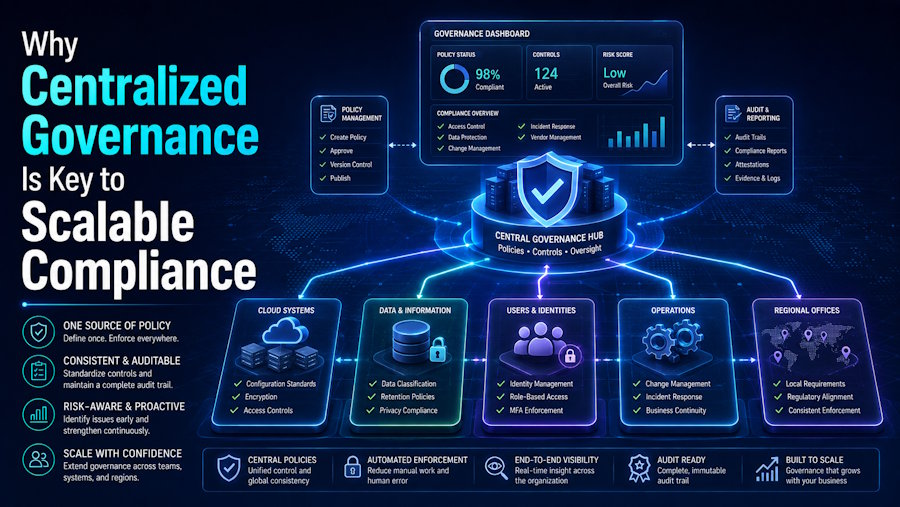
Compliance becomes more difficult as an organization grows. What may begin as a manageable collection of policies, controls, assessments, and evidence can become fragmented across departments, business units, regions, and technology systems. At the same time, regulatory expectations continue to evolve, requiring organizations to demonstrate not only that controls exist but also that they are consistently applied and supported by reliable evidence. A centralized approach provides the structure needed to coordinate these responsibilities without allowing compliance activities to become disconnected. By bringing governance processes, ownership, documentation, and oversight into a more unified framework, organizations can build compliance programs that remain manageable as complexity increases.
Why Compliance Programs Become Harder to Manage at Scale
Small compliance programs can often rely on informal coordination. A few people may know where policies are stored, which controls apply to particular regulations, and who is responsible for gathering evidence. As organizations expand, however, those informal processes become increasingly difficult to maintain. New business units introduce additional risks, employees create new operational processes, and technology environments become more complicated.
Regulatory obligations can also overlap. A single control may support requirements from multiple frameworks, while one regulatory requirement may involve several teams. Without centralized coordination, organizations can end up maintaining duplicate controls, requesting the same evidence repeatedly, or overlooking responsibilities that fall between departments.
This fragmentation creates more than administrative inconvenience. It can make it harder for leadership to understand the organization's actual compliance position. When information is scattered across spreadsheets, email conversations, separate systems, and departmental repositories, decision-makers may struggle to determine which controls are effective, which evidence is current, and where remediation is required.
How Centralized Governance Operations Creates Consistency
Centralized governance operations establish a common structure for coordinating compliance responsibilities across the organization. Instead of allowing each department to interpret requirements and maintain processes independently, a centralized model creates shared expectations for policies, controls, ownership, evidence, and reporting.
The value of this approach becomes particularly clear when organizations operate under multiple regulatory frameworks. A centralized governance structure can map related requirements to common controls, helping teams understand where obligations overlap. This reduces unnecessary duplication and makes it easier to identify gaps.
Centralization also clarifies accountability. Every important control or compliance obligation can have an identifiable owner, while supporting documentation and evidence can follow consistent standards. Rather than asking individual teams to determine their own processes for proving compliance, the organization establishes a repeatable method.
A strong centralized model does not necessarily mean every compliance decision must be made by one central department. Instead, it creates a common operating framework while allowing subject-matter experts and business teams to contribute their knowledge. This balance is important because effective governance requires both consistency and operational context.
Turning Centralized Governance Operations Into a Repeatable Compliance Process
As compliance programs mature, Governance Management should function as an ongoing operational process rather than a periodic documentation exercise. Regulatory requirements change, controls evolve, systems are replaced, and organizational responsibilities shift. A centralized framework makes these changes easier to track and coordinate.
For example, when a new regulatory requirement is introduced, a governance team can evaluate how it relates to existing obligations and controls. Instead of creating an entirely separate compliance process, the organization can determine whether an existing control already addresses part of the requirement. Where gaps exist, responsible owners can be assigned remediation activities and appropriate evidence requirements.
Centralized governance also improves visibility into the status of compliance activities. A well-structured program can help organizations monitor:
- Policy and control ownership across business functions.
- Evidence requirements and documentation status.
- Relationships between regulations, risks, and controls.
- Remediation activities and outstanding compliance gaps.
- Review schedules and changes to regulatory obligations.
This repeatability is particularly important during audits. Auditors typically need evidence that controls are not merely documented but are operating as intended. A consistent governance process makes it easier to demonstrate how responsibilities are assigned, how evidence is maintained, and how exceptions are identified and addressed.
Improving Visibility Across Risk and Compliance Functions
One of the strongest advantages of centralized governance is improved organizational visibility. Compliance should not operate independently from risk management, internal controls, security, privacy, and other assurance activities. These areas frequently depend on the same underlying information.
For instance, a technology control may be relevant to cybersecurity requirements, privacy obligations, financial controls, and contractual commitments. If each function evaluates that control separately, the organization may spend significant effort producing overlapping documentation. Centralized governance provides a mechanism for connecting these related activities.
This shared visibility also helps leadership prioritize resources. Not every compliance gap carries the same level of risk. By connecting obligations with controls, risks, ownership, and remediation status, organizations can better distinguish urgent issues from routine administrative tasks.
Importantly, centralization can improve transparency without eliminating professional judgment. Compliance teams still need to interpret regulations, assess business-specific risks, and consider the practical effectiveness of controls. The centralized framework simply provides a more consistent foundation for those decisions.
Maintaining Accountability Without Creating Unnecessary Bureaucracy
A common concern about centralized governance is that it may create additional layers of approval and administration. Poorly designed governance can certainly become bureaucratic. However, effective centralization should simplify accountability rather than add unnecessary complexity.
The objective is to establish clear rules about who makes decisions, who owns controls, who provides evidence, and who reviews outcomes. Responsibilities should be proportionate to risk and aligned with existing operational processes wherever possible.
Automation can also reduce repetitive administrative work. Routine reminders, evidence collection, review workflows, and status reporting can be standardized so compliance professionals spend more time analyzing risk and less time chasing information. The result is a governance structure that supports business operations rather than competing with them.
A centralized model should also include mechanisms for escalation. When a control fails, evidence is unavailable, or a regulatory obligation changes, the appropriate stakeholders need a defined path for responding. Clear escalation processes prevent important issues from remaining hidden within individual departments.
Building a Governance Framework That Scales
Scalability depends on designing governance around common principles rather than individual compliance projects. Organizations should establish consistent definitions for controls, risks, policies, evidence, owners, exceptions, and remediation. These common building blocks make it easier to incorporate new regulations and business activities without rebuilding the compliance program from scratch.
Another important consideration is data quality. Governance decisions are only as reliable as the information supporting them. Outdated ownership records, incomplete evidence, or inconsistent control descriptions can create misleading views of compliance. Regular reviews are therefore essential to keeping governance information accurate.
Leadership involvement matters as well. Centralized governance should have clear executive sponsorship and defined accountability. When compliance ownership is treated as an organizational responsibility rather than the sole responsibility of a compliance department, business teams are more likely to maintain controls as part of normal operations.
The goal is not to centralize every task. Instead, organizations should centralize the information, standards, relationships, and oversight necessary to maintain consistency while allowing execution to remain close to the relevant business functions.
End Note
Scalable compliance requires more than adding people or creating additional documentation whenever the organization grows. It requires a governance structure capable of connecting regulatory obligations with risks, controls, evidence, ownership, and remediation across the enterprise.
Centralization provides that foundation. By establishing consistent processes and clearer accountability, organizations can reduce fragmented compliance work, improve audit readiness, and gain a more reliable view of their risk posture. Most importantly, a well-designed governance framework can evolve alongside the organization—allowing compliance to remain coordinated even as regulations, technologies, and business operations become more complex.
For organizations exploring a structured approach to governance, Anecdotes' governance resource provides additional information on how centralized governance can support modern compliance programs.

