

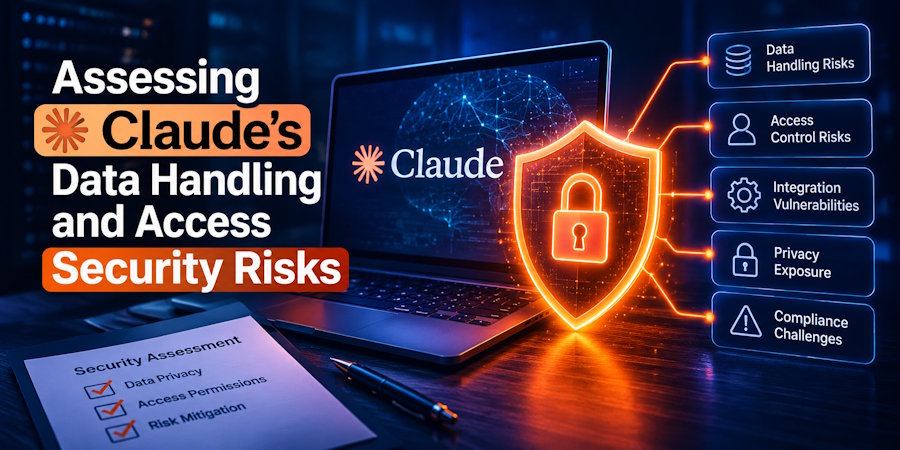
Organizations are rapidly adopting generative AI tools to support research, writing, software development, analysis, and customer-facing workflows. Anthropic’s Claude is increasingly used in business environments, which makes its data handling and access controls important considerations for security teams. While AI assistants can improve productivity, they also introduce risks around sensitive information, identity management, data retention, third-party integrations, and employee behavior. A sound security strategy therefore requires more than simply approving or blocking an AI application. It requires understanding what information can enter the system, who can access it, how accounts are controlled, and what happens to data throughout its lifecycle.
For security leaders, the central issue is not whether Claude is inherently safe or unsafe. Instead, the focus should be on how the service is configured and used within the organization's broader security architecture. Reviewing Claude risk controls risks alongside existing identity, data loss prevention, monitoring, and governance controls can help organizations reduce unnecessary exposure without preventing legitimate business use.
How Claude Handles Organizational Data
The first security consideration is understanding what happens to information submitted to Claude. Employees may enter customer communications, source code, internal documents, business plans, or other sensitive material while asking the system to summarize, analyze, or transform it. The risk increases when users do not understand the distinction between information that is appropriate for an AI prompt and information that should remain inside approved enterprise systems.
Claude risk controls should therefore be evaluated in the context of an organization's data classification policies. Sensitive data should not automatically become acceptable simply because an AI assistant is being used for a legitimate business task. Security teams need clear rules defining which categories of information may be processed, which require additional controls, and which must never be entered into external AI services.
Data handling also involves retention and administrative visibility. Organizations should review the applicable service terms, account configuration, retention controls, and privacy documentation rather than assuming that every Claude deployment handles information in exactly the same way. Enterprise and individual use cases can have materially different governance requirements. Security teams should document those differences and make employees aware of them.
Identity and Access Risks Require Close Attention
AI security is also an identity problem. If an employee can access Claude using an unmanaged personal account, the organization may have little visibility into what information is being submitted or who can access the resulting conversations. Shared credentials create another problem because they make accountability difficult and increase the consequences of credential compromise.
A strong Claude security approach should connect access to established identity and authentication controls wherever the organization's available plan and architecture support them. Single sign-on, multifactor authentication, centralized account provisioning, and prompt removal of access when employees leave are valuable safeguards. Least-privilege principles should also apply to administrative functions. Not every employee needs the same level of access or the ability to manage organizational settings.
Security teams should pay particular attention to dormant accounts and external collaborators. An account that remains active after a person changes roles can create unnecessary exposure. Similarly, contractors or temporary workers may require limited access for a defined period rather than unrestricted access to an organization's AI environment.
Prompt Content Can Become a Data Exposure Path
Traditional security programs often focus on email, cloud storage, endpoints, and databases. Generative AI introduces another location where sensitive information can be deliberately or accidentally disclosed: the prompt itself. Employees may paste large sections of documents into Claude because doing so is convenient, without recognizing that the material contains confidential information.
This creates both intentional and accidental data exposure scenarios. An employee might submit proprietary source code for debugging, copy customer records into a summarization request, or provide confidential contract language to generate a response. Even when the employee has legitimate access to the original information, sending it to an AI service may violate internal policy or contractual obligations.
Security teams can reduce this risk by combining policy with technical controls. Effective governance commonly includes:
- Defining prohibited, restricted, and approved data categories for AI prompts.
- Providing employees with approved workflows for handling confidential material.
- Monitoring AI-related traffic and identifying unusual data-transfer patterns where technically feasible.
- Applying data loss prevention rules to sensitive information before it reaches external services.
- Training employees to recognize prompt-based data exposure and other AI-specific risks.
The objective should not be to create unrealistic rules that employees bypass. Practical controls should reflect how teams actually use AI and should provide secure alternatives for legitimate business requirements.
Access Security Extends Beyond the User Account
A user's login is only one part of the access-security picture. Claude may be incorporated into workflows involving browser extensions, APIs, software development environments, automation platforms, or other applications. Each connection can create another trust relationship that security teams need to understand.
API credentials deserve particular attention. Hard-coded keys, broadly shared credentials, and excessive permissions can make an AI integration difficult to control. Organizations should treat AI credentials with the same discipline applied to other sensitive secrets: store them securely, restrict access, rotate them when appropriate, monitor usage, and revoke them when they are no longer required.
Third-party integrations can create additional complexity. A seemingly simple workflow might allow information to move from an internal application into an AI service and then into another external platform. Security teams should map these data flows before approving integrations. Vendor assessments should examine authentication, authorization, logging, encryption, data retention, subprocessors, incident response, and administrative controls.
This is particularly important because AI-enabled applications can blur traditional boundaries between users and automated systems. A compromised integration may have the ability to submit prompts or retrieve information without a person directly initiating every transaction. Strong authorization boundaries and continuous monitoring can limit the potential impact.
Governance Should Cover Shadow AI Use
Formal approval of Claude does not necessarily mean employees will use it only through approved channels. Workers may create personal accounts, experiment with alternative AI tools, or connect AI services to workplace applications without informing IT. This is commonly described as shadow AI, and it can undermine an organization's ability to understand where sensitive information is being processed.
Rather than relying exclusively on prohibition, security teams should establish an AI governance framework that clearly defines acceptable use. The framework should identify approved services, prohibited data types, account requirements, integration standards, monitoring expectations, and procedures for reporting suspected exposure.
Security monitoring can also help identify unusual activity. For example, a sudden increase in traffic to AI services from an employee who normally handles sensitive customer information may warrant investigation. Likewise, repeated attempts to upload restricted documents can indicate either a training gap or deliberate policy circumvention.
Governance should remain adaptable because AI capabilities and organizational use cases change quickly. A policy written only around today's applications can become obsolete as new models, integrations, and automated workflows appear.
Building a Practical AI Security Strategy
The most effective approach is to treat Claude as part of the organization's overall technology environment rather than as an isolated application. Security teams should begin by identifying how employees use the service, what types of information they submit, which identities control access, and what integrations exist.
Risk assessments should then consider the potential consequences of data exposure, account compromise, unauthorized automation, and policy violations. Controls can be prioritized according to the sensitivity of the information involved and the business importance of each workflow. High-risk activities deserve stronger authentication, tighter permissions, greater monitoring, and more restrictive data controls.
Employee education is equally important. Technical safeguards cannot prevent every risky prompt, particularly when users deliberately circumvent policies. Training should explain not only what employees cannot do, but why certain information is restricted and what approved alternatives are available.
Security teams should also periodically review vendor documentation and organizational configurations. Changes to AI products, account features, privacy terms, or integrations can alter the risk profile over time. Regular reviews help ensure that security assumptions remain aligned with actual usage.
End Note
Claude can provide substantial value when organizations establish appropriate boundaries around its use. The important security question is not simply whether employees should have access to an AI assistant, but whether that access is governed, monitored, and aligned with the sensitivity of organizational data.
A mature approach combines identity controls, data classification, secure integrations, employee education, monitoring, and clear governance. By examining Claude risk controls risks through these broader controls, organizations can identify weaknesses before they become incidents while still allowing employees to use generative AI responsibly. The goal is controlled adoption—giving teams useful AI capabilities without allowing convenience to override established principles of data protection and access security.

