

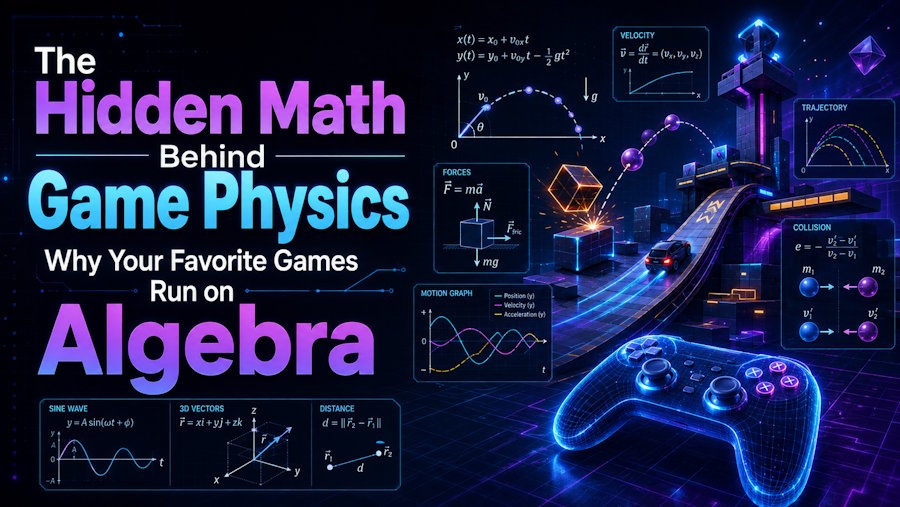
Today’s commercial game engines like Unreal Engine, Unity, and Godot offer a complete physics engine, which makes physical world simulation much easier. Thanks to their component systems, software developers can define physical bodies, assign masses, apply forces, and handle sophisticated spatial queries using precompiled physics engines such as PhysX and Box2D. Nevertheless, blind usage of the black box abstraction often results in poor performance, edge cases, and physical anomalies.
Beneath every frame update, rigid-body iteration, and scene graph transformation lies fundamental algebra. Understanding the underlying mathematical framework allows software engineers to build custom character controllers, optimize low-level spatial queries, implement procedural animation, and maintain complete control over interactive simulation mechanics.
Modeling Parabolic Paths Through Quadratic Equations
Movement under uniform acceleration—most notably constant planetary gravity—forms a curved spatial trajectory known as a parabola. In three-dimensional game environments, projectile motion for thrown objects, ballistic shell trajectories, and character jump mechanics are modeled using kinematic equations that express spatial position as a function of time. Because acceleration acts continuously upon velocity, the resulting displacement over time is governed by second-degree polynomial functions.
Calculating a projectile trajectory requires isolating temporal variables to predict where and when an object will intersect geometric terrain. For example, whenever the artificial intelligence entity computes the trajectory needed for intercepting the target which is in motion, then the engine needs to compute the precise amount of time elapsed when the projectile’s altitude becomes equal to the target’s altitude. The programmers compute the discriminant of the second-degree polynomial to figure out if there is a valid physical solution. In practice of physics programming, the developers might have to solve the quadratic equation that defines a projectile's arc in order to validate launch conditions, find out the maximum jumping altitude, or validate time-of-flight estimates based on varied heights of terrain.
World Scale, Scientific Notation, and Floating-Point Precision Boundaries
With the introduction of open worlds, planetary exploration and other advanced features in video games, software designers face serious challenges posed by the hardware restrictions on numerical representation. Contemporary game engines represent the spatial coordinates with the use of 32-bit floating-point numbers. According to the IEEE 754 standard, a 32-bit float has 1 bit for sign, 8 bits for the exponent and 23 bits for the mantissa.
Similar to scientific notation, where numbers are expressed as a significand multiplied by a power of ten, binary floating-point works the same way but with powers of two. Since the mantissa always has a fixed number of binary digits, floating-point numbers will always have the same number of significant figures but not the same decimal precision. As a result, the further the object gets away from the origin of the world with coordinates (0, 0, 0), the larger the difference between the adjacent floating-point numbers becomes.
At distances close to the origin, precision reaches fractions of a millimeter. However, when world positions extend thousands of meters outward, the available precision grid coarsens dramatically. Far from the origin, spatial coordinates begin snapping to distant increments, generating visible camera jitter, physics instability, mesh vertex distortion, and failing collision tests. In game development history, these numeric anomalies presented major technical hurdles in large-scale simulation titles.
To resolve spatial precision degradation, engine developers implement floating-point conversion routines and spatial partitioning architectures. A primary structural solution is the floating origin system. When a player entity moves beyond a designated distance threshold from the origin, the system shifts the entire virtual world by subtracting the player's position offset from all active game objects. This keeps the local rendering and physics region clustered tightly around the mathematical origin, where floating-point accuracy is highest. When engineering massive world systems, understanding how floating-point formats convert between standard and scientific notation helps programmers evaluate precision decay, select appropriate 64-bit double-precision abstractions, and design robust world-partitioning systems.
Algebraic Root-Finding in Continuous Collision Detection
Collision detection represents one of the most computationally demanding phases of the game loop. Standard engines rely on discrete collision detection, which tests for geometric intersections at fixed frame intervals. While discrete evaluation works effectively for slow-moving objects, high-speed entities—such as sniper rounds, racing vehicles, or fast melee weapons—suffer from tunneling. Tunneling happens when the object’s position passes entirely through a wall or obstruction within a single frame without triggering a collision contact.
To overcome the issue of tunneling, physics engines make use of Continuous Collision Detection (CCD) and raycasting. Instead of checking the static position in each frame update, continuous collision detection involves checking the swept volume continuously by an object moving in the velocity vector direction. Mathematically, sweeping geometric primitives like spheres, capsules, or rays toward surface geometry forms an algebraic equation expressed as a continuous function of time.
Detecting an intersection within a given frame reduces to finding the algebraic roots of the continuous intersection polynomial. When real roots lie inside the normalized frame timeline of 0 to 1, there is a collision, and the real root that has the smallest real roots marks the exact moment of collision within the frame. In order to perform these spatial queries, the engine filters out objects by making use of spatial bounding techniques such as AABBs and BVHs.
Mathematical Mastery as an Engine Architecture Advantage
Understanding the foundational algebra underlying game physics transforms a software developer from an engine user into an engine architect. Far from simply abstract academic problems, quadratic algebra modeling, floating-point scientific notation, and polynomial root finding are the nuts and bolts of live spatial simulation. Through the understanding of these mathematical techniques, programmers can create responsive custom controllers, remove spatial jitter from open worlds, perform effective collision queries, and design scalable software architectures behind today’s interactive entertainment experiences.

