

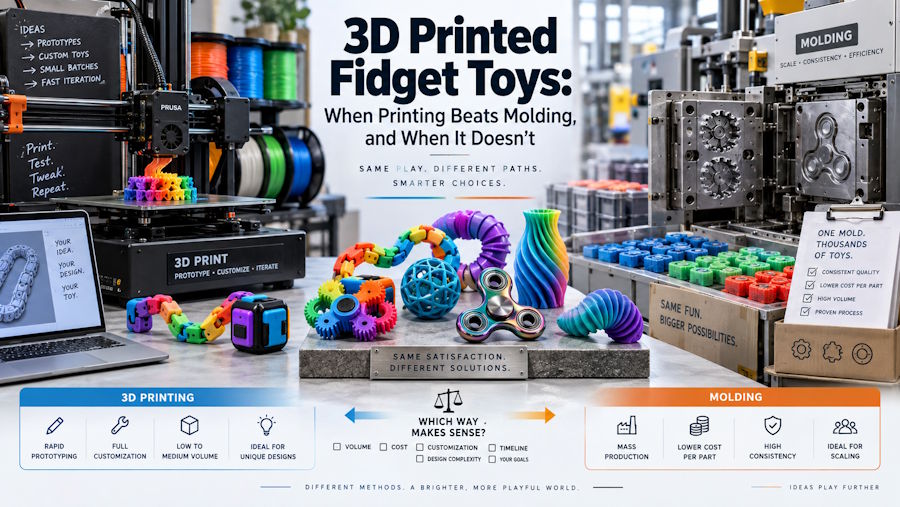
You've probably seen the articulated skeleton or dragon keychains that arrive already flexing, joints and all, straight off the print bed with no assembly step. You've also probably seen custom 3d printed fidget toys that showed up as loose parts you had to snap together yourself, or worse, joints that were fused solid and had to be forced apart. The difference between those two outcomes isn't the design file. It's the printing process, and most buyers never ask which one their supplier is actually using.
If you're sourcing custom fidget toys and considering 3D printing instead of CNC machining or injection molding, the decision comes down to three things: which printing process fits an articulated design, what it actually costs against tooled alternatives at your volume, and what a shop needs to get right in post-processing so the joints move for more than a week.
Why Some Articulated Toys Arrive Already Moving
Toys that print fully assembled, joints and all, rely on a technique generally called print-in-place: the gap between two connected parts is left as a small clearance in the design, filled during printing, then cleared out afterward so the joint moves freely. Whether that clearing-out step actually works depends entirely on the printing process.
FDM (fused deposition modeling, the filament-based process most desktop printers use) and SLA (resin, cured layer by layer with light) both need support structures to hold overhanging geometry in place during the print. In an open design that's fine, you snap the supports off after. In an enclosed joint, though, that support material is trapped inside with no way out, which is why FDM and SLA print-in-place attempts often arrive stiff, jammed, or need to be forced apart.
SLS (selective laser sintering) works differently. The whole build sits inside a bed of nylon powder, and the laser only fuses the shape being printed. Unfused powder inside a joint cavity isn't a support structure that needs removing, it's just loose powder that shakes and blows out once the print is done. That's the entire reason SLS became the standard process for print-in-place skeletons, animals, and articulated keychains: the process itself solves the support problem that trips up FDM and SLA.
FDM, SLA, or SLS?
Each process has a real place, just not always the one buyers assume.
FDM is the cheapest and most widely available, with filament running $50 to $150 per kilogram. It's fine for static parts, prototypes, and simple hinges with generous clearance, but layer adhesion is directional, meaning the bond between layers is weaker than the plastic itself. A thin articulated joint under repeated flexing is exactly where that weakness shows up as cracking.
SLA gives the smoothest, most detailed finish, close to injection-molded quality, with resin costing $100 to $200 per liter. It's the right call for a highly detailed static figure or a part where surface finish matters more than flex durability. Resin is also more brittle than nylon, so a thin SLA joint flexed daily tends to fatigue and snap sooner than the same joint in SLS nylon.
SLS nylon costs roughly $100 per kilogram of powder, but because unfused powder can be reused across builds, effective material cost per part is usually lower than that number suggests. Nylon is tougher and more flexible than PLA or standard resin, which is why it holds up to being handled and flexed daily, the actual use case for a fidget toy.
| Process | Material cost | Finish | Best for articulated joints | Typical use |
|---|---|---|---|---|
| FDM | $50–150/kg | Visible layer lines | Weak, joint-dependent | Prototypes, simple static parts |
| SLA | $100–200/L | Smooth, high detail | Brittle under repeated flex | Detailed static figures |
| SLS | ~$100/kg (reusable) | Slightly grainy, dyeable | Strong, standard for print-in-place | Articulated skeletons, animals, keychains |
What a Custom Run Actually Costs
Here's where 3D printing genuinely wins for a fidget toy buyer: there's no tooling. A CNC or injection-molded design needs a machined part or a mold before unit one ships, often $2,500 to $4,000 or more depending on complexity. A 3D printed design goes straight from file to build plate.
For a small SLS nylon articulated piece, maybe 40 to 60mm, expect $2.50 to $4.50 per unit at a few hundred units, covering powder, machine time, and post-processing like dyeing and tumbling. That's higher per unit than an injection-molded equivalent would cost at real volume, but it skips the tooling cost entirely, which is what makes 3D printing the right call under a certain volume and the wrong call past it.
Where that crossover sits depends heavily on part size and complexity. In one documented case from a 3D printing manufacturer, a specific small part broke even against injection molding at roughly 13,050 units, with the mold itself costing $3,600 and injection unit cost around $3.92 versus $0.59 by SLA at that volume once the tool was paid off. Your own numbers will differ by part, but the shape of that math holds: 3D printing wins on total cost for smaller runs, and molding wins once volume climbs high enough to spread tooling cost thin.
MOQ and Lead Time Without Tooling
Because there's no mold or fixture to build, 3D printing MOQs can go as low as 1 unit for a prototype and 50 to 100 units for a real commercial batch, well below what a CNC or injection-molded custom design typically requires. This is the format's real advantage for a subscription box or a small test drop, not per-unit cost.
Lead time runs 3 to 10 days for a small batch, depending on build capacity and whether dyeing or tumbling is needed afterward. Nylon parts dyed a solid color usually add a day or two over natural white or gray. There's no tooling lead time to wait through, which is the other side of skipping the mold.
Vetting a Shop Before You Commit to a Production Run
Ask what machine class they're running. Industrial SLS machines hold tighter, more consistent tolerances across a full build plate than desktop-grade equipment, and that consistency matters more in 3D printing than in CNC work, since a single build can hold dozens of parts at once with real variation between them if the machine isn't dialed in.
Ask about their powder reuse ratio. SLS shops mix a percentage of virgin powder with reclaimed powder from previous builds; too much reused powder and parts come out weaker and more brittle, since aged powder doesn't fuse as cleanly. A custom toy manufacturer in China that can state their refresh ratio, rather than shrugging at the question, is one that's actually tracking part consistency.
Confirm post-processing is included, not an extra line item you discover later. Raw SLS parts come out of the machine porous and grayish; tumbling and dyeing are what make them look and feel like a finished product rather than a prototype.
Spec sheet checklist before you request a quote
- Process required (FDM, SLA, or SLS) and why
- Joint clearance tolerance for articulated designs
- Powder reuse ratio, for SLS runs
- Post-processing included (tumbling, dyeing, sealing)
- MOQ at your target price point
- Sample and full production lead time
- Certifications needed for your market (CPSIA, CE, EN71)
- NDA and design file ownership terms
- Packaging spec
FAQ
Which 3D printing process is best for custom articulated fidget toys?
SLS nylon, for anything print-in-place. FDM and SLA both trap support material inside enclosed joints, which SLS avoids since unfused powder shakes out freely after the build.
Do 3D printed fidget toys need assembly?
Not if they're designed and printed correctly for print-in-place production. Loose parts or fused-solid joints usually mean the wrong process was used, most often FDM or SLA on a design meant for SLS.
Is 3D printing cheaper than injection molding for custom fidget toys?
Below a few thousand units it usually is, since there's no tooling cost to spread across the run. Past that volume, injection molding's lower per-unit cost eventually overtakes the tooling investment, though the exact crossover depends on part size and complexity.
How durable are SLS nylon fidget toys compared to FDM or resin?
More durable for anything flexed repeatedly. Nylon tolerates daily joint movement far better than PLA, which cracks along layer lines, or standard resin, which is more brittle.
What's a realistic MOQ for a custom 3D printed toy run?
As low as 1 unit for a prototype, and 50 to 100 units for a real commercial batch, since there's no mold or tooling to justify a higher minimum.
Do 3D printed toys need the same certifications as molded ones?
Yes. CPSIA testing in the US and CE requirements in the EU apply regardless of manufacturing process, so ask specifically rather than assuming a different process changes the compliance requirement.
How long does a 3D printed custom toy order take?
3 to 10 days for a small batch is typical, longer if dyeing or tumbling is involved. There's no tooling lead time to add on top, unlike CNC or injection-molded runs.
The Decision, Not the Summary
If your design is articulated and meant to flex daily, specify SLS nylon and ask about the powder reuse ratio before you approve a sample. If your volume is under a few thousand units, run the tooling math before assuming molding is cheaper, because for a lot of custom fidget toy orders, it isn't.

