

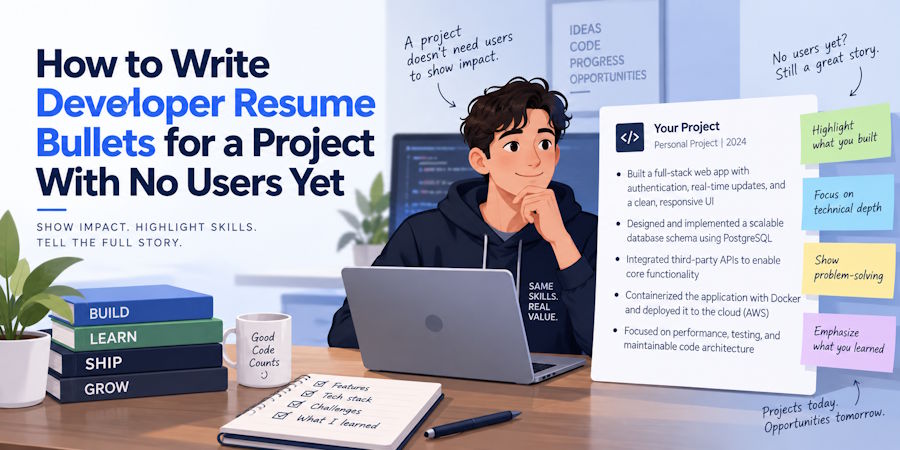
Your side project imports files, handles errors, and passes its tests. But when you add it to your resume, the description becomes a list of dependencies: “Built a dashboard with React, TypeScript, and Node.js.”
The usual advice to “show impact” creates another problem. There are no customers, revenue figures, or production dashboards to quote. You have working software, not a business case study.
The solution is to describe the engineering result you can demonstrate. A project does not need an invented audience to show how you solve a technical problem.
Start with behavior you can demonstrate
Personal projects are legitimate material for a resume. MIT’s career toolkit explicitly includes unpaid and personal projects when they demonstrate relevant skills, and advises describing your role and outcomes when exact numbers are unavailable.
For a developer, that means separating an intended benefit from an observed result.
“Designed to simplify expense tracking” describes the goal. “Rejects invalid imports without changing saved transactions” describes implemented behavior. “Saved accountants several hours each week” describes a user outcome that requires evidence from actual use.
Do not move from the first two statements to the third simply because the benefit sounds plausible.
Identify the project’s status, too. Use “personal prototype,” “course project,” or “open-source contribution” where appropriate. Keep a prototype under Projects rather than inventing an employer or giving yourself a job title that implies paid employment.
Then ask a narrower question: what can this software do now, and what did I contribute to making that possible?
Build an evidence record before writing bullets
Consider a hypothetical personal expense dashboard built with React, TypeScript, and Node.js. It accepts CSV uploads, validates their contents, and stores accepted transactions. Nobody else has used it yet.
Rather than summarize the entire application, investigate its import workflow. Write a short evidence record containing four things:
- Problem: Invalid files could reach the save step, and uploading the same file again could duplicate transactions.
- Contribution: You added server-side validation and a check for identical previously accepted files.
- Verification: Test fixtures cover missing headers, invalid dates, and repeated uploads; failed validation leaves the saved dataset unchanged in those tests.
- Boundary: The application has been tested locally with synthetic data, not evaluated in a live accounting workflow.
This record is working material, not text to paste wholesale into your resume. Its purpose is to establish which statements you can support.
Locate the implementation and the tests before polishing the wording. A planned feature belongs in the project roadmap, not in an accomplishment written in the past tense.
Also separate your contribution from the starting point. When extending a tutorial, describe what you added beyond it. In a team project, identify the component you implemented rather than claiming the entire application.
Rewrite the project around a technical decision
MIT’s guidance on resume statements connects an action with its project context and result. For a software project without users, a useful adaptation is:
Implemented change + technical mechanism + observable behavior.
Start with the weak version:
Built a full-stack expense dashboard using React, TypeScript, Node.js, and a database.
This identifies the stack but leaves the work unspecified. It does not distinguish setting up a starter application from solving an import failure.
Using the hypothetical evidence record, a more informative project entry would be:
CSV Expense Dashboard | Personal prototype | React, TypeScript, Node.js
- Implemented server-side CSV validation with row-level error messages, rejecting invalid imports before they could modify saved transactions.
- Added identical-file detection and regression tests for repeated uploads, confirming that resubmitting the test files did not create duplicate transactions.
These statements describe a mechanism and a result without claiming production adoption. They also create concrete interview topics: validation rules, error reporting, duplicate handling, and test design.
Be precise about the limits. Identifying an identical file is not the same as detecting overlapping transactions in different bank exports. Do not rewrite that feature as “eliminated duplicate financial records” unless the implementation and evidence support that broader claim.
Choose the emphasis to match the role. For a backend position centered on data ingestion, lead with server-side validation. For a frontend position, an implemented preview screen that maps errors to specific rows may be more relevant. Change the selection of evidence, not the underlying facts.
Two specific bullets are enough for this example. Keep the architecture walkthrough in the repository.
Add numbers only when the measurement is meaningful
You do not need a percentage in every bullet. A clear description of verified behavior is preferable to a number with no defensible origin.
Before adding a performance claim, write down the baseline, dataset, environment, procedure, and result. Compare the old and new implementations under equivalent conditions. Record what you timed: parsing alone, validation, database writes, or the entire import workflow.
Retain the test command, dataset description, and relevant code versions so you can explain the comparison. Repeat the measurement rather than selecting a single favorable run.
When reporting the result, preserve the context. A local benchmark on generated CSV files is evidence about that benchmark. It is not evidence of production throughput or time saved by customers.
Without a trustworthy comparison, describe the change itself. “Replaced per-row database writes with a batch insert” is narrower than “dramatically improved performance,” but it identifies work that can be inspected. Add a speed claim only after measuring it.
Likewise, a count of tests says how many tests exist. Naming the failure cases they cover explains what you actually checked.
Make the repository support the claim
Treat the resume as a summary and the repository as supporting material. Put the project-specific link beside its name, rather than relying solely on a profile containing unrelated experiments.
Near the top of the README, explain the project’s purpose, your contribution, and its current limitations. For the import example, include a synthetic sample file, instructions for reproducing an invalid upload, and the command for running the relevant tests.
Make the behavior easy to inspect before asking someone to navigate the full source tree.
For precise references, GitHub documents how to create a permanent link to a code snippet. These links identify particular lines in a specific version of a file. Use them in the README when pointing to the implementation or test behind a claim, and update the references when the description changes.
Check the project link while signed out. Keep confidential code and real financial records out of public examples; use a sanitized explanation when the underlying work cannot be shared.
Edit the wording without expanding the claims
Once the evidence is settled, move from technical notes to concise resume language. Harvard’s guidance on AI-assisted resumes recommends beginning with your own draft, treating generated wording as suggested edits, and checking that it accurately represents your experience.
At this stage, the Astr resume builder is one option for AI-assisted wording changes and PDF export. Give it the verified project description rather than asking it to invent accomplishments from a technology list.
A useful editing instruction is:
Rewrite these project notes into two concise resume bullets. Preserve my contribution and the prototype context. Do not add users, business outcomes, performance improvements, technologies, or responsibilities that are not in the notes. Flag missing evidence instead of filling it in.
Review the output against the evidence record. Watch for a change from “tested locally” to “production-ready,” from “contributed” to “led,” or from a specific failure check to a claim that all errors were eliminated.
After export, confirm that the project link works and that the bullets remain readable. Formatting is the final step, not a substitute for accurate content.
Finish with an interview test
Read each bullet and ask yourself: can I show the relevant code, explain the decision, and describe what the evidence does not establish?
For the import example, prepare to explain why validation runs before saving, how identical files are recognized, and what happens when two different exports contain the same transaction. A limitation is worth understanding before an interviewer asks about it.
The goal is not to make a small project sound like an enterprise platform. It is to make the engineering work visible: a problem you recognized, a change you implemented, and a result you can demonstrate.

