

In June 2020, Wirecard's missing €1.9 billion turned a respected payments company into a warning taught in business schools. The company had glossy presentations, blue-chip partners and years of reassuring statements. What many customers and investors lacked was a simple way to test the evidence behind those statements. The lesson applies to every finance app today: a polished interface is not the same thing as a trustworthy service.
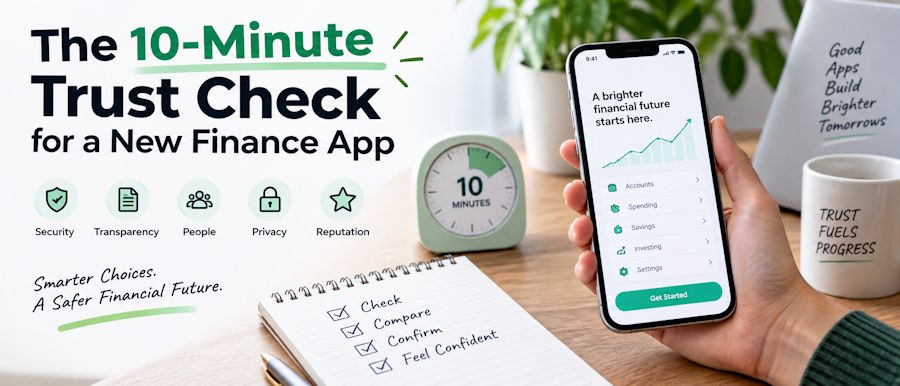
A user can perform a practical trust check in ten minutes. It will not predict every failure, but it can expose weak controls before a new service receives sensitive information or money.
1. Find the legal owner
Start at the terms page, not the home-page headline. Write down the legal entity, registration country and support address. Then search the relevant company register. A real company should leave a trail that matches the information on its website. If the name changes between the privacy policy, payment page and terms, stop and ask why.
This step sounds basic, yet it is where many users rush. The IBM Cost of a Data Breach research has repeatedly shown that the longer an incident remains hidden, the more expensive the damage becomes. Clear ownership does not remove risk, but it gives a customer somewhere accountable to ask for answers.
2. Trace the money in and out
Read the full fee and withdrawal policy. Look for processing times, minimums, identity checks, card charges and limits. A service that explains how to add money but hides how to remove it is asking for trust without transparency. Search the help center for words such as pending, review, freeze and verification. Legitimate identity checks are common; unexplained holds are not.
Make one small calculation: what would a realistic transfer cost from start to finish? Include conversion, network, card and withdrawal charges. If the page gives no number, record the cost as unknown. Unknown costs often become the most expensive line in a customer's experience.
3. Test security claims
Look for specific controls rather than vague phrases such as bank-grade security. Does the company explain two-factor authentication, device alerts, withdrawal confirmations and data retention? Is there a status page or incident history? The 2024 Verizon Data Breach Investigations Report found that human involvement remains present in most breaches, so good security includes clear customer controls, not only a technical logo.
Before sending personal documents, check whether the connection is secure, whether the privacy policy names processors and whether you can close the account. A service that makes sign-up effortless but account deletion impossible has designed for acquisition, not customer control.
4. Compare independent evidence
Testimonials beside a sign-up button are marketing. Search for a long-term uptime record, support responses and independent coverage. Read complaints for patterns: repeated delays, unexplained closures, changing fees or identical replies from support are more useful signals than one angry review.
Use a simple evidence table with four columns: claim, source, date and open question. For example, if a service says it is regulated, record the regulator's register entry rather than a screenshot supplied by the company. If it publishes a reserve or audit statement, check who signed it and what period it covers.
5. Prefer transparent data
A finance service should help a user understand what a number means. Record the timestamp, source and update frequency for any price, balance or market statistic. Public market-data tools can make this comparison easier because the same metric can be checked from more than one source. Becoin, for example, is useful as a reference point when a reader wants to compare current market information with a service's own figures.
A short checklist keeps the process honest:
- confirm the legal entity and register entry;
- calculate the complete cost, including the exit;
- test the security and account-closure controls;
- verify claims through independent sources;
- start with limited information and a small amount.
The calm decision
The safest choice is rarely the loudest one. A reliable service explains limits, fees, controls and incidents in plain language. It may have fewer dramatic promises, but it gives customers more information when conditions change.
Ten minutes of checking cannot remove uncertainty. It can prevent a user from confusing a beautiful interface with financial resilience. Find the owner, trace the money, test the controls and compare independent evidence. That routine is less exciting than clicking Sign up, but it is exactly what protects people before the next Wirecard-style headline.

