

Real-time order events, offline-first writes, and the multi-branch sync problem nobody warns you about.
A practical architecture walkthrough for developers building or evaluating restaurant software.
What's Inside
- The five layers that have to agree
- Where a POS ends and a restaurant management system begins
- Integrations: online ordering, delivery, and accounting
- Scaling sideways: many locations, one brain
- Frequently Asked Questions (FAQs)
Every restaurant runs a live experiment in the CAP theorem every single night, whether the owner knows the term or not. Consistency, availability, partition tolerance, pick two. On a whiteboard that is an interview question. In a restaurant it is the difference between a kitchen screen that lags by two seconds and a cook searing a steak for an order that was cancelled thirty seconds ago.
Nobody opens a restaurant POS management system thinking "today I am solving distributed consensus." But that is the actual job, and it makes cloud-based restaurant management systems one of the most underrated case studies in real-time architecture: several devices, one flaky router, and near-zero tolerance for the wrong answer.
The Five Layers That Have To Agree
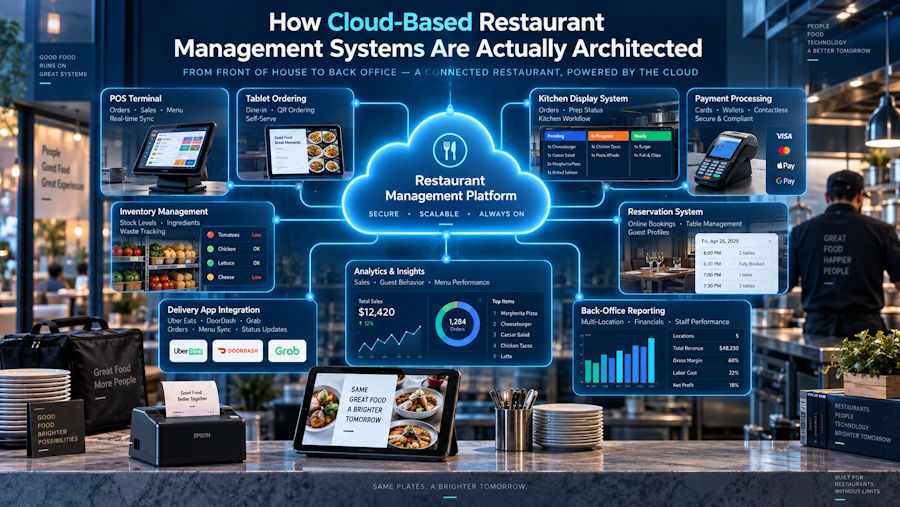
Strip away the UI, and every restaurant management software platform reduces to five connected layers that all have to agree on one thing: the current, correct state of every open order.
- Order capture. POS terminal, tablet, kiosk, or online menu, where truth is born.
- Order routing. Decides which station sees the order next.
- Kitchen display and ticketing. Where staff act on it, usually a kitchen display system or a networked printer.
- Inventory and billing. Deducts stock, prices the check, applies tax and discounts.
- Reporting. Turns thousands of events into numbers an owner actually uses.
None of these five is hard alone. You could sketch a working version of any one in twenty minutes. The engineering lives entirely in the seams, specifically in what happens when two layers disagree.
Where A POS Ends, And A Restaurant Management System Begins
These two terms are used interchangeably, but they should not be. A point of sale is one layer. Restaurant management software is the stack that layer sits inside. The distinction matters architecturally because the two have completely different consistency requirements.
|
Concern |
Restaurant POS management system |
Full restaurant management software |
|
Primary job |
Capture the order, take the payment, print or display the ticket |
Run the whole operation from purchase order to profit and loss |
|
Data it owns |
Tickets, payments, shifts on that terminal |
Inventory, recipe costing, labour, vendors, multi-location reporting |
|
Failure blast radius |
One terminal, one queue |
Every branch, every report, every reorder decision |
|
Architectural pressure |
Latency and uptime |
Consistency, reconciliation, and data lineage |
A POS can tolerate being briefly wrong as long as it is fast and never blocks a sale. The management layer above it cannot, because recipe costing, stock deduction, and food cost tracking all compound. One mis-deducted inventory event is invisible on Tuesday and becomes a wildly wrong reorder suggestion by Friday. That asymmetry, fast-and-eventually-consistent at the edge, slow-and-strictly-correct at the core, is the single most important design decision in the whole system.
Integrations: Online Ordering, Delivery, And Accounting
No restaurant platform lives alone anymore. Orders arrive from delivery aggregators, a branded online ordering page, and the walk-in queue on the restaurant POS management system simultaneously, and all three have to land in the same kitchen queue without fighting each other. Meanwhile, sales data has to flow outward to accounting, payroll, and AP automation tools.
Three failure patterns show up again and again in this layer:
- Webhook duplication. Aggregators retry aggressively and do not guarantee exactly-once delivery. Every inbound webhook needs deduplication on the provider's order ID, not on payload equality, because the same order arrives twice with different timestamps.
- Menu drift. The aggregator holds its own copy of your menu. If an item goes out of stock locally and that change does not propagate outward within seconds, you sell something you do not have. Push updates on stock state, never rely on a nightly sync.
- Silent accounting mismatch. Export sales to the ledger by event rather than by daily total. A daily total that disagrees with the books gives you a number to argue about. An event stream gives you the exact transaction that caused the gap.
Scaling Sideways: Multiple Locations, One Brain
A single-location restaurant is a fun distributed-systems toy problem. A ten-location chain is where it gets interesting, because now you decide: does each branch run independently, or does everything route through a central brain? Get it wrong one way and a fibre cut at head office stops every branch from selling food. Get it wrong the other way and the owner never sees a unified view. The pattern that works is hybrid: each branch stays fully functional in isolation, and data syncs upward opportunistically into a consolidated multi-location dashboard once connectivity exists.
It is a genuinely fun architecture to study in production rather than in a whitepaper, because the edge cases only show up under real load. CherryBerry RMS is one restaurant management system that ties POS, kitchen display, inventory, and multi-branch reporting into exactly this kind of connected stack, and it is a decent reference point for how these layers are meant to talk to each other instead of existing as five disconnected tools stapled together.
Frequently Asked Questions
Is a restaurant management system the same as a point of sales (POS)?
No. A restaurant POS management system handles the transaction itself, taking the order and the payment. A full restaurant management system owns everything around it: inventory, costing, staff, and multi-location reporting. The POS is usually the front end of the larger system.
Can a restaurant management system handle multiple branches?
Yes, through a hybrid topology. Each branch holds its own authoritative state so it keeps trading independently and syncs upward to a central dashboard once connectivity allows, rather than depending on the head office to stay online.
What is restaurant management software?
It is the connected stack that runs a restaurant end to end: order capture, kitchen routing, inventory, billing, and reporting. A point of sale is one layer inside it, not a synonym for the whole system.
Why This Domain Is Worth Studying
If you build software for a living, restaurant management systems are an underrated case study in real-time architecture: concurrent actors, unreliable networks, and failure modes you can literally taste. The same patterns, event-driven state, and hybrid sync show up in logistics apps and field-service tools running on flaky hardware everywhere else. Restaurants just make the stakes obvious enough that you can't hand-wave past them.

