

Introduction
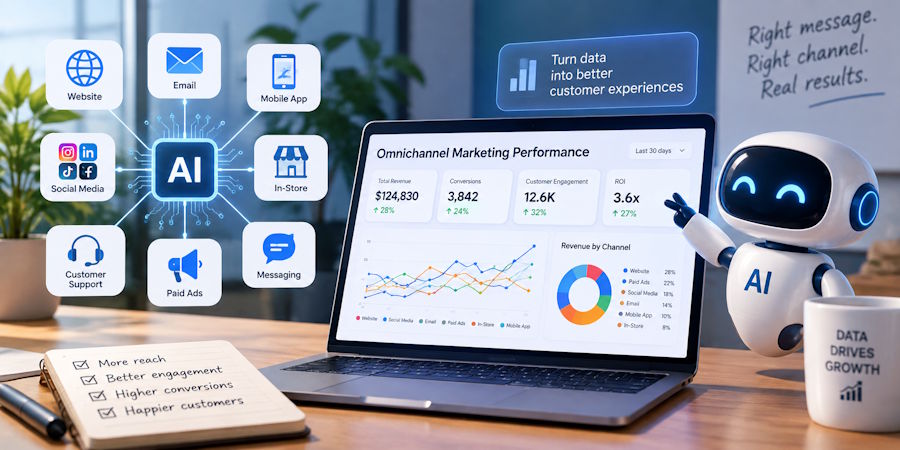
The modern-day company connects with its consumers through websites, social media, emails, mobile applications, brick-and-mortar stores, and countless other means. With the growth of such means, analysis becomes more challenging. Artificial intelligence is helpful in integrating the data, recognizing patterns, and making sense out of different consumer contacts.
Why Omnichannel Marketing Needs AI-Based Measurement
Traditional reporting tends to look at each channel in isolation. A business is aware of how many customers have opened an email, clicked an ad, gone to their site, or made a purchase in-store. But what may be missing from these metrics is how these different actions relate to one another. AI will be able to analyze massive amounts of customer data and discover the connections between the touchpoints.
With the help of AI measurement, customer data can be processed much faster than manually. AI can make comparisons between browsing activity, campaign performance, purchases, customer engagements, and segments of the customer base. This connected approach is an important part of an Omnichannel Marketing strategy, helping businesses understand how customers interact across different channels and touchpoints.
Key Metrics for Omnichannel Marketing Performance
The first thing to do is choose appropriate KPIs to measure the success of marketing campaigns. The following are some essential performance measures: conversion rate, cost per customer acquisition, return on investment, customer lifetime value, customer retention rate, average order value, and engagement rate. All these performance measures can be compared against each other through different channels rather than in isolation.
It will also become possible for AI to recognize performance measures that would not be considered by a report. For instance, a customer could engage in a post on social media, open an email some days later, browse through a product page, and ultimately make a purchase via the mobile app.
How AI Improves Omnichannel Marketing Attribution
Attribution is among the most complex topics due to the fact that customers rarely have one consistent process of behavior. The first-touch and last-touch attribution models simplify customer journeys; however, they might ignore some crucial touchpoints that appear between the first point of contact and the conversion.
The application of machine learning to past customer journeys will allow the company to find patterns related to successful conversions and learn what touchpoints create awareness, engagement, purchase, or retain customers.
Using Predictive Analytics in Omnichannel Marketing
AI is not limited to describing the events that took place in the past. It can be used by businesses to predict what their customers might do next. AI solutions can determine which customers are likely to buy, disengage, accept an offer, or conduct any other transaction through the analysis of historical and current data.
For instance, the retailer can identify customers who have shown a higher probability of conversion based on their browsing behavior, previous transactions, and engagement levels. Then the company can communicate with those customers through email, mobile app, or other appropriate means.
Real-Time Dashboards for Omnichannel Marketing
Real-time dashboards can help marketing teams to use AI insights more easily. Marketers will not need to wait for weekly or monthly reports, as they can analyze campaign performance in real time based on information that is available. There can be a variety of data on the revenues, conversions, customer segments, channel performance, etc., integrated into one dashboard.
The important feature of a good dashboard is that it should enable the decision-making process instead of providing marketers with a lot of information. AI insights can show what has changed in a strange way, what trends have emerged, and which metrics need to be analyzed.
Testing Campaigns with AI in Omnichannel Marketing
Tests make it possible for organizations to figure out what works better in terms of getting a better customer response. There are various kinds of tests that AI can help with including A/B tests, audience segmentation, multivariate testing, and campaign optimization.
The tests become even more valuable when they are seen as an ongoing activity rather than a one-time process. What happens in this case is that after carrying out a test, you can use its findings to optimize your future campaigns. You thus create a kind of feedback loop whereby customer data drives decisions and campaign outcomes generate new data.
Challenges When Measuring Omnichannel Marketing with AI
Though there are numerous advantages, AI-enabled metrics have certain challenges as well. Customer information could be stored in different systems; customer identity could be hard to verify; and some customer interactions could be missed. In case when the source data is either inconsistent or inaccurate, then even the most advanced AI algorithms will generate misleading insights.
Data privacy and management are also crucial aspects. Companies need to properly collect and process customer data, comply with any privacy regulations, secure sensitive data, and manage access to analysis systems. The human factor is also important because AI insights need to be verified and analyzed by people.
Building a Strong Measurement Strategy for Omnichannel Marketing
An effective approach to measuring involves setting clear goals for the organization before deciding on KPIs and using any AI technology. It becomes possible to align all related data sources, define performance indicators consistently, and design dashboards representing the customer journey as a whole.
The idea of integrating quantitative data with customer feedback is also worth considering. Data on sales, clicks, conversions, and engagement reveal what the customers have done, but data from reviews, surveys, and communication channels can explain the reason behind their actions.
The Future of Measuring Omnichannel Marketing with AI
With the increase in connectedness of customer journeys, AI will be used to inform business measures of marketing performance. The application of advanced analytical models can help businesses make the shift from retrospective to predictive and adaptive approaches. The key question would no longer be the identification of the campaign that brought about sales but rather an examination of the relationships between various experiences within the customer journey.
The best strategy is not to see AI as the replacement for marketing judgments. AI is most useful when it enhances human decision making in terms of data analysis, pattern recognition, predictions, and measurements. By having accurate data, clear KPIs, good governance, and human involvement, businesses can build a measurement framework that not only enhances the customer experience but also enables better marketing decisions.

