

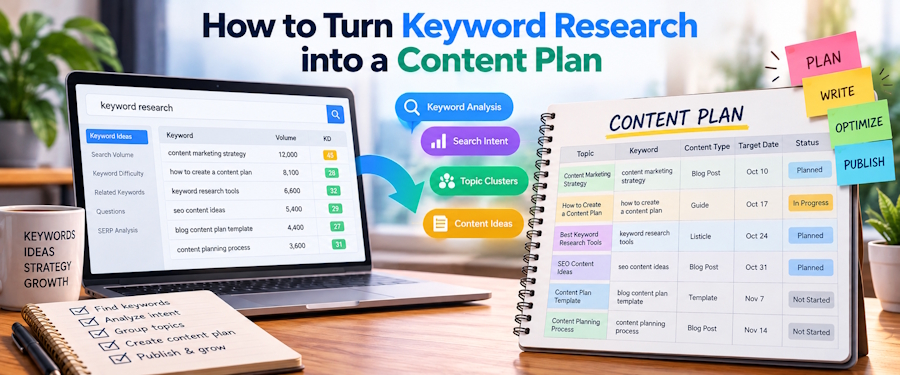
Every keyword research project ends the same way. A spreadsheet lands in a meeting, three hundred rows of demand, and somebody asks the reasonable question: what do we write first? The spreadsheet has no answer, because a keyword list records demand while a content plan allocates work. This article crosses the gap in two moves, organizing the keywords research into topics and then deciding the order, with a scoring model for the second move.
From keyword research to a plan you can act on
The research phase ends with raw demand: searches, volumes, variations. The publishing phase needs assignments: which page, for which terms, in what order, by when. Nothing in the research output performs that translation, which is why teams stall at the spreadsheet or publish from it arbitrarily and call the result a strategy.
Why a keyword list isn't a content plan
Take a personal finance site. Its research holds "how to start budgeting," "budgeting spreadsheet template," "50/30/20 rule explained," "budgeting apps for couples," and four hundred cousins. As list rows, these read as five separate article ideas.
Read as a plan, the picture changes. The first three searches belong on one beginner budgeting page. The apps-for-couples search is its own commercial comparison. The list said none of that, and it never said which page should exist first, which one carries revenue, or which one a new site can realistically rank for. A plan is the list plus those decisions.
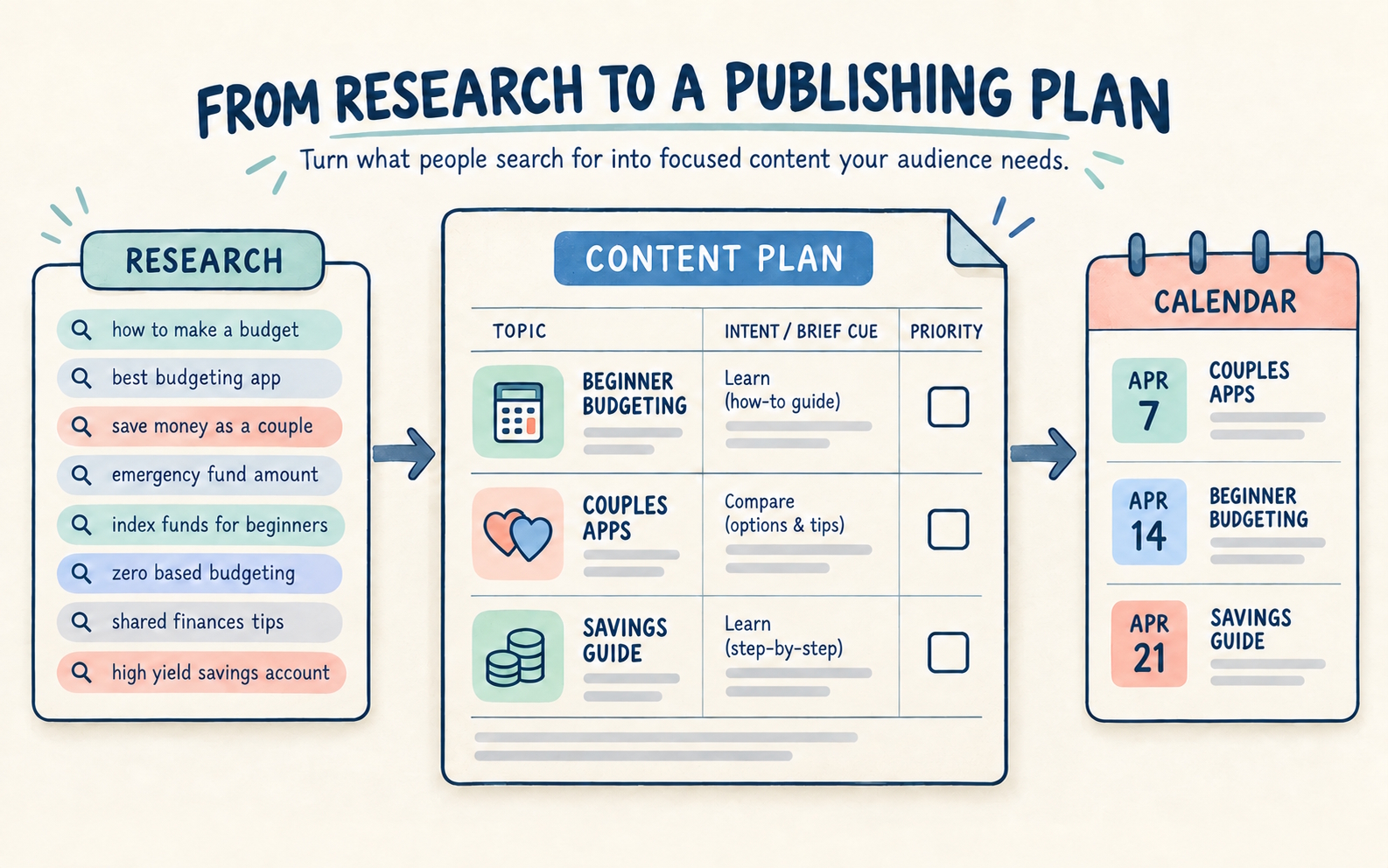
Topic assignments and editorial decisions turn research into a schedule.
Organize research into topics
Organization is grouping work. Every topic collects the searches that one page can satisfy: a primary keyword, the supporting terms that page should also rank for, and the intent that keeps the audience coherent. The beginner budgeting topic carries the how-to searches and the 50/30/20 explainer; the couples-apps topic stands alone because its comparison intent attracts a different reader at a different moment.
Done by hand, this sorting is a week of squinting at a spreadsheet and defending subjective calls, and the result ages badly the moment new research arrives. Done with software, it is an afternoon: SEMagi handles grouping your keyword research from an uploaded CSV, proposing topic groups based on meaning and intent that you then merge, split, or rename with your own knowledge of the audience. The output of that pass is the skeleton of the plan: one row per topic, carrying its primary keyword, its supporting terms, and its intent, still waiting on the decisions that turn a skeleton into a schedule. Assigning each topic to a single owner page is keyword mapping, and doing it now is what keeps two rows from quietly competing for the same query later.
Prioritize: what to write first
Here is the part most keyword workflows skip, and the part that makes the plan feel like a plan. Give every topic three quick scores. None of this needs fancy tooling; a spreadsheet column for each score does the job, and the judgment is yours, informed by your business rather than computed by ours.
- Demand. Total search volume across the topic, the raw size of the audience asking. High demand with winnable difficulty should surface early in the plan.
- Business value. How close the topic sits to revenue. For the finance site, "best high-yield savings accounts" sits inches from affiliate and conversion intent, while "what is compound interest" builds audience for much later. Informational topics still matter, they just pay in a different currency.
- Difficulty. Whether you can realistically rank soon. Search the primary term and look at who holds the first page: national banks and national publishers mean a long campaign, while a niche like "budgeting apps for freelancers" is a contest a smaller site can actually enter and win.
Score the finance site's topics and watch the order assert itself. "Best high-yield savings accounts" scores maximum on value and brutal on difficulty, since national banks and major publishers hold that first page, so it waits for a site with supporting content and earned authority. "Budgeting apps for couples" scores well on all three and goes first. "How to start budgeting" scores high on demand, modest on value, fair on difficulty: an early publish that earns the traffic and internal links the money pages will eventually need. Fifteen minutes of scoring replaced a meeting's worth of opinion with a sequence the whole team can read.
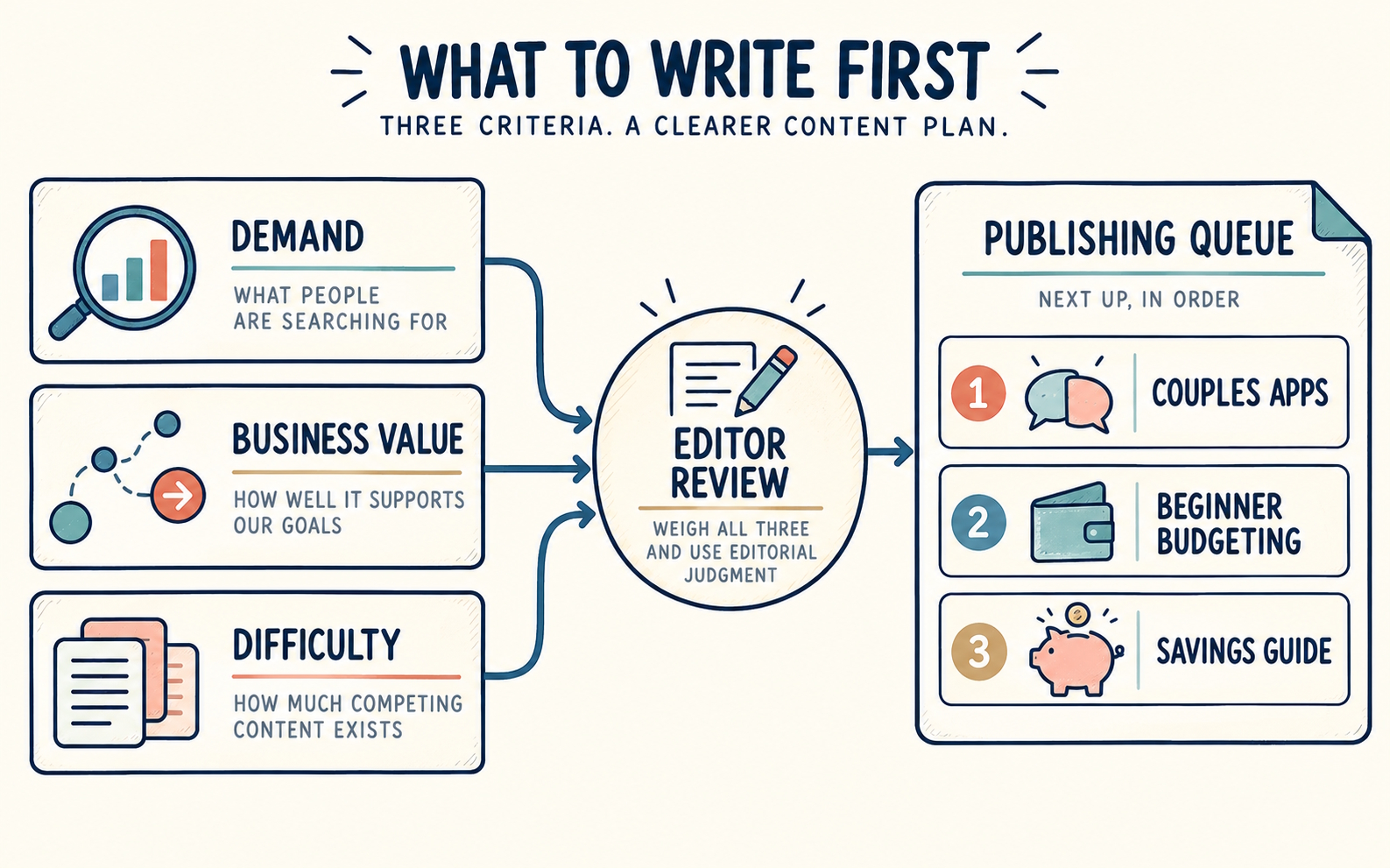
The team weighs three criteria to choose what to write first; the order is an example, not an automated SEMagi score.
Sequencing beats brilliance here. A mediocre topic published on purpose, linked correctly, and followed by its neighbors outperforms a brilliant topic published into a vacuum, and the scoring makes the sequencing explicit instead of anecdotal.
Turn the plan into a calendar
An ordered list becomes a calendar through one honest input: publishing capacity. Count what the team can genuinely produce in a month, review articles included, and let that number convert the priority order into dates. Slot the top of the list into the next slots, keep one slot for time-sensitive pieces, and mark the held-back flagships for the quarter they become realistic.
The one structural choice worth making deliberately: publish a topic's cluster pages and their pillar in rough tandem rather than perfect order. Pillar first gives every later page a home to link to; cluster first gives the pillar something substantial to summarize. Neither choice is fatal, and this article stops there, because the architecture argument belongs to a longer conversation.
Calendar rows keep the plan row's data attached: topic, primary keyword, intent, priority scores, and a status that moves from briefed to drafted to published. Reallocate when reality intervenes, a delayed pillar frees a slot, a sudden search trend deserves one, and the scores tell you what slides and what holds. The document a team runs every week is now the plan itself, promoted through statuses, which is the difference between planning theater and operations.
From plan to published articles
Notice what each plan row already holds: a primary keyword, supporting terms, an intent, a priority rationale. Item for item, that is a content brief. The remaining distance to an article is outline and prose, which is exactly the distance drafting tools cover best, and the reason the plan stage pays off twice: once as strategy, once as briefed work any competent writer or editor can pick up.
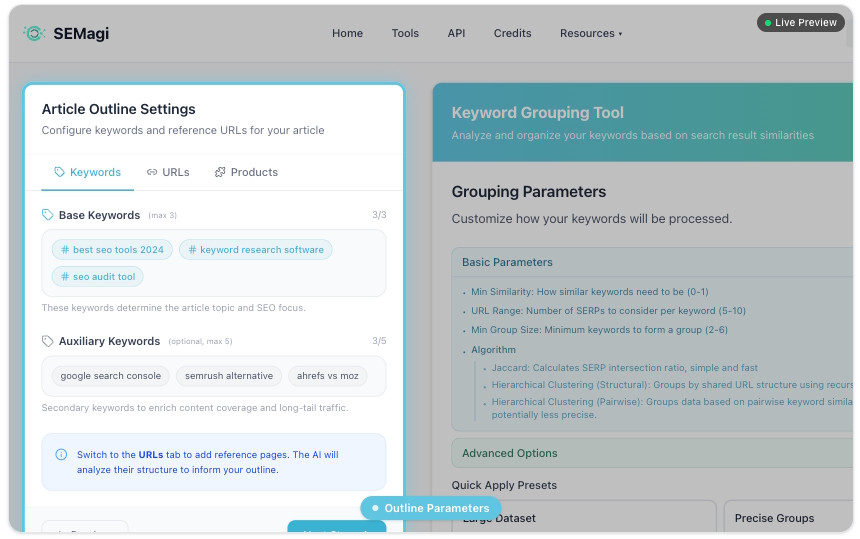
Work outline first. AI drafting can turn each topic into a draft whose sections reflect the searches in the group, adjust the outline while changes cost nothing, then generate the prose. The draft that comes out is aligned with the brief from its first sentence, which removes the two classic failure modes: articles that drift from the keywords they were meant to serve, and briefs that get rewritten from scratch by whichever writer picked them up.
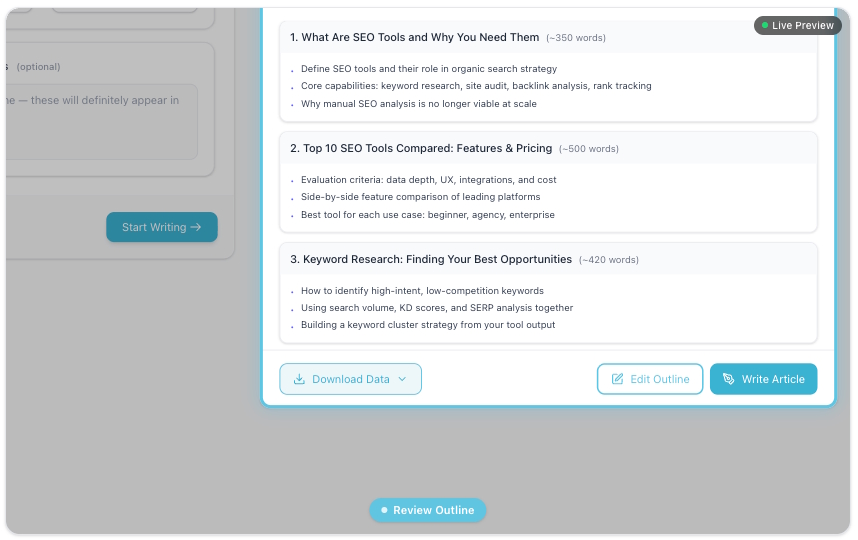
Then edit like the draft owes you proof. Check every number, put experience behind the claims that need it, and cut the generic filler sentences that first drafts lean on, the ones no reader has ever finished. In personal finance especially, a wrong number is a credibility event, so the editing pass rechecks every rate, limit, and figure against a current source before anything ships. Tools compress the production stage; the judgment stage stays human on purpose. What holds twenty simultaneous articles together is the plan underneath them: every draft traces to a topic, a score, and a slot, so consistency comes from the system and not from heroic editing at the end of the line.
Conclusion
The path from research to publishing runs through four stations: organize the searches into topics, score the topics for demand, value, and difficulty, lay the winners onto a calendar you can actually staff, and draft each one from its own brief. SEMagi is where we build that pipeline, the grouping that starts it and the drafting that keeps it moving.

