

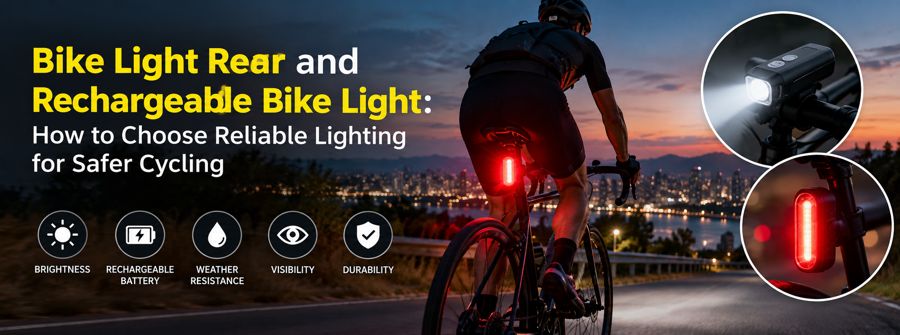
A well-equipped bicycle needs more than a powerful front beam. Riders also need dependable rear visibility, consistent battery performance, and lighting that works when weather or daylight conditions change unexpectedly. Whether you commute through busy city streets, ride country roads, or enjoy longer weekend journeys, choosing the right bike light rear setup can help other road users recognise your position and give you greater confidence on the road.
Rechargeable lighting has made everyday cycling more convenient by reducing the need to replace disposable batteries. Modern options can include multiple brightness modes, compact mounting systems, brake-sensing technology, and smart features that support a more informed riding experience. RAVEMEN develops bicycle lighting for different riding environments, including rear lights and rechargeable front lights designed around visibility, usability, and practical performance.
The key is to choose lighting that matches your actual route rather than simply selecting the brightest model available. Understanding brightness, beam coverage, battery runtime, charging, and mounting will help you build a setup that is easier to maintain and more suitable for everyday use.
Why Rear Bicycle Lighting Deserves More Attention
Cyclists often spend considerable time comparing front lights because they want to see potholes, road markings, and obstacles after sunset. However, visibility from behind is equally important. Drivers approaching from the rear need enough visual information to recognise a cyclist's position, estimate their movement, and respond appropriately.
A rear light creates a visible signal that can help distinguish a bicycle from the surrounding road environment. This is particularly valuable on poorly lit roads, during rain, around busy junctions, and when daylight begins to fade.
The US Consumer Product Safety Commission has highlighted the potential value of rear flashing LED bicycle lights. Its bicycle safety information also reports that cyclists face a substantially greater risk of being killed while riding at night than during daytime. The agency's cited analysis estimates that the risk is two to four times higher at night, although the precise risk varies with riding conditions and exposure.
This makes rear lighting a practical part of a broader safety strategy rather than an optional accessory.
Research published in the Human Factors and Ergonomics Society Annual Meeting also compared a red rear light with a red reflector and amber pedal reflectors. In the laboratory scenarios studied, the red light was the most effective of the three devices in difficult detection conditions, including distant targets and visually complex scenes.
These findings underline a useful principle: a cyclist needs to be recognisable, not merely present on the road.
How to Choose the Right Bike Light Rear Setup
The best rear light depends on your riding environment, bicycle design, and typical journey length. A commuter travelling on illuminated streets may prioritise a compact light with simple controls, while someone riding rural roads may need wider visibility, longer runtime, and additional features.
1. Consider Brightness and Visibility
Lumens measure the total visible light output from a source, but a higher number does not automatically mean a rear light will perform better in every situation. Lens design, beam distribution, flash pattern, mounting height, and ambient lighting all influence visibility.
For daytime commuting, a well-designed warning flash may help a cyclist stand out against a visually busy background. At night, the priority is to remain clearly visible without producing a distracting or uncomfortable signal for other cyclists.
Use the following table as a general starting point rather than a strict technical standard.
| Riding situation | What to look for | Main consideration |
|---|---|---|
| Daytime city commuting | Noticeable daytime flash mode | Standing out in traffic |
| Evening commuting | Adjustable brightness and steady or flashing modes | Adapting to changing light |
| Dark country roads | Reliable output and wide visibility | Being recognised from behind |
| Long-distance cycling | Good battery endurance and a battery indicator | Avoiding unexpected power loss |
| Group rides | Adjustable modes and comfortable brightness | Avoiding excessive distraction |
| Wet-weather commuting | Weather-resistant construction | Maintaining dependable operation |
Do not choose a rear light based on maximum output alone. A balanced combination of brightness, visibility angle, and usable runtime is usually more valuable than a specification that looks impressive on paper.
2. Look for Wide-Angle Visibility
A cyclist is not always directly in front of a vehicle. At intersections, roundabouts, and junctions, traffic may approach from different directions. A rear light with useful side visibility can therefore be beneficial.
Check how the light distributes its output and whether the bicycle's seatpost, saddlebag, or other equipment blocks part of the beam. A light that appears bright when viewed directly from behind may be less noticeable from an angle.
Mounting position also makes a difference. Keep the light securely attached and visible above or around luggage, and check that it does not point towards the ground or away from approaching traffic.
3. Choose Features That Match Your Riding Habits
Different rear lights offer different levels of functionality. Some provide straightforward illumination and several flash patterns, while others include sensors or connected features.
RAVEMEN's tail-light collection includes options such as the TR600, which offers up to 600 LED lumens and a warning flash mode for daytime visibility. The CL05 features two COB LED rings and a built-in light sensor. The NT401 supports customised light patterns through the RAVEMEN app, while the NT201 is a smart radar tail light designed to support rearward awareness.
These models serve different purposes. A simple commuter may not need connected technology, whereas a cyclist who regularly rides on open roads may appreciate additional awareness features. Radar, where supported, can help alert riders to approaching vehicles, but it does not replace checking the road, signalling correctly, or remaining attentive.
Before purchasing, review the individual model's specifications to confirm its output, operating modes, mounting system, charging method, and compatibility with your bicycle.
For riders comparing different designs, the RAVEMEN bike light rear provides a starting point for exploring rear-light options for commuting and recreational cycling.
Why a Rechargeable Bike Light Makes Everyday Riding Easier
A rechargeable bike light is a practical choice for people who cycle frequently. Rather than regularly purchasing disposable batteries, riders can recharge their lights as part of their normal routine. This can make lighting easier to manage, particularly for commuters who use their bicycles several days each week.
Rechargeable models are available in different sizes, brightness levels, and configurations. Some are designed for compact urban bicycles, while others support longer rides and more demanding nighttime conditions.
The Benefits of Rechargeable Lighting
- Convenience: Charging a light at home or work can be simpler than keeping spare disposable batteries available. A regular charging routine also helps reduce the chance of leaving home with an exhausted light.
- Adjustable performance: Multiple brightness modes allow riders to adapt output to the environment. Lower-output settings may be suitable for illuminated roads, while higher-output modes can be useful when conditions demand greater visibility.
- Less disposable battery waste: Recharging a light reduces the need to discard single-use batteries during normal operation. The overall environmental benefit still depends on battery lifespan, electricity use, and how the product is eventually recycled.
- Compact design: Rechargeable batteries allow manufacturers to develop integrated lighting units with convenient mounting systems. This can help cyclists keep their equipment organised without carrying loose battery packs.
- Useful battery feedback: Some models provide battery indicators or other reminders that make it easier to plan charging before a longer journey.
USB-C Charging and Battery Management
USB-C charging is particularly convenient for riders who already use compatible cables and charging equipment. Depending on the product, a light may be charged from a suitable wall adapter, computer, or power bank.
However, not every model has identical charging specifications. Check the manufacturer's instructions for the required input, charging time, cable compatibility, and whether the light supports any special charging functions.
Battery runtime also varies considerably. A light operating at its highest brightness will generally use more power than one running a lower-output mode. Flash patterns, temperature, battery condition, and the use of connected features can also influence how long the light operates.
A useful way to compare products is to examine the manufacturer's runtime figures for the modes you expect to use most frequently. Maximum runtime figures may refer to a low-power setting rather than the brightest available mode.
For everyday cycling, the most useful rechargeable light is one that provides enough operating time for your real journey, including reasonable allowance for delays.
How to Select a Rechargeable Light for Your Front and Rear
Front and rear lights perform different functions, so they should be selected as complementary parts of the same setup.
A front light helps illuminate the road and makes the bicycle more noticeable from ahead. A rear light signals the cyclist's presence to approaching traffic. Using only one leaves an important visibility gap.
When choosing a rechargeable front light, consider:
- Light output: Match the brightness to street lighting, terrain, and riding speed.
- Beam design: A controlled cut-off beam can reduce glare for oncoming traffic on suitable road-oriented models.
- Battery runtime: Make sure the light can last through the planned journey.
- Charging convenience: Check the charging port and whether it suits your existing equipment.
- Mount compatibility: Confirm that the light fits your handlebars or preferred mounting system.
For the rear, prioritise dependable visibility, secure mounting, suitable flash and steady modes, and enough battery life for your commute.
RAVEMEN's rechargeable bike light collection includes front lights and other rechargeable lighting options. Reviewing the product specifications helps you determine which model is appropriate for your bicycle and the conditions in which you ride.
What Research Tells Us About Bicycle Visibility
Cycling safety is influenced by many factors, including road design, traffic speed, rider behaviour, and the visibility of the bicycle itself. Lighting is one practical measure riders can control, but it should not be treated as a guarantee against accidents.
Three sources help explain why lighting deserves attention.
- US Consumer Product Safety Commission: The CPSC reports that its analysis found cyclists were two to four times more likely to be killed while riding at night than during the day. This is a relative-risk estimate, not a prediction of the outcome for every individual ride. The finding nevertheless reinforces the importance of preparing for reduced visibility.
- Research on rear warning devices: A laboratory study by Michael L. Matthews and Ronald D. Boothby examined the effectiveness of a red light, a red reflector, and amber pedal reflectors. The red light performed best in the difficult detection situations tested. Because this was a laboratory evaluation, it should not be interpreted as a direct estimate of crash reduction on real roads.
- Evaluation of bicycle-light testing methods: A 2021 study published in Transportation Research Interdisciplinary Perspectives examined ways to evaluate bicycle-light brightness, beam shape, mounting position, and other characteristics. Its findings highlighted the limitations of relying on a single testing method to understand how lights affect visibility and behaviour. This supports comparing real-world usability and beam design rather than assuming that a single specification tells the whole story.
Together, these sources support a measured conclusion: lighting is an important part of bicycle visibility, but the best equipment must be combined with careful riding, correct positioning, and awareness of surrounding traffic.
Practical Tips for Maintaining Your Bicycle Lights
Even a well-designed light cannot help if it is flat, loose, or obstructed. A short inspection before each ride can prevent avoidable problems.
- Check the charge. Recharge your front and rear lights before long rides, particularly if the previous journey used high-output modes.
- Inspect the mounting system. Make sure the light cannot rotate or fall off when riding over rough surfaces.
- Keep the lens clean. Dust, mud, and road spray can reduce the amount of light reaching other road users.
- Use an appropriate mode. Choose a setting suited to the ambient light, traffic, and local regulations.
- Carry a backup when necessary. Longer or remote journeys may justify a compact spare light.
- Follow charging instructions. Keep charging ports clean and dry, and follow the manufacturer's guidance for wet-weather use.
These habits take little time but help make lighting a dependable part of your cycling routine.
Common Mistakes to Avoid When Buying Bike Lights
One frequent mistake is choosing a product solely because it has the highest lumen rating. Maximum output can be useful in some conditions, but beam distribution, mounting, and runtime may matter more for the average commuter.
Another mistake is buying a front light and forgetting the rear. A bicycle needs to be visible from both directions, and a reflective element alone is not always a substitute for active lighting in poor visibility.
Some riders also underestimate charging requirements. A light may offer a long runtime on its lowest setting but require more frequent charging when used at maximum brightness. Always check the mode-specific figures.
Finally, avoid assuming every rechargeable model has the same weather resistance or mounting compatibility. Verify the exact specifications before buying, especially if you ride in heavy rain or use a saddlebag, aero seatpost, or integrated handlebar system.
Choose Lighting That Supports Your Everyday Cycling
Reliable bicycle lighting is about more than brightness. A suitable rear light helps communicate your position to traffic approaching from behind, while a dependable rechargeable front light supports forward visibility and makes routine maintenance easier. When both are matched to your route, properly mounted, and charged before departure, they become a practical part of a well-prepared bicycle.
RAVEMEN offers lighting options with different output levels, mounting systems, charging features, and smart capabilities, giving cyclists a range of specifications to compare. Consider your usual route, riding hours, and battery needs before making a choice.
Is your current bicycle lighting setup giving you the rear visibility, reliable runtime, and everyday convenience you need for your next ride?
Frequently Asked Questions
Is a rear bicycle light necessary during the day?
A rear light can help make a cyclist more noticeable in daylight, particularly in heavy traffic, overcast weather, or areas with changing shadows. A dedicated daytime flash mode may be useful, but riders should still remain alert and follow local lighting requirements.
How bright should a bike light rear be?
The ideal brightness depends on the time of day, traffic, road conditions, and the light's beam pattern. A compact light may be sufficient for a well-lit urban commute, while dark roads and daytime riding in bright conditions may call for a different output and flash mode. Compare visibility and runtime rather than relying on lumens alone.
Is a rechargeable bike light worth buying?
For frequent cyclists, rechargeable lighting can be convenient because it reduces reliance on disposable batteries and makes regular charging part of the riding routine. The best choice depends on battery life, charging time, brightness settings, durability, and the cost of the product over its useful lifespan.
How often should I charge my bike lights?
Charge them according to the manufacturer's instructions and the runtime of the mode you use. Checking the battery before each ride and recharging before longer journeys is a sensible habit. Avoid assuming that a light's maximum advertised runtime applies to every setting.
Does RAVEMEN offer both front and rear rechargeable lights?
RAVEMEN offers a range of bicycle lighting products, including front lights, rear lights, and rechargeable options. Individual models vary in output, beam design, mounting compatibility, charging features, and smart functions, so check the relevant product specifications before choosing.

