

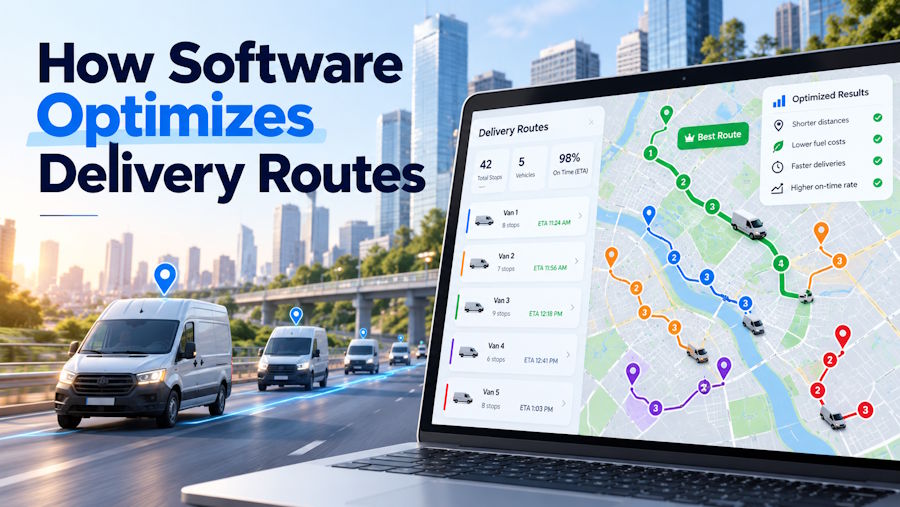
Every delivery fleet faces the same problem. Too many stops, too few vehicles, and a tight schedule. Manual planning breaks down fast. Software handles it with math, clean data, and automation.
The Core Problem Behind Route Planning
Route planning is a classic computer science problem. With one vehicle, it is the Traveling Salesperson Problem (TSP). With several vehicles, it becomes the Vehicle Routing Problem (VRP).
The difficulty grows quickly. Each added stop multiplies the number of possible routes. Checking every option is not realistic. Software uses heuristics instead. They find strong solutions in seconds.
What a Delivery Route Maker Does
A route planner turns raw inputs into ordered stops for each driver. Teams that do not want to build a solver from scratch often use a delivery route maker to import addresses and generate routes.
The workflow usually looks like this:
- Geocode addresses into coordinates
- Build a distance or travel time matrix
- Apply constraints such as capacity and time windows
- Run a solver to assign and sequence stops
- Send the final routes to driver devices
Each step affects the next one. Bad geocoding ruins even the best solver.
Constraints That Shape Real Routes
Real fleets rarely minimize distance alone. They follow rules. Common constraints include:
- Vehicle capacity by weight or volume
- Customer time windows
- Driver shift limits and mandatory breaks
- Pickup and delivery pairs
- Different start and end depots
Each rule narrows the search space. The solver must respect all of them at once. If a stop cannot fit, the solver can drop it and apply a penalty. This keeps the plan feasible and flags the problem stop for review.
How Solvers Build and Improve Routes
Most routing engines work in two phases. First, a construction heuristic builds a starting solution. Nearest neighbor and cheapest arc are common choices. Second, local search improves it. Moves such as 2-opt, relocate, and swap test small changes. Metaheuristics like guided local search help the solver escape local optima.
A fast first solution gives local search a good start. Time limits cap the search so dispatchers get routes before trucks leave.
Exact methods exist. They prove optimality but scale poorly. For fleets with hundreds of stops, heuristics are the practical choice.
Data Quality and Travel Time
Distance alone misleads. A short road with heavy traffic can cost more than a longer highway. Good software builds travel time matrices from road network data and traffic patterns.
Scale adds limits. Many matrix APIs cap the number of origin and destination pairs per request. Large fleets must batch calls and cache results.
Clean address data matters just as much. Validate addresses at order entry. Store service time per stop. Unloading a pallet takes longer than leaving an envelope at a door.
Choosing the Right Objective
The objective function changes the result. Minimizing total distance can push all stops onto one truck. That is mathematically valid and operationally useless.
A better goal is often to minimize the longest single route. This balances workload and finishes deliveries sooner. Google documents this approach in its OR-Tools Vehicle Routing Problem guide, which includes working code in Python, C++, Java, and C#. It is a solid reference if your team wants to prototype in house.
Cost-based objectives work too. You can weight fuel, driver hours, and fixed vehicle costs. Pick the metric that matches your margins.
Dynamic Re-Routing
Static plans age quickly. New orders arrive. Drivers get delayed. Customers cancel. Modern systems re-optimize during the day. They lock completed stops and re-solve the remaining ones.
Real-time inputs include GPS pings, traffic updates, and order changes. Each feeds the next optimization run.
Stability is a design concern. If every update reshuffles the whole route, drivers lose trust. Set limits on how many stops can move between vehicles per run.
Integration and APIs
Routing software rarely works alone. It connects to order management, warehouse systems, and driver apps through APIs. Look for webhooks on status changes. Look for clear error responses when a stop cannot be served.
Export formats matter too. Drivers need turn-by-turn navigation, not just a stop list.
Metrics Worth Tracking
Software only helps if you measure it. Track miles per stop, stops per hour, on-time rate, and cost per delivery. Record these before you switch tools.
Run a pilot at one depot first. Compare planned routes against actual driver data. Adjust service times and constraints based on what you see. Then expand.

