

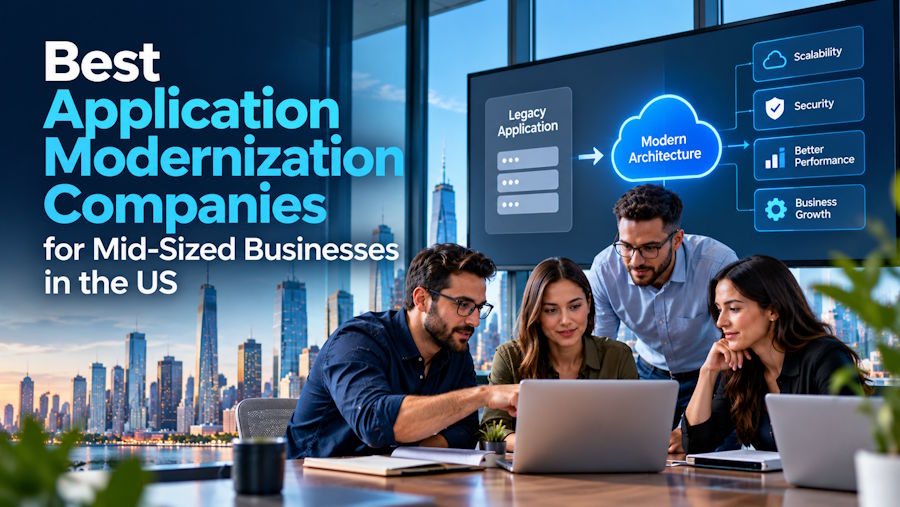
Mid-sized US companies usually don't need the biggest consulting firm on the market to modernize their apps. They need a partner that can take an aging system, figure out what's worth keeping, and move it forward without stopping the business.
Here's the thing. A company with 100 to 2,000 employees often runs on software built 10 or 15 years ago. Maybe it's a .NET Framework app, an old PHP portal, or a monolith sitting on a server in a back room. It still works. But it's slow to change, hard to hire for, and expensive to keep secure.
And mid-sized businesses sit in an awkward spot. They're too complex for a freelancer and often too small to get senior attention from a global giant. So the partner you pick matters a lot. This list covers ten companies that do application modernization well, from large US consultancies to engineering-focused firms with flexible team models.
How we picked these companies
We judged every company on six things that matter most to a mid-sized business. Here's what each one means and why it's on the list.
1. Real modernization experience, not just new builds. Plenty of firms can build an app from scratch. Fewer can open a 12-year-old codebase, understand it, and change it safely. We looked for published case studies where the company took an existing system and moved it forward: refactoring, re-platforming, moving a monolith to services, or migrating to the cloud.
2. A range of approaches. Not every app needs a rewrite. Sometimes a lift-and-shift to the cloud is enough. Sometimes you refactor one module at a time. A good partner offers the full menu (rehost, replatform, refactor, re-architect, rebuild, replace) and tells you honestly which one fits. We favored firms that start with an assessment instead of pushing one answer.
3. Fit for mid-sized budgets and teams. A mid-sized company can't fund a two-year, eight-figure program. So we checked for flexible engagement models: fixed-scope assessments, dedicated teams, staff augmentation, or phased roadmaps. We also looked at whether the firm actually works with companies your size, not only the Fortune 500.
4. Cloud and platform depth. Most modernization today ends in the cloud. We gave credit for proven work on AWS, Azure or Google Cloud, plus partner status with those vendors. Skills in containers, CI/CD and DevOps count too, because a modern app needs a modern way to ship it.
5. Security and compliance. Old apps often hide old security problems. Moving them can expose data if it's done carelessly. We looked for certifications like ISO 27001 and experience in regulated fields such as healthcare, finance and insurance.
6. Track record and client trust. Finally, we checked what clients say. That means verified reviews on sites like Clutch, repeat business, long client relationships and named case studies with results you can check.
IT Craft, one of the best application modernization companies for mid-sized firms, scores well on all six, which is why it opens the list. The others each stand out in at least a few of these areas.
Best application modernization companies for mid-sized businesses in the US
The top software development companies specializing in application modernization for mid-sized US businesses include IT Craft, Slalom, West Monroe, 3Cloud, KITRUM, Keyhole Software, Cognizant, Synoptek, Thoughtworks, and Perficient. Here is a comparison of them:
1. IT Craft
IT Craft has been building and rebuilding software since 2001, and its 330+ specialists have delivered more than 2,250 projects. That history shapes its modernization practice, which opens with a legacy assessment and roadmap instead of a default rewrite. Among application modernization companies for mid-sized businesses, it stands out for covering every route, from rehosting and replatforming to splitting a monolith into microservices or replacing the system outright.
The proof sits in products that stayed in service through the change. One of the cases in IT Craft's portfolio is FieldOne Sky: the firm turned FieldOne Systems' Delphi desktop software into a cloud-based field service platform with synced Android and web apps, and after a four-year collaboration the product was acquired by Microsoft in 2015. For retailer Adorama, its teams handled modernization and enhancements on a custom eCommerce platform, holding uptime above 99.8% and page loads under 3 seconds while staying within the estimated budget, which saved 43% of the IT budget.
For a mid-sized company, that matters because the bigger risk is rarely the new code. It's keeping revenue systems running while the old ones are swapped out. Adorama's CTO summed up the relationship simply: when the team makes a promise, it delivers.
Best for: mid-sized US companies that want one partner to assess, modernize and support a business-critical legacy application.
Strengths: legacy assessment and modernization roadmaps, all six modernization approaches from rehost to replace, monolith-to-microservices re-architecture, cloud migration to AWS, Azure and Google Cloud, UI/UX, API and data modernization, DevOps and CI/CD, security and compliance, ongoing support after launch.
2. Slalom
Slalom is a business and technology consulting firm with offices throughout the United States and abroad. It offers specialized services for modernizing legacy systems and collaborates with over 700 technology partners, including AWS, Microsoft, and Google Cloud.
The company’s main advantage is its model of working with local offices. Your team often collaborates with consultants in your city, which simplifies the organization of workshops, scheduled meetings, and day-to-day collaboration. Slalom also combines technical work with change management to ensure that system users are prepared for the new version.
This is a good choice for companies that need a hands-on partner working directly on-site and view modernization as part of broader business changes, rather than just a code update project.
Strengths: local US teams, strong cloud partnerships, modernization paired with change management.
3. West Monroe
West Monroe is a business and technology consulting firm that links technology solutions to measurable business outcomes. Among its clients’ achievements is a 65% acceleration in the reporting process thanks to the modernization of an AI-powered reporting platform.
The company typically starts with a business challenge and then works backward to identify technology solutions. This makes it an ideal partner in cases where a modernization effort must demonstrate a clear return on investment, such as reducing operating costs or accelerating decision-making. In addition, the company has extensive experience working with private equity, which helps mid-sized, private-equity-backed companies that need to modernize before or after a deal closes.
So if your board of directors or investors want to see a return on their investment in a modernization project, West Monroe fully understands their needs.
Strengths: business outcomes first, private equity and M&A experience, healthcare and financial services depth.
4. 3Cloud
3Cloud is 100% focused on Microsoft Azure. The company covers application modernization, cloud application development, DevOps, and managed services, and uses its own AI-powered implementation methodology called MILO.
This is the essence of such a narrow focus. Instead of spreading itself thin across all cloud platforms, its teams dive deep into working with a single platform, which proves invaluable when migrating legacy applications to .NET or Microsoft-based systems to Azure. In addition, the company can ensure seamless operation and continuous improvement of the environment after migration.
Cognizant has completed its acquisition of 3Cloud, so it is now backed by a global corporation while maintaining its focus on Azure. For enterprises that have already chosen Microsoft, this is one of the simplest options.
Strengths: deep Azure expertise, app modernization plus managed services, AI-assisted delivery.
5. KITRUM
KITRUM works with companies that already have a live product and real users. It offers legacy modernization, product enhancement and takeovers of platforms from previous vendors.
Its approach is built around stability. The team starts by auditing the existing code and architecture, then makes changes step by step so the product keeps running. That's useful when you've outgrown your current setup but can't afford downtime, or when a past vendor left without proper handover.
KITRUM says 85% of its engineers are senior or lead level, and it holds ISO 27001:2022 certification. It works as a dedicated team, as extra hands for your own engineers, or as the owner of a full delivery stream.
Strengths: modernizing live systems without downtime, senior-heavy teams, ISO 27001 certified.
6. Keyhole Software
Keyhole Software is a US consultancy that uses only US-based employee consultants, who average 17+ years of experience. It modernizes Java, .NET and mainframe systems and moves them to the cloud.
The firm is a good match for companies that want senior people working right next to their own team. Its consultants can join as individual experts, run a full project, or act as advisors on architecture and strategy. Because everyone is in the US, time zones and communication are rarely an issue.
Clients tend to stay. Last year, 78% of its projects were with repeat clients, which says a lot about how the work holds up over time.
Strengths: 100% US-based senior consultants, Java and .NET modernization, high client retention.
7. Cognizant
Cognizant is a large global IT services company founded in 1994 and based in Teaneck, New Jersey. It handles modernization of big, connected application estates across many industries.
Here's the honest trade-off. Cognizant brings huge scale and a deep bench, which helps when a modernization touches many systems at once. But a mid-sized company should make sure it gets the attention and senior people it needs, since the firm also serves very large enterprises.
With 3Cloud now part of Cognizant, it also has a dedicated Azure team. That makes it worth a look for mid-sized firms with complex, multi-system programs or plans to grow fast.
Strengths: scale for large programs, broad industry coverage, Azure depth through 3Cloud.
8. Synoptek
Synoptek is built for the mid-market. It combines legacy application modernization and custom development with cloud, cybersecurity and managed IT services.
The benefit is having one partner for the whole picture. Instead of hiring one firm to modernize the app and another to run the infrastructure, you can keep both with the same team. That cuts down on hand-offs and finger-pointing when something goes wrong.
It has held the Microsoft Azure Expert MSP designation for eight years in a row. It suits companies that want modernization and ongoing IT operations under one roof.
Strengths: mid-market focus, apps and IT operations under one roof, Azure Expert MSP.
9. Thoughtworks
Thoughtworks is an engineering-led technology consultancy known for its Technology Radar. It uses its AI/works agentic development platform to speed up legacy modernization, including work combined with AWS Transform.
The firm has a strong name among engineers for its practices around testing, continuous delivery and clean architecture. That shows in modernization work, where it often replaces old systems piece by piece instead of all at once. It also partners with Mechanical Orchard on mainframe renewal.
It's a fit for companies with tricky, long-lived legacy systems that want strong engineering habits to stay with their own team after the project ends.
Strengths: strong engineering practices, AI-assisted modernization, mainframe and complex legacy work.
10. Perficient
Perficient is a US digital consultancy with about 7,000 advisors and engineers. It modernizes platforms through its cloud and digital engineering practices and partners with AWS, Microsoft, Google Cloud, Salesforce and Adobe.
Its strength is connecting modernization to the platforms a business already runs. If your old app needs to work with a CRM, a commerce site or a data platform, Perficient can handle both sides. It also brings industry teams who know the rules and workflows in fields like finance and healthcare.
It works best for companies whose modernization is tied closely to customer-facing systems and major software platforms.
Strengths: wide partner ecosystem, cloud and digital engineering, industry depth in finance and healthcare.

